


Fogo Isn’t Trying to Win the Speed Race and That’s Exactly Why I’m Paying Attention
I’ve been covering blockchain projects long enough to recognize the pattern. Someone releases a benchmark. The marketing team turns it into a headline. The headline becomes a narrative. The narrative attracts capital. And then real users show up and wonder why the actual experience feels nothing like the benchmark.
Fogo is doing something different and it took me a few days to fully understand what.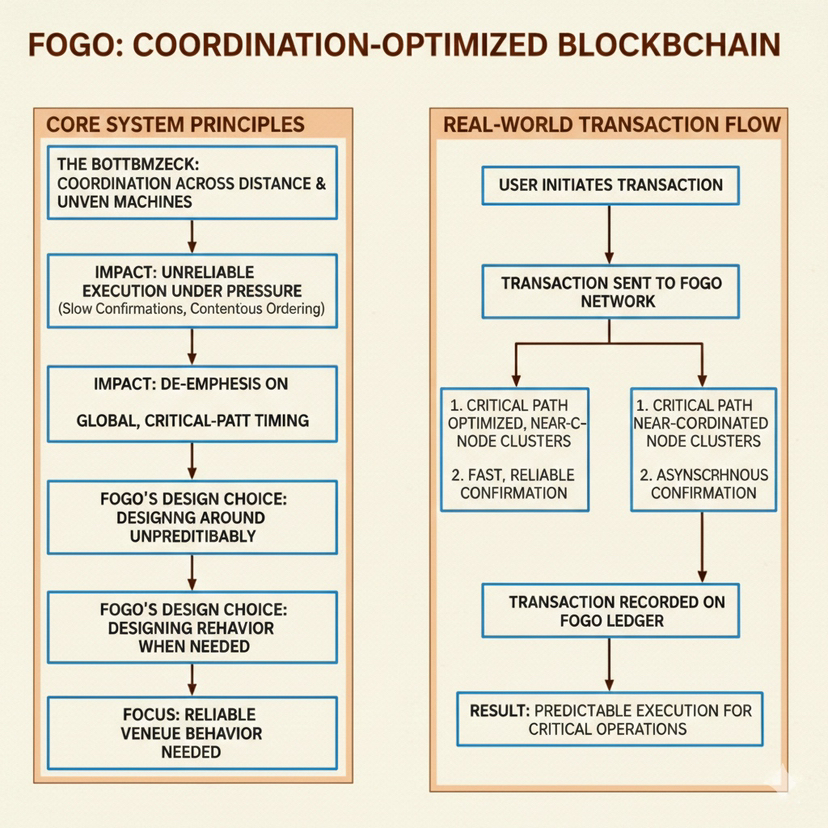
The Wrong Question
Every high-performance blockchain I’ve covered starts with the same question. How many transactions per second can we process?
It’s the wrong question. I realized this after talking to a trader who’d blown up his entire automation setup not because his chain was slow on average, but because it got weird at exactly the wrong moment. One confirmation that stretched unexpectedly. One ordering decision that didn’t make sense. One moment where the network seemed to be negotiating with itself instead of settling.
Fogo’s litepaper starts from a completely different place. It argues that modern networks don’t fail because they can’t process transactions. They fail because the slowest moments become the only moments users remember.
That’s a psychology insight dressed up as an engineering problem. And it’s completely correct.
Why 40 Milliseconds Actually Matters
Fogo publishes some aggressive numbers. Block times around 40 milliseconds. Confirmations around 1.3 seconds. I’ve seen faster claims from projects that couldn’t sustain those speeds for five minutes under real load.
But here’s what’s different about how Fogo frames these numbers. They’re not presenting them as a trophy. They’re presenting them as a baseline promise.
The distinction matters enormously. A chain that averages 40ms blocks but occasionally spikes to 4 seconds is a completely different product than a chain that consistently delivers 40ms blocks under stress. One is a demo. The other is infrastructure.
What Fogo is actually selling is the second thing. Whether they can deliver it is the question worth asking.
The Physics Problem They’re Solving
I spent an afternoon going through their litepaper’s section on tail latency and physical distance. It reads less like blockchain marketing and more like a distributed systems engineering document.
The core insight is straightforward once you see it. When validators are spread across continents, messages have to travel huge distances just to reach quorum. Light has a speed limit. Geography is real. The slowest validator in your consensus path sets the pace for everyone else.
Most chains accept this as an unavoidable cost of global decentralization. Fogo decided to design around it.
Their adaptation of the Solana protocol adds localized or zoned consensus. During any given consensus round, the quorum path gets shorter and more geographically concentrated. Messages don’t have to circle the globe to reach agreement.
A developer I talked to who’s been building on Fogo described it like this: “It’s the difference between calling a meeting where everyone dials in from different time zones versus just talking to the three people in the same room.”
Running on the Solana Virtual Machine
Fogo chose to run the Solana Virtual Machine and I initially assumed this was just a developer acquisition play. Copy the ecosystem, inherit the tooling, skip the bootstrapping problem.
But sitting with it longer, I think the choice is smarter than that. The SVM is battle-tested in genuinely hostile conditions. Solana has been pushed to its limits by actual usage, not just load tests. Building on top of that execution environment means Fogo’s team can focus their engineering attention on what they believe is the real differentiator, which is network behavior under pressure, rather than rebuilding execution primitives from scratch.
It’s an honest acknowledgment that not every problem needs to be solved from first principles.
The Validator Problem Nobody Wants to Enforce
Here’s where Fogo gets politically uncomfortable. They’re explicit about performance enforcement for validators.
The argument is simple. One weak validator can drag down the entire network experience when the chain is under stress. If you care about consistent performance, you can’t just politely hope every operator maintains high-quality infrastructure.
So Fogo talks about standardized high-performance validation as a design requirement, not a suggestion. Mainnet launches with a custom Firedancer client optimized for stability and speed. Validator operations are framed around high-performance infrastructure centers.
I understand why this makes decentralization advocates nervous. Enforcing performance standards means excluding operators who can’t meet them. That’s a form of permissioning.
My honest take: if your target user is a trader executing hundreds of transactions per hour, they don’t care about the ideology. They care whether their orders go through. Fogo is making a deliberate choice about who they’re building for.
Sessions Changed How I Think About Blockchain UX
I tested Fogo Sessions for about a week and it genuinely shifted my thinking about what blockchain user experience could feel like.
The problem it’s solving is obvious once you’ve tried to use any DeFi application seriously. Every single action requires a signature. Every signature is an interruption. Multiply that by hundreds of interactions per session and you’ve created an experience that would embarrass any mainstream software product.
Sessions works by letting a user sign once to create a time-limited, scoped permission set. A temporary session key then handles approved actions without repeated prompts. Apps or third parties can sponsor fees so users don’t even have to think about gas.
What this means in practice: interacting with a Fogo application can feel closer to using a regular app than performing a series of cryptographic rituals. For users who didn’t grow up treating wallet popups as normal, this is the difference between adoption and abandonment.
The token program is built on the Solana SPL Token model but modified to accommodate Sessions natively. That tells me this isn’t a bolt-on feature. It’s a core design decision about what the chain is for.
The Token Structure and What January 2026 Told Us
Public reporting from January 2026 described Fogo launching public mainnet after a token sale that raised around 7 million dollars. For context, that’s a relatively modest raise for a project with this level of technical ambition. It suggests either lean operations or early stage positioning, and probably both.
The tokenomics documentation is unusually explicit. FOGO powers gas, secures the network through staking, and sits at the center of an ecosystem value loop where the foundation funds projects and partners commit to revenue sharing that feeds back into the broader economy.
Allocations span community ownership, investors, core contributors, foundation, advisors, and launch liquidity. There are lockups, cliffs, and gradual unlock schedules. A significant share of supply is locked at launch with gradual release over years.
I appreciate the transparency. It doesn’t make the numbers automatically good, but it lets you actually reason about supply pressure instead of guessing.
The Airdrop Design Reveals the Culture
The official airdrop post from January 15, 2026 describes distribution to roughly 22,300 unique users with fully unlocked tokens and a claim window closing April 15, 2026.
What caught my attention wasn’t the size. It was the methodology. Anti-sybil filtering, minimum claim thresholds, structure designed to reward real engagement over automated extraction.
Most airdrops I’ve watched get immediately farmed by bots and sold within 48 hours. The people who actually care about the project end up with nothing because they didn’t game the snapshot. Fogo’s approach suggests the team thought about this and tried to design around it.
Whether it worked is a different question. But intention shapes culture, especially in the early days of a network.
Where the Risks Live
I want to be honest about what could go wrong here because the thesis only holds together if several things mature simultaneously.
Zone rotation adds operational complexity that hasn’t been tested at scale. Localized consensus sounds clean in a whitepaper but coordinating the rotation across real infrastructure under real load is genuinely hard. If the rotation mechanism introduces its own latency spikes, the whole pitch falls apart.
The single client approach via Firedancer reduces variance but concentrates systemic risk. One serious bug in a widely deployed implementation has a much larger blast radius than bugs distributed across diverse clients. This is a known trade-off that Fogo is making deliberately, but it’s still a trade-off.
Validator curation creates governance pressure over time. Today’s performance standards are enforced by a team with a clear technical vision. What happens three years from now when commercial pressures, political dynamics, or simple organizational drift start influencing who gets included or excluded?
Paymasters sponsoring fees through Sessions introduce a dependency layer that currently sits outside the protocol’s decentralization guarantees. The smoothest user experience runs through actors with their own business models. That’s worth understanding clearly.
What I’m Watching For
If Fogo’s thesis is correct, the evidence will show up in specific places.
Application developers who care about execution quality will choose to build there because their users can feel the difference. Not because of grants or incentives, but because the chain actually makes their product better.
Confirmation behavior will stay stable during high-activity periods. The whole point of this design is performance under stress, so stress is where it gets evaluated.
Governance around validator standards will stay consistent even when enforcement is inconvenient. Rules that bend when it matters aren’t rules. They’re suggestions.
Sessions infrastructure will become more open and competitive over time rather than concentrating into a small set of preferred paymasters.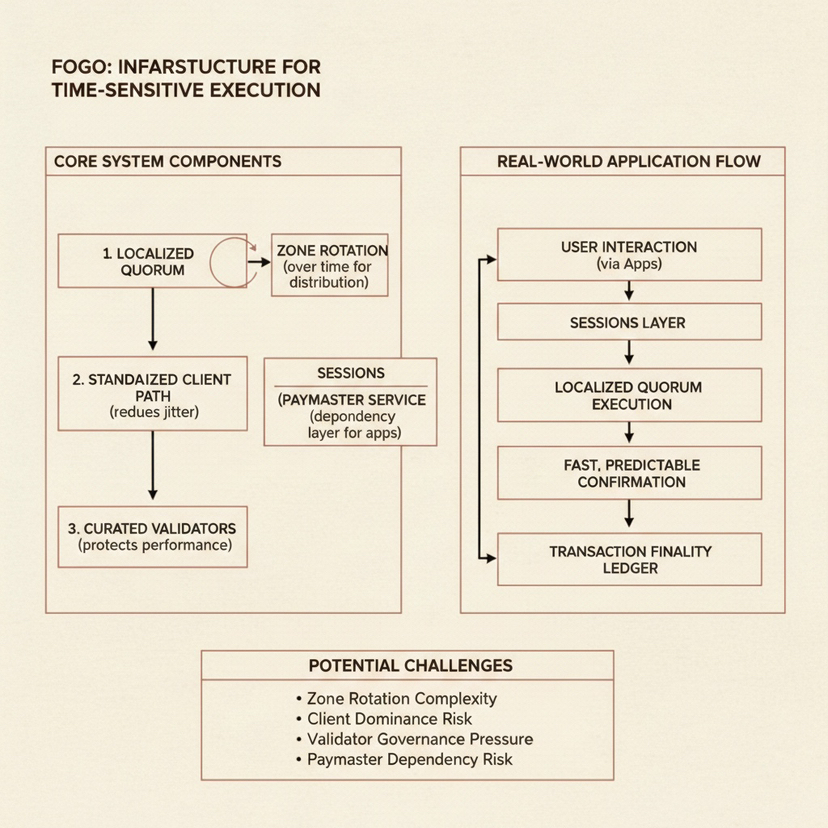
The Honest Summary
Fogo isn’t trying to be a general-purpose chain that wins every category. It’s trying to be the right chain for speed-sensitive markets and real-time experiences where consistent confirmation timing and smooth UX are the difference between adoption and churn.
That’s a coherent and specific bet. The engineering decisions, the validator requirements, the Sessions design, the tokenomics structure all point in the same direction.
Whether the execution matches the vision is what the next twelve months will tell us. I’m not predicting an outcome. I’m paying attention because the question they’re trying to answer is the right one, and right questions don’t come along that often in this space.
