
Intro and Market Background
Monad mainnet has been live since late November. The praying phase is already over, but the data is even stronger than many people think. Let's talk about the current state.
$MON is staying at $0.02, a 37% correction from its December high. With a $224M market cap, the token is finding its actual floor.
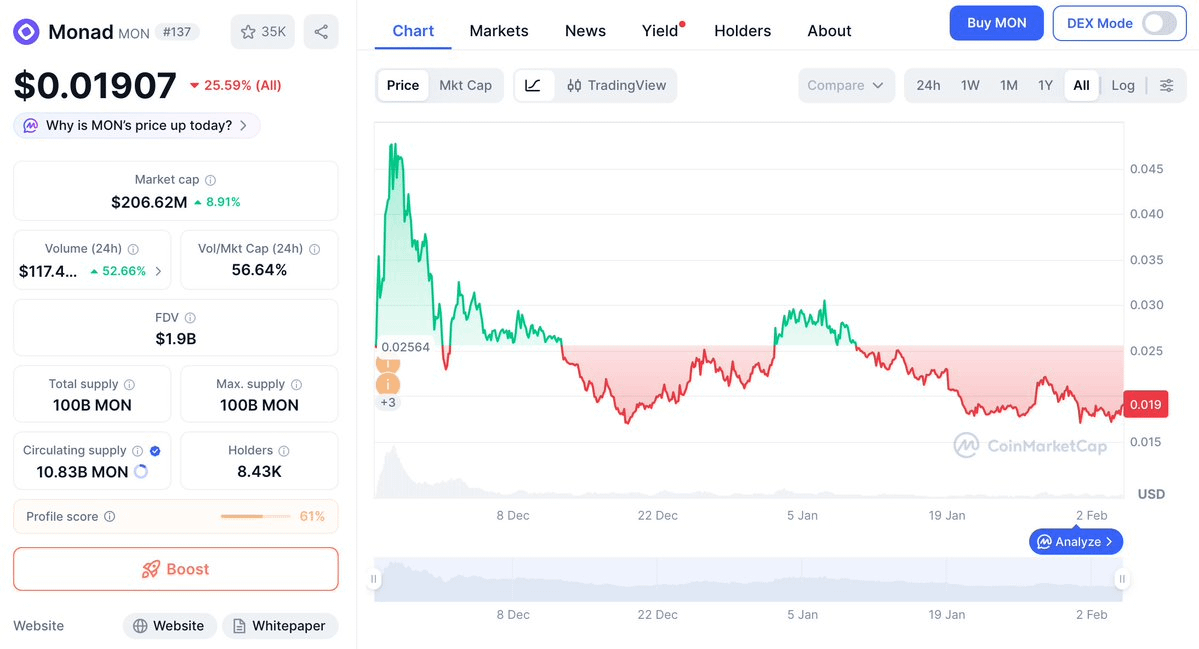
TVL metrics vary, DeFiLlama’s $233M baseline suggests capital is settling in. There's definitely no serious money leak now.
Some Onchain Statistics
304 protocols are live on Monad - it's a faster start than in previous L1 cycles. The $414.5M in stablecoins, mostly $USDC - this is real potential waiting for a reason to move.
Verified bridge netflows remain partly hidden, consistent activity generates ~$5,000 in daily fees. It’s an early baseline and competitive compared to several Ethereum L2s.
The number of validators was already approaching 200. Decentralisation is still a work in progress, but it already looks better than other multiple chains.
What About Infrastructure?
Among the real advantages, is the parallel EVM with a speed of 10K TPS. It works, and allows developers to simply increase the speed of the same application without having to learn new languages.
This has great potential for expansion if certain triggers arise.
Monad Ecosystem
DeFi is led by aPriori and Curvance. Despite an early Sybil incident, where 5,800 wallets in aPriori took a massive share of the drop. The team’s supplemental rewards showed they actually care about community health.
Fortytwo (AI) and Lumiterra (GameFi) are building things that would lag on slower chains. MuDigital ($13M TVL) is the dark horse here, which positions Monad for institutional credit as regulations clear.
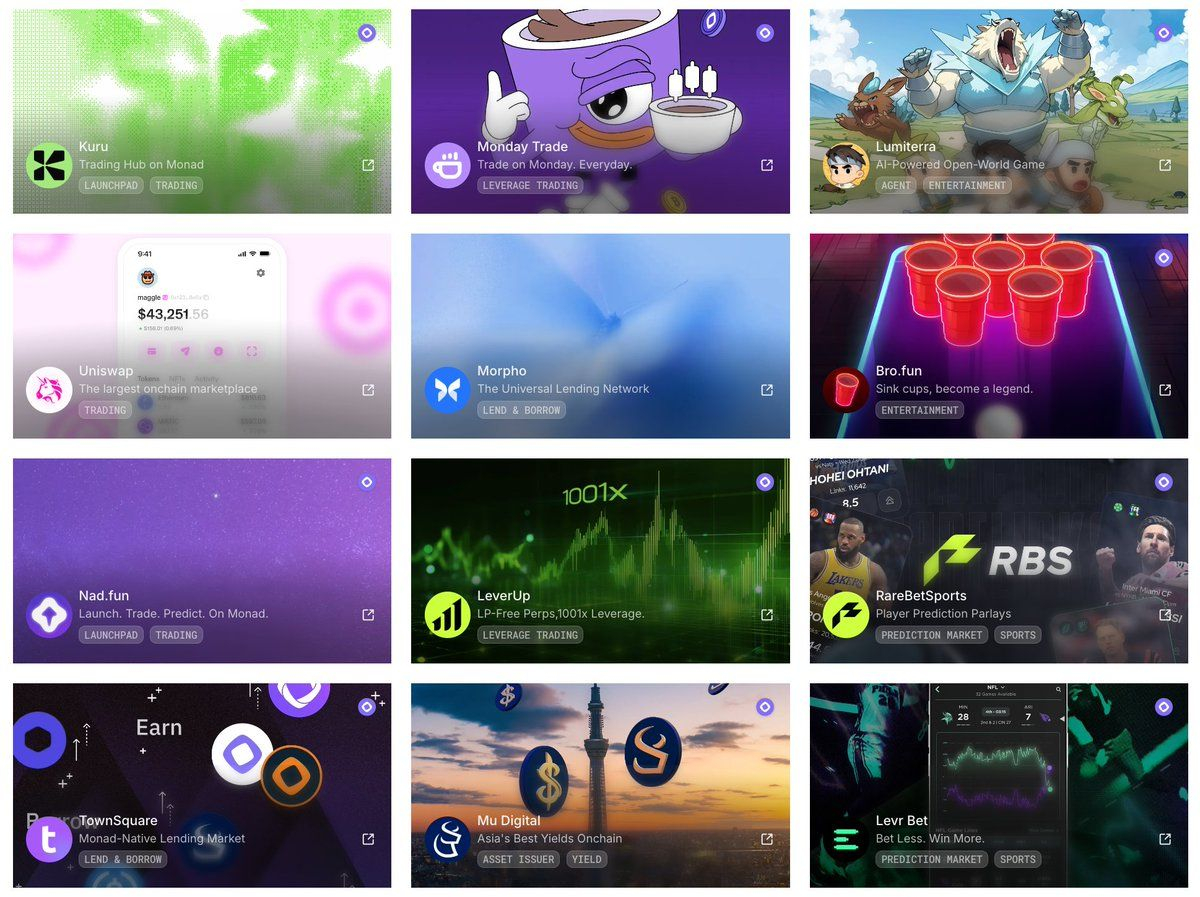
Meanwhile, $CHOG and $GMONAD keep the social layer active while the infrastructure matures. They really keep their communities active, so Monad as an idea won't die.
Cicada’s View on Projects to Watch
Morpho:
Morpho entered Monad as an established heavyweight, with over $6B in total TVL across multiple networks. Within the Monad ecosystem, its role is to provide capital efficiency.
Thanks to the Morpho Blue model, the protocol enables the creation of isolated lending markets. In Monad’s high-performance environment, this minimises gas costs and allows oracles to update faster - resulting in higher collateralisation ratios.
As of early February 2026, Morpho - together with a few other major protocols, accounts for nearly 50% of Monad’s total TVL, which peaked at $678.6M. This signals that large players prefer Morpho’s proven security when deploying $MON and stablecoins.
Neverland:
Neverland is a protocol born inside the ecosystem. Its core strength lies in veTokenomics and deep integration with protocol revenues.
While Morpho provides the raw lending infrastructure, Neverland builds an ecosystem on top, featuring self-repaying loans and automated yield strategies. It absorbs the liquidity made available by Morpho and transforms it into more complex financial products.
Neverland is already showing strong traction for a native protocol: ~$23.16M TVL with $82.27M in borrow volume. This reflects high capital velocity - exactly what Monad’s parallel EVM was designed to enable.
Insights from Morpho and Neverland
We asked the Morpho team two insightful questions so you can get a deeper, insider perspective.
What is your take on Monad’s infra potential and Parallel EVM?
A hyper-performant chain infrastructure allows builders like us to stay on the bleeding edge and create products that aren’t possible elsewhere.
At the same time, EVM compatibility lets us preserve network effects and bring over our battle-tested infrastructure and tooling, resulting in a more robust developer ecosystem.
Which projects do you see as the hidden gems within the Monad?
Nad.Fun stands out for how it experiments with native mechanics and user flows, pushing the boundaries of what consumer-facing apps can look like on Monad. It’s a great example of how performance unlocks entirely new product design space.
FastLane plays a critical role on the infrastructure side. By focusing on execution efficiency and order flow, it strengthens the foundations of the ecosystem and enables more sophisticated DeFi primitives to emerge.
We also asked some questions to the Neverland team to get a more complete picture.
As a team building on Monad today, what has actually changed for your product compared to building on other EVM chains?
We have previously worked on apps on Ethereum and Avalanche, and despite different fee profiles, both were constrained by congestion and latency that limited what could realistically run on-chain.
Monad’s speed and low fees are a prerequisite for enabling continuous self-repaying loans, frequent user actions, viable liquidations of any size, and higher capital efficiency through real-time risk management rather than conservative penalties.
What is your take on Monad’s infra potential and Parallel EVM?
Monad’s infrastructure unlocks what the EVM was always meant to be but never practically achieved. Parallel execution combined with low fees removes the need to design around congestion, latency, or user hesitation.
It allows apps to operate continuously rather than defensively. For us, that means building systems that assume constant interaction, fast risk response, and seamless scaling from day one.
Parallel EVM isn’t just a performance upgrade - it’s a structural shift in what kinds of protocols are economically and operationally viable on an EVM chain.
Market Conditions and Future
Monad has a full year of runway. The first supply cliff (16.6%) doesn't hit until November 24, 2026, followed by a 36-month vesting period. This gives the ecosystem time to move beyond ETH ports and launch truly native apps.
Chain delivered a machine that works. At $0.02, the entry reflects a reset of expectations. If Q1 catalysts like native staking trigger a supply cutting, the upside is significant.
The tech is solid, and now the focus shifts to organic growth. The question is: "When will the tech meta be back", because infrastructure is already here and waiting.