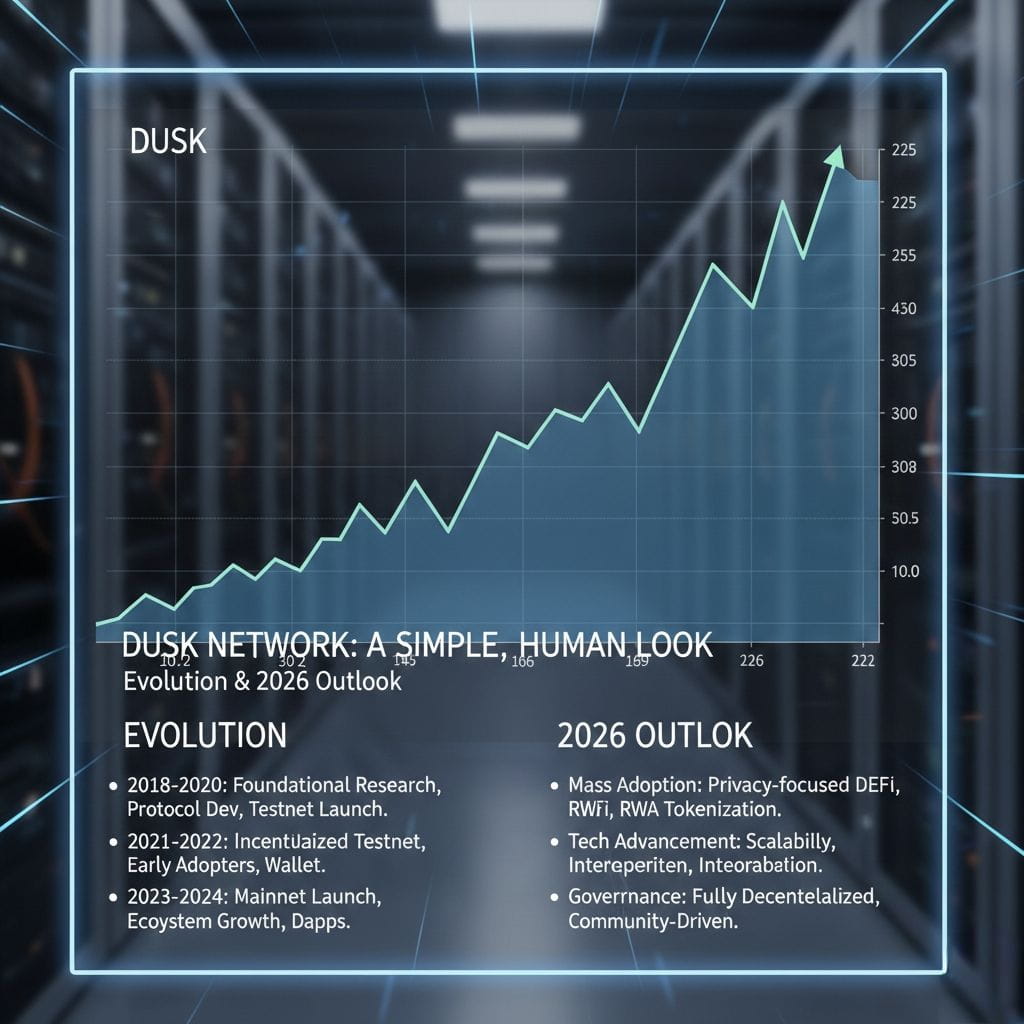
Dusk Network is a Layer 1 blockchain project that started its journey in 2018 with a very specific vision:to build blockchain infrastructure that can actually be used by regulated financial institutions without sacrificing privacy. While many blockchains focus mainly on speed or decentralization, Dusk was designed from the beginning to balance privacy, transparency, and compliance. This makes it different from most public chains that struggle to meet real-world legal and regulatory requirements.
At its core, Dusk is built for financial use cases such as tokenized real-world assets, compliant DeFi, and institutional-grade applications. The idea is simple but powerful: users should be able to transact privately, while institutions and regulators can still verify and audit activity when legally required. Privacy is not about hiding illegal behavior, but about protecting sensitive financial information in a controlled and lawful way.
Over the years, Dusk evolved from a research-focused project into a fully working blockchain. After extensive testing and development, the Dusk mainnet went live in early 2025. This was a major milestone because it marked the transition from theory and experimentation into real-world usage. Since then, the team has focused on improving performance, expanding developer tools, and building an ecosystem that institutions can trust.
One of the most important technical aspects of Dusk is its privacy-by-design transaction system. Instead of using a traditional account-based model, Dusk uses a privacy-friendly structure that allows transactions to remain confidential while still being verifiable by the network. This system is especially useful for financial products like bonds, shares, and funds, where transaction details often need to stay private but auditable.
Dusk also uses advanced cryptography, including zero-knowledge proofs. These allow the network to confirm that transactions follow the rules without revealing sensitive data such as amounts or identities. This approach is becoming increasingly important as governments demand transparency while users demand privacy. Dusk aims to sit right in the middle of those two needs.
The consensus mechanism used by Dusk is designed to support staking while reducing unnecessary exposure of validator information. Validators help secure the network by staking the native DUSK token, earning rewards while maintaining network integrity. The design prioritizes fast finality and resilience, which are essential for financial markets.
To make development easier and attract builders from other ecosystems, Dusk introduced EVM compatibility. This means developers familiar with Ethereum tools and smart contracts can build on Dusk without starting from scratch. On top of that, Dusk is working on a high-performance Layer 2 environment that increases scalability while settling securely on the main chain. This combination allows Dusk to stay efficient while remaining flexible.
Another major focus for Dusk is real-world adoption. The project is not targeting hype-driven retail trends alone. Instead, it aims to serve banks, exchanges, asset issuers, and regulated marketplaces. This is why the network places strong emphasis on compliance features such as controlled disclosure, audit trails, and regulatory alignment.
In recent developments, Dusk has moved closer to institutional adoption by integrating reliable data infrastructure and cross-chain communication tools. These integrations are critical for tokenized assets, where real-world prices, legal events, and settlement data must be accurate and trustworthy. Such steps signal that Dusk is serious about being used in real financial environments, not just experimental DeFi.
Looking to 2026
Looking ahead to 2026, Dusk’s future largely depends on execution and adoption rather than ideas. The technology foundation is strong, but success will be measured by how many real assets are issued, traded, and settled on the network. If more regulated platforms choose Dusk for tokenizing equities, bonds, or funds, the network’s relevance could grow significantly.
Regulatory clarity, especially in Europe, could work in Dusk’s favor. As rules around crypto assets become clearer, institutions are more willing to explore blockchain solutions. Dusk’s compliance-first design positions it well for this environment. Instead of adapting later, the protocol was built with these rules in mind from the start.
However, challenges remain. Competition in the blockchain space is intense, and many larger networks are also targeting real-world assets. Dusk must continue to prove that its privacy and compliance model offers real advantages. Liquidity, developer activity, and ecosystem growth will be key factors to watch.
2026 over view
By 2026, the most important question will not be about promises, but about usage. If Dusk can demonstrate steady growth in institutional participation, real asset issuance, and developer engagement, it could establish itself as a specialized but valuable financial blockchain. If adoption is slow, progress may continue quietly without major market recognition.
Conclusion
In summary, Dusk Network is not trying to be everything for everyone. It is focused on a specific problem: how to bring privacy, regulation, and blockchain together in a practical way. With its mainnet live, expanding infrastructure, and long-term institutional focus, Dusk’s path toward 2026 is less about hype and more about building trust, one regulated use case at a time.