


Walrus is not trying to be another hype token. The WAL token is the fuel that powers the whole Walrus storage network. Its job is simple and clear. It helps secure the network, pays storage operators, and lets the community vote on important changes. The token is not meant to be a quick pump coin. It is meant to be a working infrastructure token that lasts for years
The total supply of WAL is fixed at 5 billion tokens. This means there is no endless printing or inflation. The design is focused on steady incentives, controlled deflation, and long term sustainability instead of short term excitement
How WAL payments work
When someone wants to store data on Walrus they pay in WAL upfront. The payment is for a specific storage period and it is paid in advance. But the money is not given to storage nodes immediately. Instead it is released over time in a linear way
This system has two big advantages. First it protects users from token price swings because storage cost is pegged to a fiat price. So the cost stays stable and predictable. Second it gives storage operators steady income over time. They do not need to depend on token price to earn money. So WAL works more like prepaid storage credit than a normal fee token
Staking and security
Security on Walrus comes from staking. Storage nodes must attract delegated WAL stakes to get data assignments. The more stake a node holds the more data it can store and the more rewards it can earn
This creates a merit based system. Operators who keep good uptime and prove their data availability earn more. Operators who fail or go offline face penalties. These penalties include partial slashing and token burns. This means bad behavior has real cost and the network stays reliable
Delegators also play a big role. They stake WAL behind nodes they trust. In return they earn passive yield. This creates a strong system where operators focus on performance and delegators focus on risk and reliability
The plan is to improve slashing rules over time so accountability gets stronger and the network stays secure
Governance and community
WAL holders can vote on protocol changes. Voting power is based on stake so the people with the most operational risk have the biggest voice. They vote on things like penalty rules, reward rates, and system fees
More than 60 percent of the total supply is reserved for the community. This includes airdrops, reserves, and ecosystem incentives. About 10 percent of the supply is set aside to subsidize early usage. This helps lower the barrier for developers and users while the network grows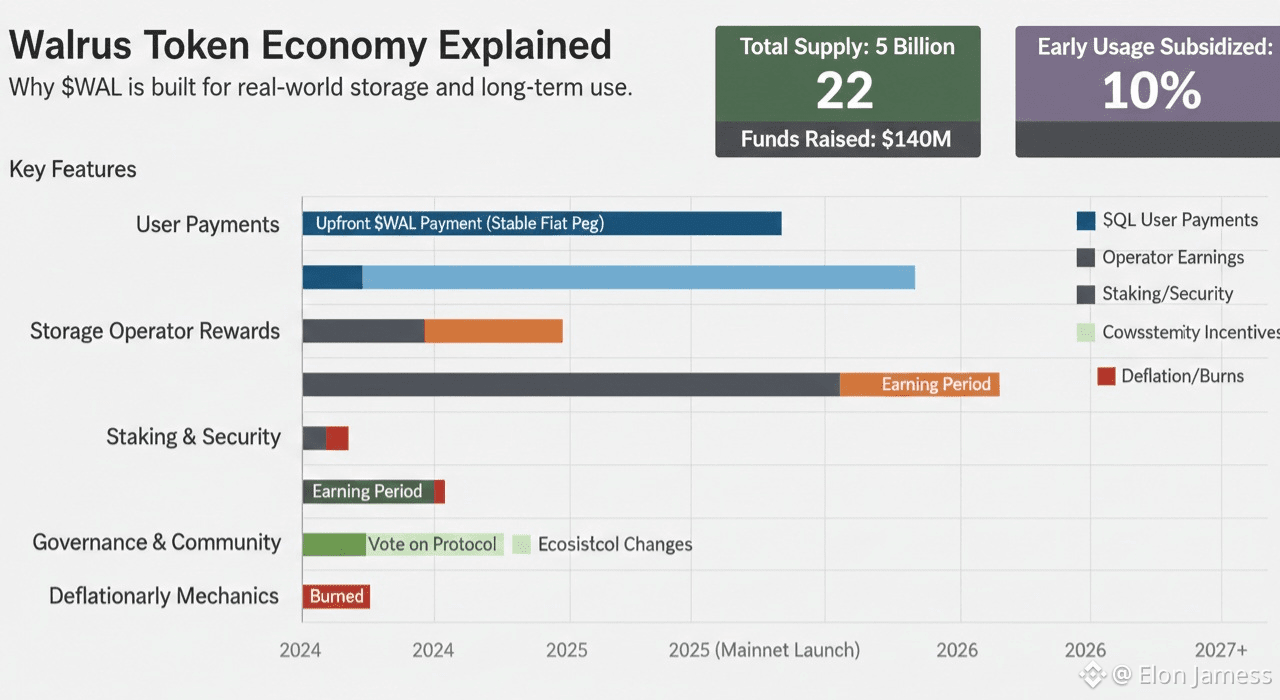
Deflation built into the system
Walrus has deflationary mechanics that reduce supply over time. Short term stake movements incur fees and a part of those fees is burned. This discourages staking hopping that could harm network stability
Slashing events also burn tokens. So as usage grows, the supply slowly decreases. This means the more storage used on Walrus, the more WAL is removed from circulation
In other words every additional gigabyte stored helps support long term value
Adoption and funding
After the mainnet launch in 2025, Walrus pushed hard on adoption. Staking programs and ecosystem incentives helped drive growth. More than 120 projects integrated Walrus storage
Walrus also raised $140 million from big firms like Andreessen Horowitz and other investors. This funding valued the fully diluted supply at around 2 billion dollars showing strong institutional confidence
But starting in 2026 token unlocks will test the system. This is where deflation and real demand for storage will be needed to balance sell pressure
How WAL is different from Filecoin and Arweave
Filecoin requires constant deal negotiation which can create friction and slow down adoption
Arweave focuses on permanent storage but it lacks flexibility for changing data needs
Walrus sits in the middle. It offers flexible storage durations, predictable pricing, and strong economic enforcement through staking and slashing
Binance and market access
WAL is also listed on major exchanges including Binance. This gives liquidity and access to real traders and holders. Binance also helped with ecosystem exposure through community programs and listing support
The big picture
If you want to think about $WAL in a simple way it is like a circulation system
Users pay upfront
Rewards flow to operators over time
Stakes secure the network
Burns reduce supply
Governance keeps the system evolving
The goal is not to hype a narrative
The goal is to build a real storage economy that lasts beyond market cycles
For long term holders $WAL is not a gamble
It is a stake in the future of decentralized storage and a growing need for reliable data infrastructure
