
@Dusk There’s a familiar tension that shows up the moment real-world assets enter a blockchain conversation. People want liquidity because liquidity feels like freedom, like an exit door that isn’t locked. But the moment liquidity appears, control often disappears, and the people responsible for the asset start to feel the floor move under them. That isn’t just a technical trade-off. It’s a human one. It’s the difference between an issuer sleeping at night and an issuer spending every weekend explaining to lawyers why something moved in a way it shouldn’t have. Dusk’s RWA story matters because it is built around the uncomfortable idea that liquidity and control can coexist, but only if the system treats “control” as a legitimate requirement instead of an insult. 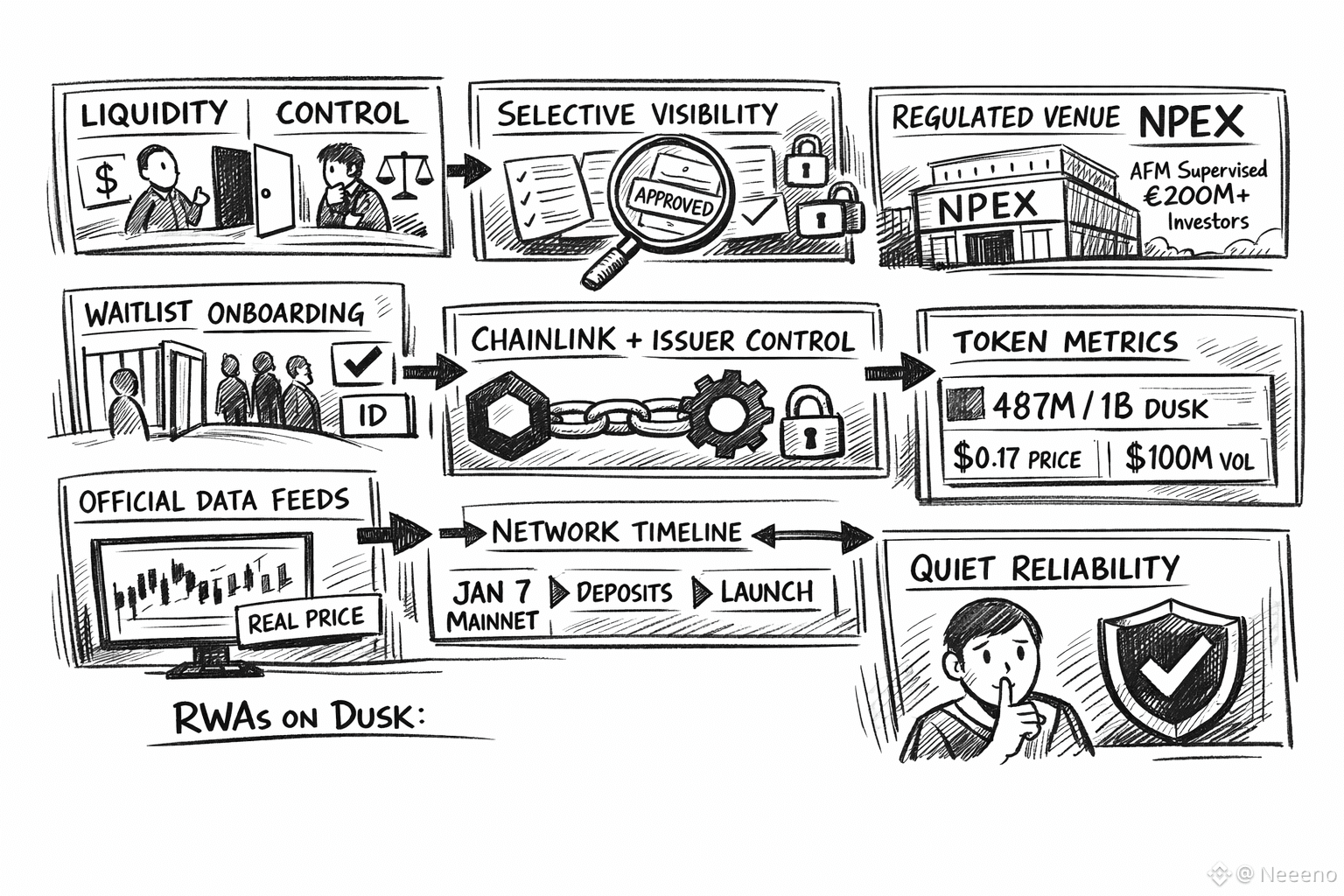
In regulated markets, “control” doesn’t mean censorship. It means accountability. It means you can draw boundaries around who can hold what, under which conditions, and you can prove later that those boundaries were followed without turning every participant into a public exhibit. Most people only understand this after they’ve watched a deal get questioned. The question is rarely “did it happen?” The question is “was it allowed, and can you show that without exposing everything else?” Dusk positions itself inside that question, designing for selective visibility where the right parties can verify what matters while the public doesn’t automatically get the whole story. That design goal reads abstract until you remember what RWAs actually are: contracts, identities, jurisdictions, and the kind of disputes that arrive with paperwork attached.
Liquidity, in this context, is not a meme about “tradable tokens.” Liquidity is what happens when an asset can move without begging for permission each time, while still respecting the rules that made it legitimate in the first place. The real fear for issuers is not volatility alone. It’s uncontrolled distribution, accidental non-compliance, and the reputational blast radius of a mistake that becomes visible to everyone at once. Dusk’s approach to RWAs is shaped by the reality that markets don’t fail politely. They fail through partial information, mismatched records, and people acting on different versions of truth. That’s why the architecture leans so hard into being verifiable when needed, rather than loudly transparent all the time.
The most practical signal that this isn’t just theory is the ecosystem’s visible drift toward regulated venues and real issuance pathways, not just “token representations.” Dusk has framed its RWA direction around partnerships and structures that already live under supervision, including NPEX, a Dutch exchange supervised by the Netherlands Authority for the Financial Markets (AFM), with a track record of facilitating over €200 million in financing and a base of 17,500+ active investors. That sort of detail isn’t decoration. It changes the emotional posture of the whole system.
When the marketplace is real, mistakes actually hurt, and the rewards and punishments actually matter. And the uneasy part: RWAs don’t just need a spot to appear—they need a place they can safely live and be handled properly. . They need a place to be traded without breaking the relationship between the asset and its legal reality. You can see the outline of that intent in the public-facing “waitlist-first” approach for the tokenized-asset platform being built around Dusk, which explicitly frames onboarding, verification, and region-specific access as core steps rather than afterthoughts. Even the preview of what “assets” look like there—money market funds and similar instruments—quietly signals the target audience: people who care about predictable value, clean reporting, and controlled access more than they care about adrenaline.
A big part of “liquidity without losing control” is accepting that assets don’t live on one island anymore. The minute a security can move, it becomes part of a wider environment: different wallets, different rails, different liquidity venues, different kinds of users. Dusk’s late-2025 decision to adopt a widely used interoperability and data standard through Chainlink is revealing here, not because interoperability is trendy, but because of the specific language around issuer control: rate limits, upgrade paths, and retaining ownership of token contracts while still enabling movement across environments. That is the heart of the RWA problem. The goal isn’t to make assets roam freely with no leash. The goal is to let them move while keeping the issuer’s responsibilities intact.
It’s also worth noticing how much of RWA liquidity depends on something boring: data that people will accept in a dispute. Traders love price feeds when things are calm. Compliance teams love them when things aren’t. Dusk and NPEX describing themselves as official data publishers for regulated-grade information, using on-chain delivery of official exchange data and low-latency streams, is the kind of infrastructure move that only feels exciting if you’ve ever watched a market argument spiral because the parties couldn’t agree on what the “real” price was at the decisive moment. When RWAs become liquid, disagreements don’t disappear; they accelerate. So the system has to be built around reducing ambiguity without overexposing participants.
The network timeline matters too, because RWAs don’t sit comfortably on “someday.” Dusk’s own mainnet rollout plan set an explicit target for producing its first immutable block on January 7, with steps leading into genesis and early deposits. That kind of dated commitment is more than marketing. It’s a declaration of operational readiness, and it shifts how builders and institutions evaluate risk. RWAs are already heavy with real-world obligations; they don’t tolerate infrastructure that feels like a moving target.
Token behavior becomes part of this story whether people like it or not, because the token is not just a chart—it's also a stress test of attention, liquidity, and participant confidence. As of January 18–19, 2026, DUSK has been trading around $0.17, with reported 24-hour volume around $100M+ and circulating supply reported at roughly 487 million against a maximum supply of 1 billion, placing the fully diluted value around double the spot market cap depending on venue and timing. These numbers matter less as bragging rights and more as an indicator that the market can actually absorb activity without collapsing into illiquid fragility. If you’re serious about RWAs, you eventually have to care about market depth, because thin liquidity doesn’t just punish speculators—it punishes real users trying to rebalance exposure responsibly. 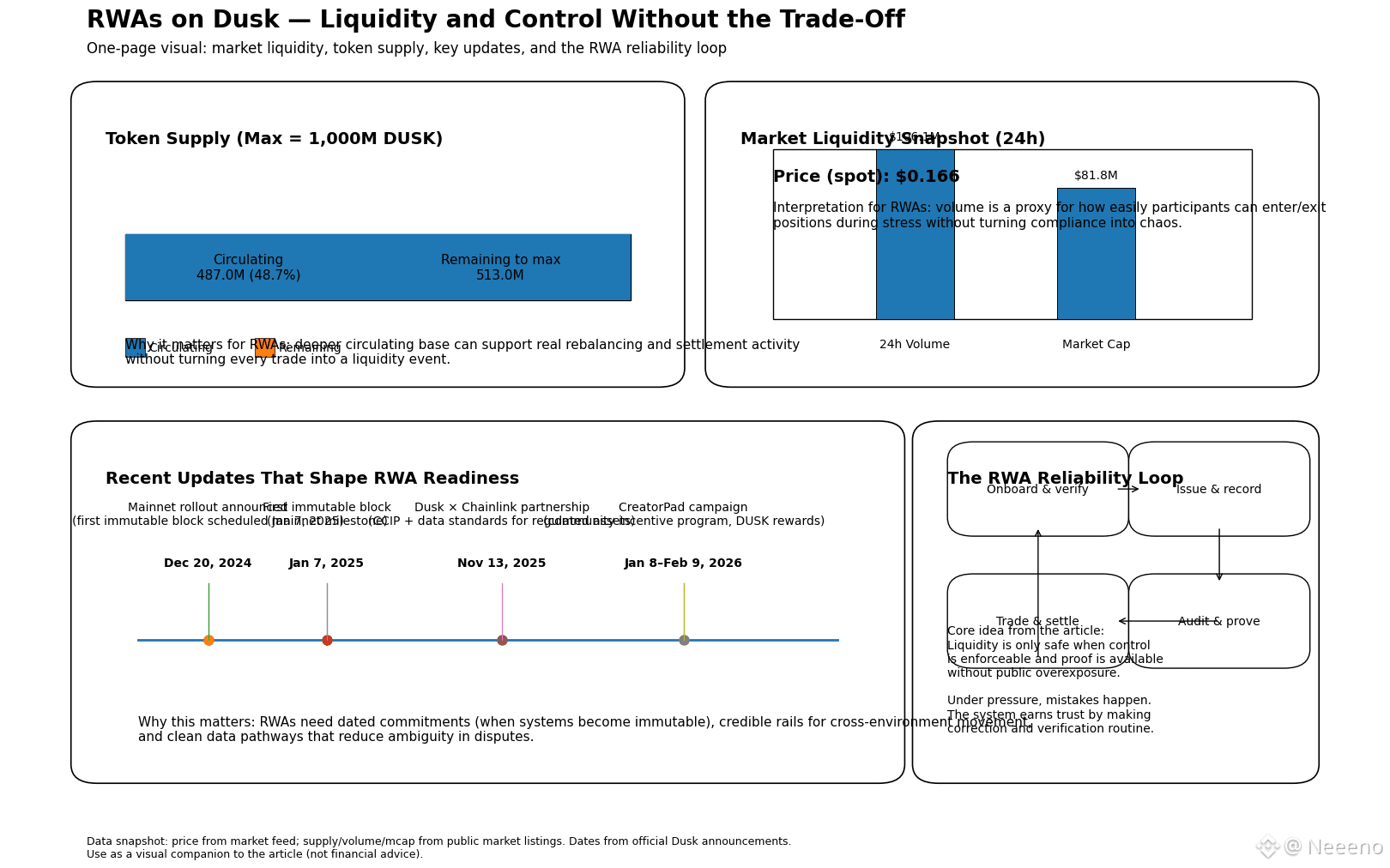
But the deeper point is that liquidity isn’t only “how fast can I sell.” For issuers, liquidity is also “how predictable is the system when people rush.” When volatility spikes, people don’t behave like ideal users. They fat-finger transactions. They misunderstand settlement. They assume the interface is lying. In that kind of stress, a privacy-conscious system isn’t about secrecy as a vibe; it’s about reducing the amount of unnecessary information that can be weaponized mid-panic, while preserving the ability to prove correctness after the fact. That’s the psychological promise Dusk keeps pointing toward: you don’t have to broadcast everything to be trustworthy, but you do have to be able to demonstrate integrity when challenged.
There’s also a subtle economic layer that gets missed. RWAs require participants who show up over time—operators, validators, integrators, and the institutions doing issuance and distribution work. Incentives can’t just be “number go up.” They need to reward the quiet work of keeping the network dependable, because regulated assets amplify the cost of downtime and inconsistency. Dusk’s public messaging around staking accessibility and reward design has been framed as part of building a durable participant base, which is exactly what you want if you’re trying to host financial instruments that people treat as savings, payroll, or balance-sheet assets rather than weekend trades.
A lot of people talk about RWAs as if the hard part is tokenization. It isn’t. The hard part is making sure the token stays tethered to the real-world rights and restrictions that give it meaning. That tether is made of identity checks, jurisdiction rules, official market data, and the ability for regulated venues to meet obligations without becoming custodial honeypots. Dusk’s emphasis on partnering with licensed actors and building around regulated exchange infrastructure is a strong signal that it’s treating the tether as primary, not secondary. You can even see this in how the ecosystem highlights licensing and regulatory pathways as strategic advantage, because licenses aren’t “nice to have” in RWAs—they are the map that keeps you from walking into a cliff.
Where this starts to feel like “liquidity and control without the trade-off” is in the idea that controls can be programmatic and auditable rather than purely manual. The Chainlink partnership language is telling: maintaining issuer control while enabling movement, using official data, and designing cross-environment flows with guardrails. This is the kind of design that assumes things will go wrong—bridges will be attacked, markets will gap, users will behave irrationally—and still tries to keep the core promise intact: that a regulated asset can move in a modern way without dissolving into an ungovernable blob the moment it touches open liquidity.
I keep coming back to how “quiet” this all is when it’s done properly. Most users won’t notice the difference between a system that merely moves tokens and a system that can survive a dispute. They’ll only notice when something breaks—when a transfer is questioned, when an issuer needs to halt a cascading error, when an auditor asks for evidence that doesn’t leak everyone’s private business. Dusk’s recent cadence—mainnet rollout targets, regulated exchange partnerships, official data integrations, and a visible path toward tokenized securities access—looks like a network trying to earn the right to be boring.
And maybe that’s the most honest way to talk about RWAs on Dusk right now. The token has real market signals behind it—roughly 487 million circulating out of 1 billion, trading around $0.17 with heavy daily turnover on major venues—and the ecosystem is attaching that liquidity to regulated rails: supervised exchange activity, official data publishing, and a platform narrative that starts with onboarding and legitimacy rather than frictionless anonymity.In that blend is a kind of quiet responsibility: the acceptance that invisible infrastructure matters more than attention, that reliability is a moral choice when other people’s assets are involved, and that the future of on-chain finance will be decided less by who shouts the loudest and more by who can keep working when markets are tense, messy, and very human.
