

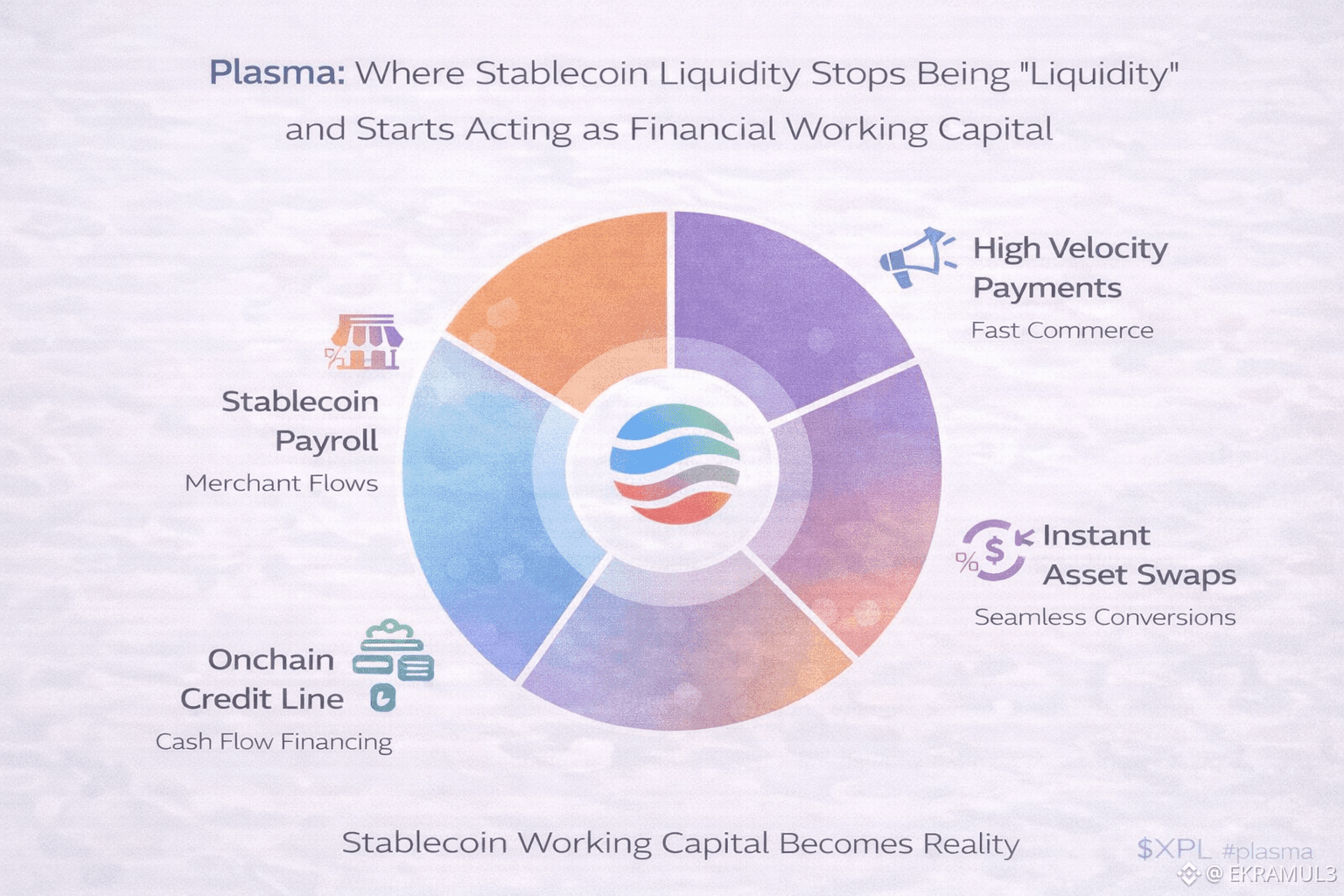
 If you study financial history long enough, you eventually notice that products do not win markets because they are “new” they win because they become liquid. Liquidity is not merely capital; it is confidence, optionality, and the ability for a system to support activity without stalling. A chain that acquires liquidity acquires permission to host financial primitives. A chain that acquires the right kind of liquidity acquires permission to host entire markets. Plasma is entering the second category, and that is why its rise feels different from most Layer 1 narratives.
The important distinction here is that Plasma is not just accumulating stablecoin liquidity it is accumulating circulating liquidity. Stablecoins on Plasma do not pool idly for speculation; they cycle between lenders, borrowers, treasuries, market makers, and settlement systems. Capital that cycles behaves like working capital in a business balance sheet: it fuels operations. That shift from “TVL as a vanity metric” to “TVL as operating capital” is a turning point few chains ever reach.
Most chains chase headline TVL because it signals confidence to outsiders. Plasma is quietly building something more durable: depth that can clear leverage, borrow demand, and payment flows without cracking. When a lending market reaches a size where large positions can enter and exit without destabilizing the system, builders recognize the environment as credible. They do not have to ask, “Will my users get filled?” or “Will liquidation auctions work?” or “Will treasury strategies settle?” The market answers those questions in real time.
This is the subtle reason Plasma’s lending scale matters. It is not about being “second largest” by headline. It is about the structure of that liquidity. Broad participation, thick borrow books, predictable utilization, and repayment flows that look like a functioning credit system. Liquidity that behaves like a credit market is significantly harder to dislodge than liquidity that behaves like a farm.
You can see the psychological shift in how builders talk about Plasma. It has stopped being framed as a “new chain with interesting tech” and started being treated as a place where financial products can actually clear. That is a profound difference. For financial developers, the question is not “Can I deploy here?” but “Will my system find counterparties here?” When the answer becomes yes, ecosystems compound.
The stablecoin dimension amplifies this effect. Stablecoins are not speculative assets; they are operational assets. They sit in treasuries, payroll systems, merchant flows, remittances, and automated settlement. Chains that host them are not just hosting value they are hosting business logic. Plasma understood early that the chain that becomes the settlement substrate for stablecoins becomes the substrate for whatever financial machinery forms around them. Lending is simply the first visible primitive in that formation.
The second-order effect is resilience. Concentrated TVL can exit. Diffuse liquidity anchored to use cases does not. Plasma’s liquidity profile resembles the second category. Thousands of wallets, institutional borrowers, market makers, treasury operators not one whale propping up a narrative. A system like that can absorb shocks, expands without permission, and attracts smarter capital that does not chase hype cycles. Stability breeds seriousness, and seriousness attracts builders who are allergic to ecosystems that rely on sentiment.
This is why I believe the next generation of stablecoin innovation will not emerge on the chains optimized for speculation. It will emerge where stablecoins behave as financial infrastructure, not as tokens. Builders need settlement, not slogans. They need throughput, not narratives. They need liquidity that clears, not liquidity that waits. Plasma is assembling those conditions. Markets are noticing. The ecosystem is warming. And the flywheel is beginning to rotate.
Financial infrastructure does not advertise itself when it is forming. It becomes obvious only in hindsight after the liquidity has already rooted and the builders have already arrived. Plasma looks like it is entering that phase now. If the future of onchain finance revolves around stablecoins (and all evidence suggests it will), then the networks that turn stablecoin liquidity into working capital will be the ones that matter. Right now, Plasma is one of the few chains actually doing that in the open.
