

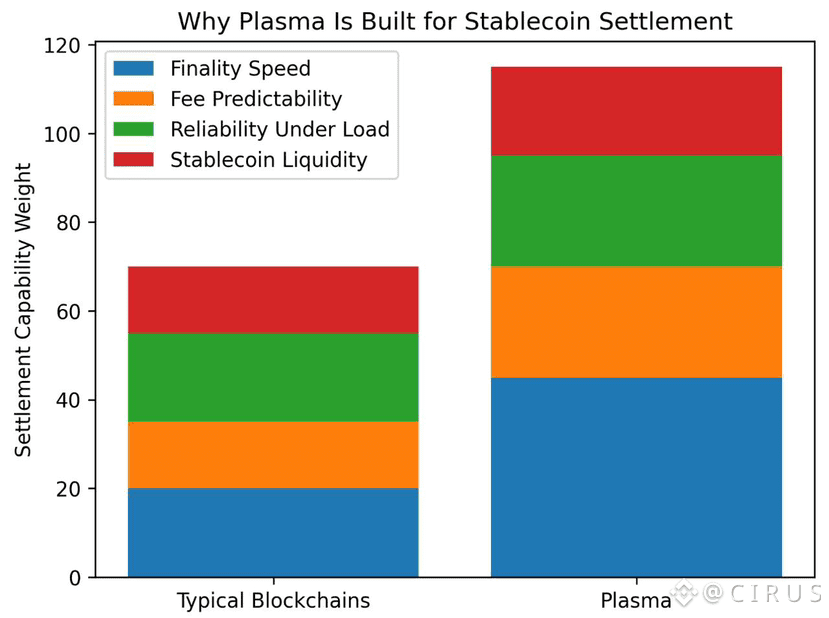
Most conversations about blockchain speed focus on throughput. How many transactions per second. How cheap each transfer is. However, when it comes to stablecoins, speed alone is not the bottleneck. The real constraint is finality. How quickly a payment becomes irreversible, trusted, and usable again.
This is where Plasma positions itself very differently.
Plasma is built around sub-second finality not as a performance flex, but as a settlement primitive. And once you look at stablecoin flows through that lens, the implications for both retail and B2B payments become much clearer.
Why finality matters more than raw speed
In traditional finance, settlement lag is expensive. Card payments feel instant to users, but merchants wait days. Bank transfers clear in batches. Cross-border payments can take even longer. Capital sits idle during this window, and risk stays unresolved.
Stablecoins promise to fix this, but only if settlement is truly final.
On many chains, transactions are fast but probabilistic. You wait for confirmations. You manage reorg risk. For consumer payments, this adds friction. For businesses, it adds operational uncertainty.
Sub-second finality changes the equation. It turns a stablecoin transfer into a completed payment almost immediately. No waiting. No conditional states. No ambiguity.
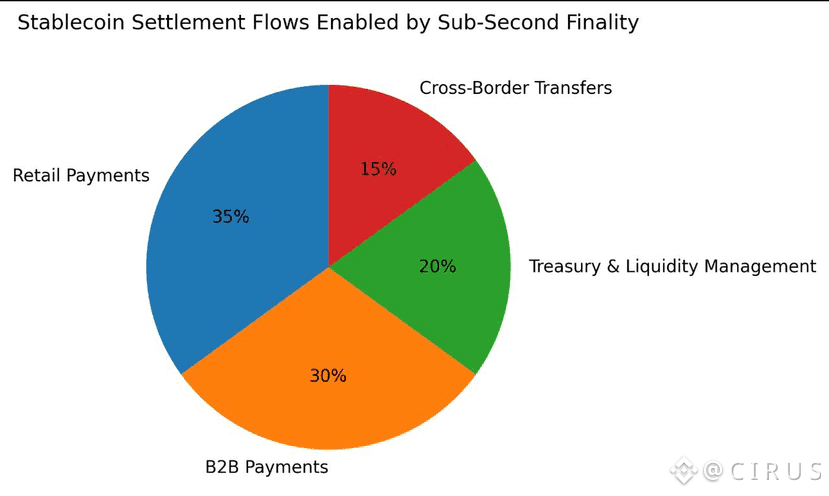
What this unlocks for retail stablecoin payments
For retail users, sub-second finality is less about numbers and more about experience.
When a stablecoin payment settles instantly and irreversibly, it behaves like cash in a digital form. The moment a user pays, the merchant can accept, confirm, and move on. There’s no need to delay fulfillment or hedge against reversals.
This unlocks:
• true point-of-sale stablecoin payments
• instant wallet-to-wallet transfers without confirmation anxiety
• real-time refunds and adjustments
Most importantly, it removes the mental gap between “transaction sent” and “transaction done.” Payments feel natural instead of technical.
Why B2B flows care even more about finality
In B2B payments, finality is not just convenience. It’s balance sheet impact.
Businesses manage cash flow tightly. Delayed settlement means trapped liquidity, reconciliation overhead, and credit risk. Even a few hours can matter at scale.
With sub-second finality, stablecoins on Plasma can support:
• instant invoice settlement
• real-time treasury movements
• continuous supplier payments instead of batch cycles
This allows companies to operate with lower buffers and faster capital reuse. Over time, that efficiency compounds.
Stablecoin settlement, not general computation
Plasma’s design makes sense when you view it as a settlement chain, not a general-purpose playground.
Instead of optimizing for every possible use case, Plasma prioritizes:
• deterministic finality
• predictable fees
• reliability under load
• deep stablecoin liquidity
These are exactly the properties payment systems require. They are also the properties most general chains struggle to guarantee consistently.
By narrowing its focus, Plasma aligns its architecture with how money actually moves at scale.
Reducing operational complexity
One of the hidden costs in stablecoin adoption is operational workarounds. Businesses build internal rules around confirmations, delays, and edge cases. Developers add logic to handle uncertainty.
Sub-second finality simplifies all of this.
When settlement is immediate and final, systems can be designed around completion instead of probability. Accounting becomes cleaner. Automation becomes safer. Payment flows become easier to reason about.
This is especially important for B2B integrations, where reliability matters more than experimentation.
Why this matters for stablecoin adoption
Stablecoins are already widely used, but mostly as transfer tools or trading pairs. To become everyday payment infrastructure, they need to behave like settlement money.
Plasma’s sub-second finality pushes stablecoins closer to that role.
It doesn’t change what stablecoins are. It changes how confidently they can be used. Retail users get smoother payments. Businesses get faster cash cycles. Developers get simpler logic.
My take
Sub-second finality isn’t about winning benchmarks. It’s about removing friction where money changes hands.
Plasma understands that stablecoin settlement is a different problem from general blockchain usage. By designing around finality first, it unlocks payment flows that feel immediate, reliable, and usable in the real world.
If stablecoins are going to move from rails to real infrastructure, this is the direction they need to go.
