

Know About #walrus grow with @Walrus 🦭/acc Stay with $WAL
In the rapidly shifting landscape of decentralized technology, the Walrus Protocol and its native WAL coin have emerged as more than just another storage solution. They represent a fundamental shift in how we manage, verify and interact with digital information. Developed by Mysten Labs (the creators of the Sui blockchain), Walrus is designed to handle "blobs" large binary objects like high-resolution videos, AI datasets, and complex game assets that traditional blockchains find too heavy or expensive to manage.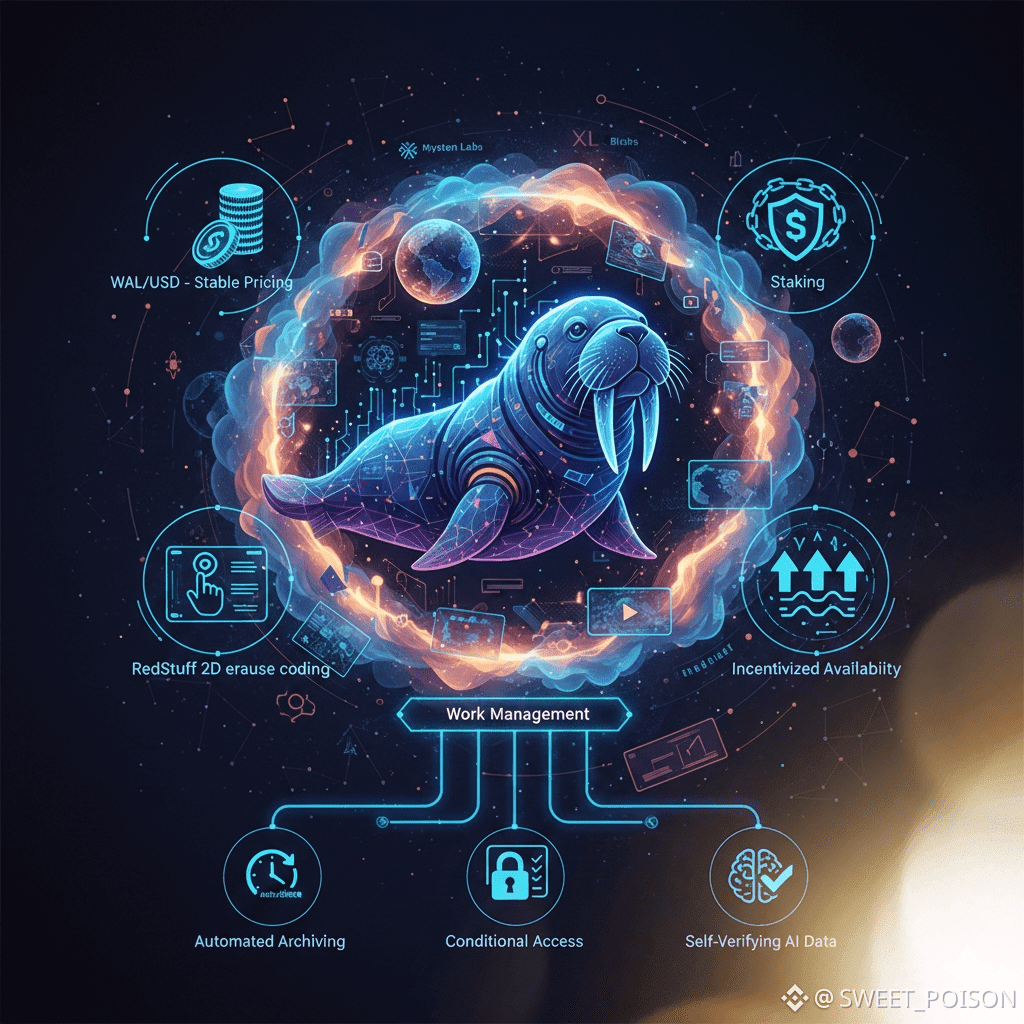
As of early 2026, the discussion around WAL has moved from theoretical whitepapers to real-world infrastructure. This post explores why Walrus is considered a new idea revolution and how it is redefining work management in the digital age.
1. The Core Innovation: Beyond Simple Storage
Traditional cloud storage relies on central authorities, while early decentralized storage often suffered from high costs or slow retrieval speeds. Walrus breaks this deadlock using a breakthrough technology called RedStuff.
Unlike older systems that might make ten identical copies of a file (leading to 10x costs), Walrus uses a 2D erasure-coding algorithm. It fragments a file into tiny shards and distributes them across a global network. Because of this mathematical efficiency, the network only needs a replication factor of about 4x to 5x to ensure data is safe.
The result? Even if two-thirds of the storage nodes on the network go offline simultaneously, your data remains fully recoverable. This level of resilience is revolutionary for enterprises that cannot afford even a second of downtime.
2. The WAL Coin: More Than Just a Currency
The WAL token is the lifeblood of this ecosystem. It isn't just a speculative asset; it serves four critical functions that keep the protocol running smoothly:
* Payment for Storage: Users pay in WAL to store their data. Interestingly, the protocol is moving toward stable pricing (pegged to USD but paid in WAL), which allows businesses to budget their storage costs without worrying about crypto market volatility.
* Network Security (Staking): Node operators must "stake" or lock up WAL coins to participate. If a node fails to provide the data it promised or acts maliciously, its stake is "slashed" (taken away). This creates a self-policing system where honesty is the most profitable path.
* Governance: Holders of WAL have a say in the protocol’s future. They can vote on technical upgrades, fee structures, and how the community treasury is spent.
* Incentivized Availability: Unlike other coins where you just "hold" and wait, WAL rewards those who actively contribute to the network's health, creating a circular economy of value.
3. Revolutionizing Work Management
The "Work Management" aspect of Walrus is perhaps its most underrated feature. In a traditional corporate setting, managing data requires expensive IT teams, complex backups, and constant monitoring. Walrus automates this through Programmable Storage.
Because Walrus is built on the Sui blockchain, every piece of data (blob) is treated as an on-chain object. This means developers can write "smart contracts" that manage data automatically. For example:
* A company could set a contract to automatically delete old logs after 30 days to save money.
* A legal firm could ensure that sensitive documents are only accessible once certain conditions are met, without a human intermediary.
* AI researchers can store massive training sets that are "self-verifying," ensuring the data hasn't been tampered with between training sessions.
This reduces the "human work" required to manage digital assets, shifting the burden from managers to math.
4. Why 2026 is the Turning Point
In the first quarter of 2026, the Walrus ecosystem has seen a massive surge in adoption. Several factors have contributed to this:
XL Blobs and AI Integration
As AI models become larger, the need for decentralized, tamper-proof storage has skyrocketed. Walrus recently introduced support for XL Blobs, allowing for the storage of multi-gigabyte files with ease. This has made it the preferred home for open-source AI datasets that need to remain public and unchangeable.
One-Click Migration
A new suite of developer tools has made it possible for traditional Web2 companies to migrate their data from services like Amazon S3 to Walrus with a single click. This lowers the barrier to entry, allowing non-crypto businesses to benefit from decentralized security without needing a PhD in blockchain.
Ecosystem Growth
With over 70 partners ranging from DeFi platforms like Myriad to decentralized social media networks the "Walrus effect" is spreading. It is no longer a niche tool; it is becoming the "data layer" of the internet.
5. Market Outlook and Future Potential
While the price of any coin is subject to market sentiment, the fundamental value of WAL is tied to utility. As more data is stored on the network, the demand for WAL increases.
Analysts point out that the decentralized storage market is projected to reach billions of dollars by the next decade. If Walrus continues to offer costs that are 80% lower than competitors like Filecoin and 99% lower than Arweave (as current benchmarks suggest), its market share is likely to grow exponentially.
Conclusion
The Walrus Protocol is not just a place to "put files." It is a dynamic, programmable and highly resilient engine for the digital economy.
By combining the efficiency of RedStuff encoding with the economic incentives of the WAL coin, it has created a system where data is truly owned by the user, not the provider.
Whether you are a developer looking for a better way to manage application data, or an investor looking at the next pillar of Web3 infrastructure, Walrus represents a significant leap forward. It is the transition from "passive storage" to "active, intelligent data management."