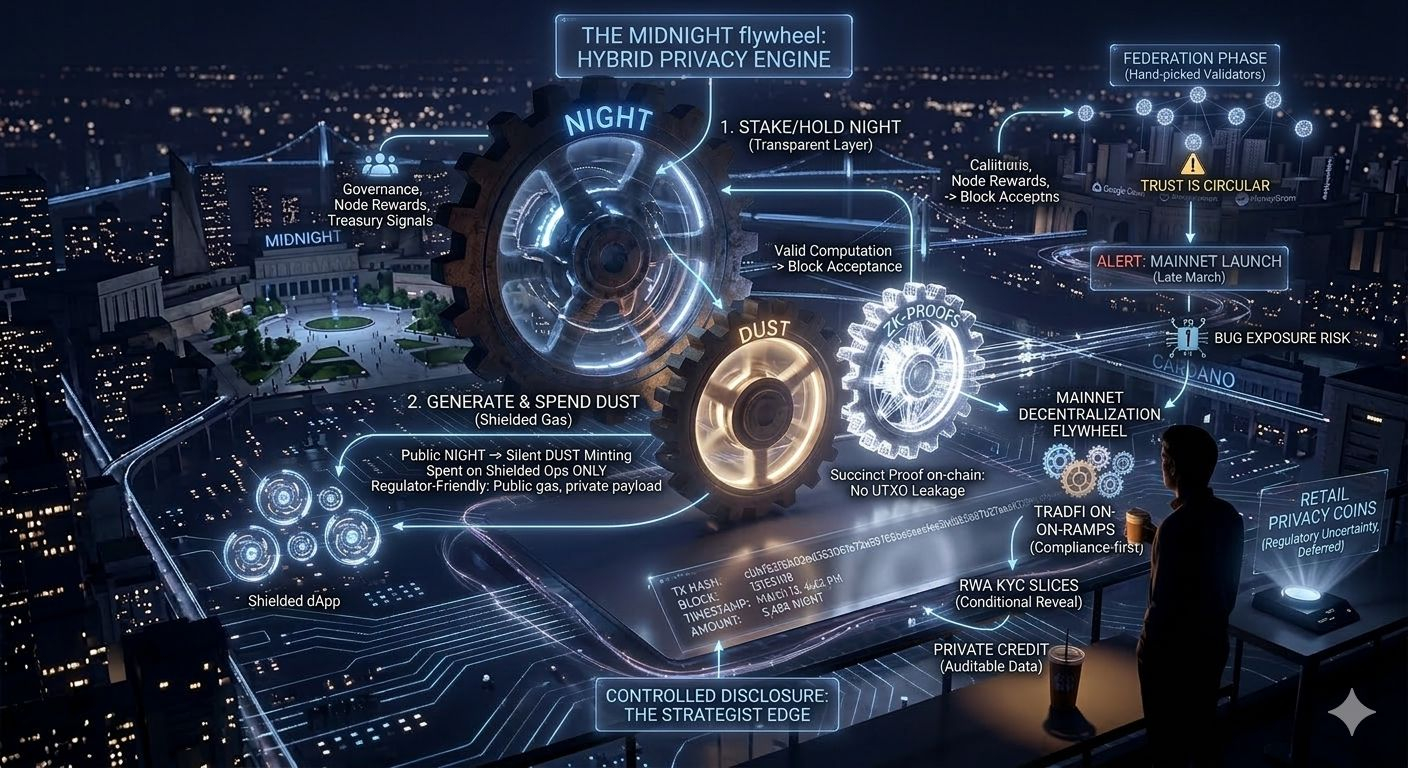
wait — this transfer executed last night
Poured coffee at 2 AM after closing the position. The room was dead quiet except for the fridge humming. Stared at the dashboard and saw it hit — that NIGHT transfer, block 13155108, epoch 618 slot 255479, timestamped March 13 at 4:42 PM. Just 5,484 NIGHT sliding between two stake addresses. Nothing dramatic. No fanfare, no volume spike, no tweet storm. Just another quiet move on Cardano's ledger.
Yet in the role of Midnight Network in advancing privacy-focused blockchain innovation, this ordinary move felt different tonight. The token itself stays fully public on Cardano — listed on exchanges, visible in every wallet tracker, no weird compliance red flags popping up anywhere. Meanwhile the actual Midnight network, still grinding through preprod stabilization, keeps the truly sensitive stuff completely shielded behind zero-knowledge walls. It's this clean separation that keeps hitting me harder each time I watch one of these transfers confirm.
I mean, I had been running a quick local sim earlier that evening, nothing fancy — just testing a basic split-state contract I'd mocked up to move dummy assets with selective reveal. Hit execute and watched the proof submit on-chain in under a second. The payload? Never left my machine. Not a byte leaked to the node, not even metadata hints. I sat there refreshing like an idiot, half-expecting something to break, but it just... worked. Clean. Actionable takeaway number one: hold NIGHT openly for governance votes, staking rewards, treasury signals — all the visible coordination stuff — and let it quietly mint DUST in the background purely for shielded execution fees. No need to expose user payloads or intent just to pay for gas. That alone flips how teams even begin to price privacy layers without immediately triggering every regulator's radar.
hmm… the three quiet gears turned for me
Picture it as three quiet gears meshing in the dark. First, the unshielded NIGHT layer — fully transparent, the one everyone can audit and participate in: governance proposals, node operator incentives, treasury allocation signals, all out in the open where trust can form publicly. Second, DUST — generated silently from staked or held NIGHT, spent exclusively on shielded ops, never needing to reveal what it's buying or moving. Third, the zk-proof itself — that tiny receipt landing on-chain: "rules followed, computation valid, no further details required." No broadcast of balances, no public UTXO graph, just cryptographic assurance.
The preprod blocks I scanned yesterday — including one regular, just thirty minutes before I finally logged off — showed the engine idling smoothly but unmistakably ready. No weird reverts, no anomalous gas burns, no leaks in the logs I could spot. Intuitive behavior number two: most chains force full broadcast of everything for anyone to verify — sender, receiver, amounts, memos, the works. Midnight inverts the script completely. You prove compliance and correctness locally on your own hardware, then broadcast only the succinct proof. Regulators can sample proofs or require disclosure keys when needed; everyday users never have to expose more than the protocol demands. That inversion alone feels like the real unlock after years of watching privacy projects swing between total opacity and forced transparency.
Timely example? Seven major global players — names like Google Cloud, Blockdaemon, MoneyGram — announced they’re running initial federated nodes just days ago, right around the Consensus Hong Kong wrap-up. Public, verifiable signal of institutional skin in the game. At the same time these small NIGHT transfers keep ticking across Cardano — the count blew past 350,000 in the early months post-launch and keeps climbing steadily. The market isn't chasing memes here; it's quietly watching the bridge mechanics and the proof throughput.
honestly the part that still bugs me
Wait — actually the federation phase still sits heavy in my head tonight. Mainnet is slated for late March now, confirmed repeatedly from Hoskinson on stage to the foundation blogs, yet right now validators are still this hand-picked, trusted set. I get the safety ramp — bootstrapping a zk-heavy chain isn't trivial, stability matters more than speed at genesis. But trust in a privacy network that's built, even temporarily, on hand-selected trust feels… circular. Almost ironic. I caught myself rethinking the whole pitch while the coffee went from hot to cold on the desk.
What if a shielded dApp launches early on mainnet and one subtle bug — maybe in proof composition, maybe in the compact circuit — exposes even a sliver of the gap between cryptographic promise and running reality? The innovation is legitimately there: rational, programmable privacy that finally lets real-world finance flows, health records, supply-chain attestations live on-chain without full exposure or off-chain crutches. Still, the hesitation lingers at 3 AM. It's not fear-mongering; it's pattern recognition from watching too many "private" systems crack under first real pressure.
3:42 AM and this finally clicked
Late-night reflections always hit harder when the screen glare is the only light left. Midnight doesn't sell anonymity theater — the kind that promises everything hidden then crumbles on subpoena. It sells controlled disclosure: reveal exactly the slice a counterparty, auditor, or regulator needs, cryptographically enforced, and nothing more. That's the strategist edge in a world drowning in compliance creep. Teams building institutional-grade apps — think tokenized RWAs with KYC slices, confidential settlement rails, private credit scoring — can finally move forward without the binary choice between privacy suicide and regulatory paralysis.
Forward, I see the flywheel starting to spin once full decentralization kicks in after the federated bootstrap: more NIGHT legitimately staked for security and rewards, more DUST minted organically through usage, more shielded contracts deploying and proving themselves daily under real load. Second reflection — expect dApp teams already embedded in regulated worlds (TradFi on-ramps, enterprise data consortia, cross-border payments) to adopt first, and quietly. They live under those compliance hammers every day; rational privacy is oxygen to them. Retail-facing privacy coins? Those probably come later, if the regulatory winds allow it at all.
Third, the bridge to Cardano remains the quiet multiplier nobody talks about enough. Liquidity can flow both ways — NIGHT moving to fund shielded ops, value accruing back without forcing users to abandon one chain for the other. It's hybrid by design, not retrofit.
If you’ve been watching the preprod explorer yourself, or running your own split-state tests on local nodes, drop what you noticed lately. No hype, no shilling — just the raw mechanics, the weird edge cases, the proofs that surprised you.
But here’s the raw part that still keeps me up as the sky starts to lighten: when the first big shielded contract finally goes live on mainnet and those zk-proofs start stacking reliably block after block, will we even notice the quiet trust we've slowly gained through each confirmation — or will we only truly feel it the moment something, somewhere, suddenly goes missing?