
For years, blockchain has been asked to serve two masters that do not naturally get along. One is transparency. The other is privacy. Public ledgers were built to make transactions visible, verifiable, and difficult to alter. That design solved a trust problem. It did not solve the far more ordinary problem of discretion. In actual life, people and institutions are constantly required to prove something without revealing everything. A patient proves eligibility for treatment. A company proves compliance with internal controls. A contractor proves authorization to access a system. None of those interactions works well if the underlying data is pushed into permanent public view.
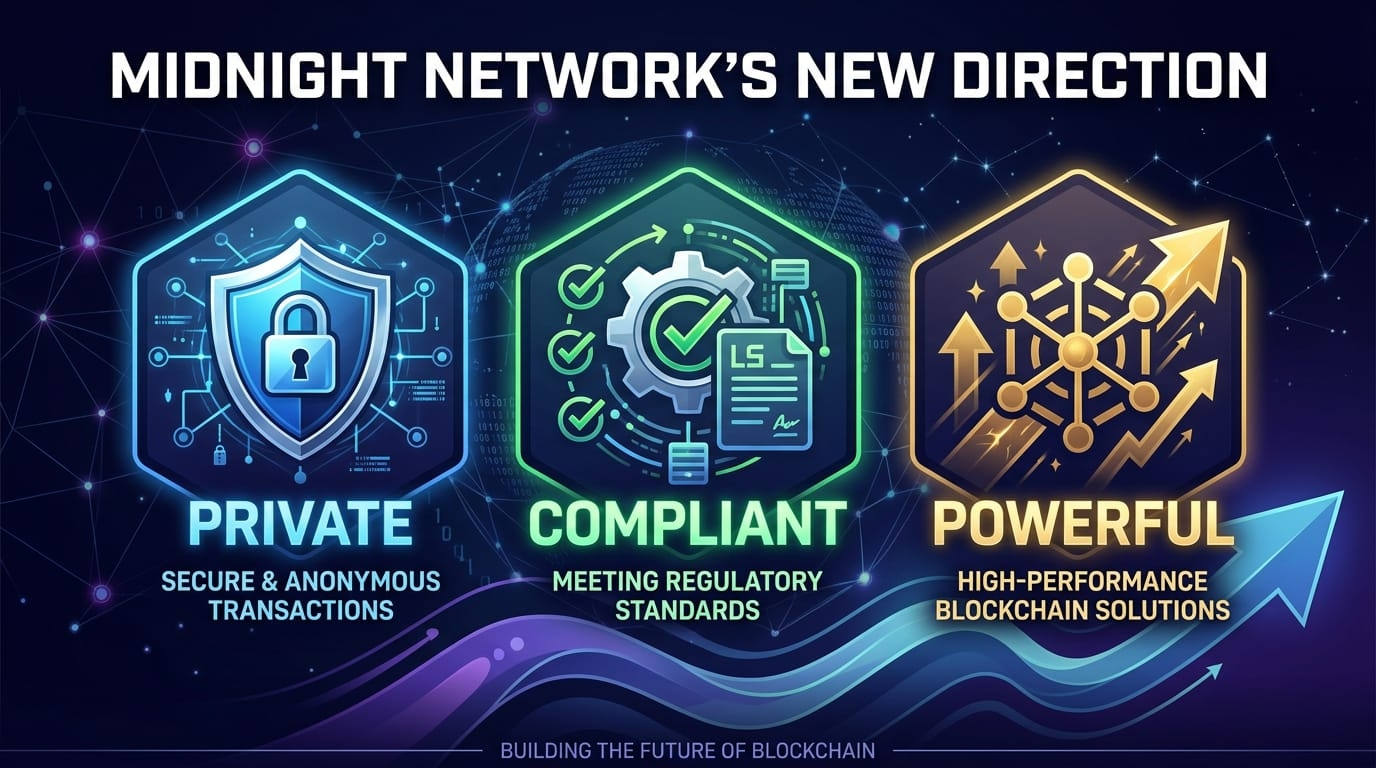
Midnight Network is trying to take that tension seriously. Developed by Input Output Global, the engineering firm best known for Cardano, Midnight is built around a straightforward but difficult premise: blockchain systems need a better way to handle sensitive data. Not by abandoning verification, and not by hiding everything behind a black curtain, but by allowing information to remain private while still making certain claims provable. That sounds technical because it is. But the basic logic is familiar to anyone who has ever filled out a form, shown an ID, signed a contract, or sat through a compliance check. The world already runs on selective disclosure. Blockchain mostly does not.

That is what gives Midnight’s new direction some weight. It is less interested in privacy as a slogan than in privacy as a working condition. The distinction matters. Crypto has spent years treating privacy either as a moral absolute or as a feature request. Neither frame is especially useful once you move from speculation into fields like healthcare, procurement, identity, payroll, or regulated finance. In those settings, secrecy for its own sake is rarely the goal. The goal is narrower. Protect what should remain confidential. Reveal what must be revealed. Keep a record that can stand up later when someone asks what happened and why.
This is harder than it sounds. Public blockchains are elegant in part because they flatten everything into the same logic. A transaction happens. The network validates it. The ledger records it. Once you ask the system to support private business rules, confidential records, or limited-access data, the architecture becomes more demanding. You need a way to prove that the right conditions were met without exposing the underlying information. You need permissions that are precise enough to matter and simple enough to manage. You need developers to understand what is hidden, what is visible, and what can be selectively disclosed to different parties under different circumstances.
That is where Midnight’s approach becomes more interesting than the usual privacy rhetoric. The network appears aimed not at total opacity, but at a more realistic model of controlled disclosure. A person might need to prove they meet an age requirement without handing over a full identity document. A business might need to show that a transaction met policy standards without publishing the contract behind it. A regulator may need access to a narrow slice of information without turning the rest of the record into a public artifact. These are practical scenarios. They happen every day in offices, clinics, banks, shipping departments, and government portals. Blockchain has often struggled to meet them because its default posture is too blunt.
Midnight is trying to build a finer instrument. Whether it succeeds will depend less on the conceptual appeal than on the mechanics. Privacy systems tend to sound convincing right up until they meet implementation. That is when the familiar problems arrive. Proofs can be computationally heavy. Developer tooling can be incomplete. User experience can turn awkward fast when wallets, permissions, and disclosure settings start interacting. Legal teams may understand the value of protected data but still hesitate if the system’s audit logic feels unclear. Engineers may support the architecture in principle but avoid it if integration slows shipping or increases operational risk.
This is why the word compliant matters in the title, and not just as a concession to institutional sensibilities. Compliance, at its best, is not about surveillance for its own sake. It is about controlled accountability. Serious systems need to show that rules were followed, obligations were met, and access was granted on legitimate grounds. Midnight’s challenge is to support that without collapsing back into full transparency. That is a delicate balance. Too much privacy, and the system becomes difficult for institutions to touch. Too much disclosure, and the privacy claim weakens into branding.
There is also a broader shift happening in how people think about blockchain’s role in the world. For a long time, transparency was treated almost as a virtue in itself. The public nature of the ledger was the point. But over time, that clarity has begun to look more like a constraint in many contexts. Ordinary users do not want their financial behavior permanently legible to strangers. Businesses do not want procurement data or internal agreements floating on a public chain. Governments and regulated sectors do not want systems that force them to choose between total visibility and total darkness. They want boundaries. Real ones. Boundaries that can be inspected when necessary and respected by default the rest of the time.
Midnight’s promise is that those boundaries can be built into smart contract infrastructure rather than layered awkwardly on top of it. That would be meaningful if it works. Not revolutionary in the theatrical sense, but meaningful in the way infrastructure becomes meaningful: by allowing more kinds of activity to happen without forcing people into absurd compromises. Developers could build applications that handle sensitive data with more care. Institutions could test blockchain logic without treating every interaction as a publication event. Users could prove more and expose less.
Still, restraint is warranted. Privacy-preserving computation is difficult. Selective disclosure has legal and technical complexity that marketing language tends to flatten. Many projects have claimed to reconcile confidentiality and accountability. Fewer have done it in ways that survive real workloads, real users, and real scrutiny. Midnight will be judged there, in the details nobody can afford to ignore. What are the costs? How are permissions managed? How does recovery work? What is visible to whom, and when? How predictable is the experience for developers who need to build under deadlines rather than in idealized conditions?
That is the real story of Midnight’s new direction. Not that it promises private blockchain, and not that it borrows the language of compliance, but that it is trying to design for the world as it actually operates. Trust in the real world is rarely absolute. It is conditional, context-specific, and bounded by rules. If blockchain is going to move beyond speculation and become useful in more grounded settings, it will need to reflect that. Midnight is one attempt to do so. That does not make it inevitable. It does make it worth taking seriously.
$NIGHT #night #NIGHT @MidnightNetwork