
A few mornings ago I was sitting at my desk before sunrise, coffee next to me slowly getting cold while my laptop fan made that constant humming sound. I was going through my notes on Fabric Foundation again, and one question kept coming back to my mind.
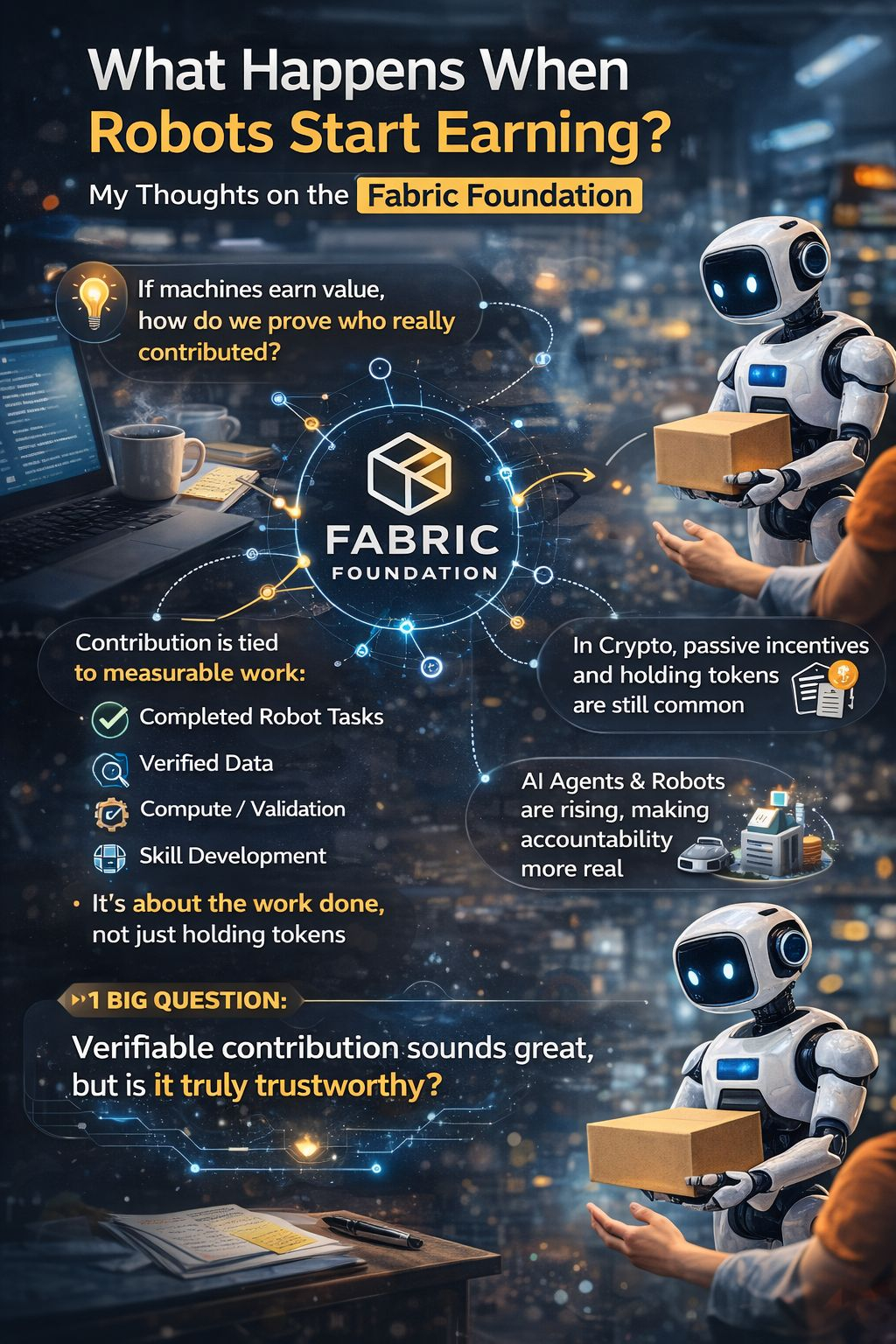
If machines eventually start earning value in the real world, how do we actually prove who contributed to that work?
The more I thought about it, the more interesting Fabric started to feel to me.
What really caught my attention is the way the project talks about contribution. From what I understood while reading through the whitepaper, rewards are not meant to come from simply holding tokens. Instead, they are connected to work that can actually be measured. That could be robots completing tasks, verified datasets being provided, compute resources being used, validation work, or even developing skills inside the network.
In simple terms, the idea seems to be that value should come from what people (or machines) actually contribute, not just what they hold.
At first it sounded like a very basic idea to me. But when I compared it with how many systems in crypto still rely on passive incentives, it suddenly felt like a stricter standard. Maybe that’s part of the reason the project has been getting more attention recently.
The December 2025 whitepaper gave people something real to analyze, and the February 2026 rollout of $ROBO made the whole discussion more concrete.
At the same time, with AI agents and robotics becoming more common, the question of accountability doesn’t feel theoretical anymore. If machines start interacting with real systems and generating value, proving contribution will probably matter a lot more than we think.
Personally, I find the idea interesting, but I’m still watching it carefully. A system based on verifiable contribution only works if the verification itself stays trustworthy.
And honestly, that’s the part I’m most curious to see play out.$ROBO @Fabric Foundation #ROBO