
Most analysts looking at Fabric Protocol are wrong, and in fact wrong on two counts.
The first is, quite simply, a failure to do some basic reading. A token and a robot equals AI speculation. A second, although far more interesting, is those who read further but fail to capture the essence of the token and its associated benefits. These are the seekers of the magic. They are not looking for a decentralized agent that facilitates the payment of crypto to one and another and in the process build a self constituting, self sustaining, transnational, machine driven civilization.
In terms of the investment potential, Fabric is a far more plausible story. If you believe in magic, you have to believe that the world will solve all of the hard problems in order for that story to happen.
What is the story that Fabric is focused on? It is what happens when you stop believing in magic and start thinking about what is possible.
We'll start here.
What every robotics company knows but will not say is that the hardware is almost ready, but the coordination layer is a nightmare. That is, for most of the world, the capability gap is closing. For the less pessimistic, the capability gap is closing quickly. There is technology that can enable the сел in the last mile to minimize monitoring by the human operator, for example, Drones are able to inspect one of the construction sites with implant precision, able to cut, and the system is able to build, navigate, and operate in a warehouse by itself. It can also build a delivery system that can navigate the ⌂ (chilled delivery system on pets).
The for the world is quickly closing.
Nothing matters if you don't have answers to boring questions. Who approved the use of that drone? Who checks that the inspection included all the required zones? Who gets how much money? Who gets sued? Who shows the robot followed the correct procedure? Who gets to deal with the operator dispute when he says “done” and the customer says “that’s not what I paid for”?
The following questions are not about science fiction. They are about today's real concerns that any business faces when managing work with strangers. Presently, we solve these with contracts, lawyers, and, with time, trust. That method works at the speed of people.
At the speed and scale of machines, it fails terribly.
The Architecture of Consequences

From the start, the design of Fabric is based on a rather grim-sounding, yet accurate hypothesis: in open networks, people cheat if they can profit. Instead, the focus is on incentivizing honesty.
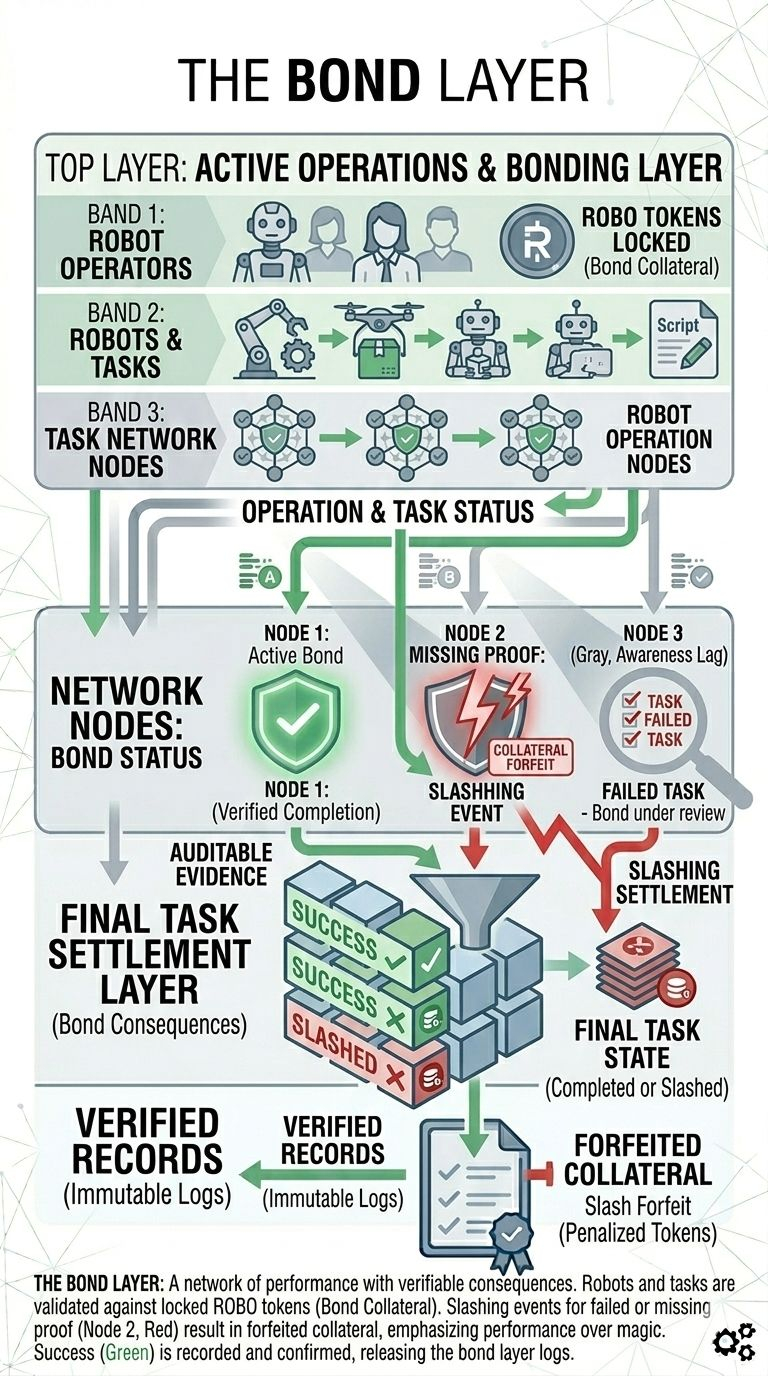
The answer is the bond model.
Operators are required to lock a certain amount of ROBO tokens as collateral. If there is honest behavior, the bond remains intact. If there is dishonesty, or if there is a failure to deliver, the bond is slashed. Therefore, the network does not need to trust you. They just need you to have skin in the game.
This is the same mechanism that secures proof-of-stake networks. However, when applied to machine labor, it does something extraordinary: it transforms trust from a vague concept to a line item on a balance sheet. A robot is not considered “trustworthy” on the basis of a five-star rating system. A robot is considered trustworthy when the owner has financial capital at risk. The distinctive capital that can be seized.
This alters behavior in ways that a reputation score will never be able to.
What Success Actually Looks Like
If Fabric is successful, it is likely that the majority of users will not even mention the service.
This is infrastructure. While everyone is using the internet, very few know and understand how the TCP/IP specifications work. The protocol becomes invisible. What is built on the protocol becomes visible.
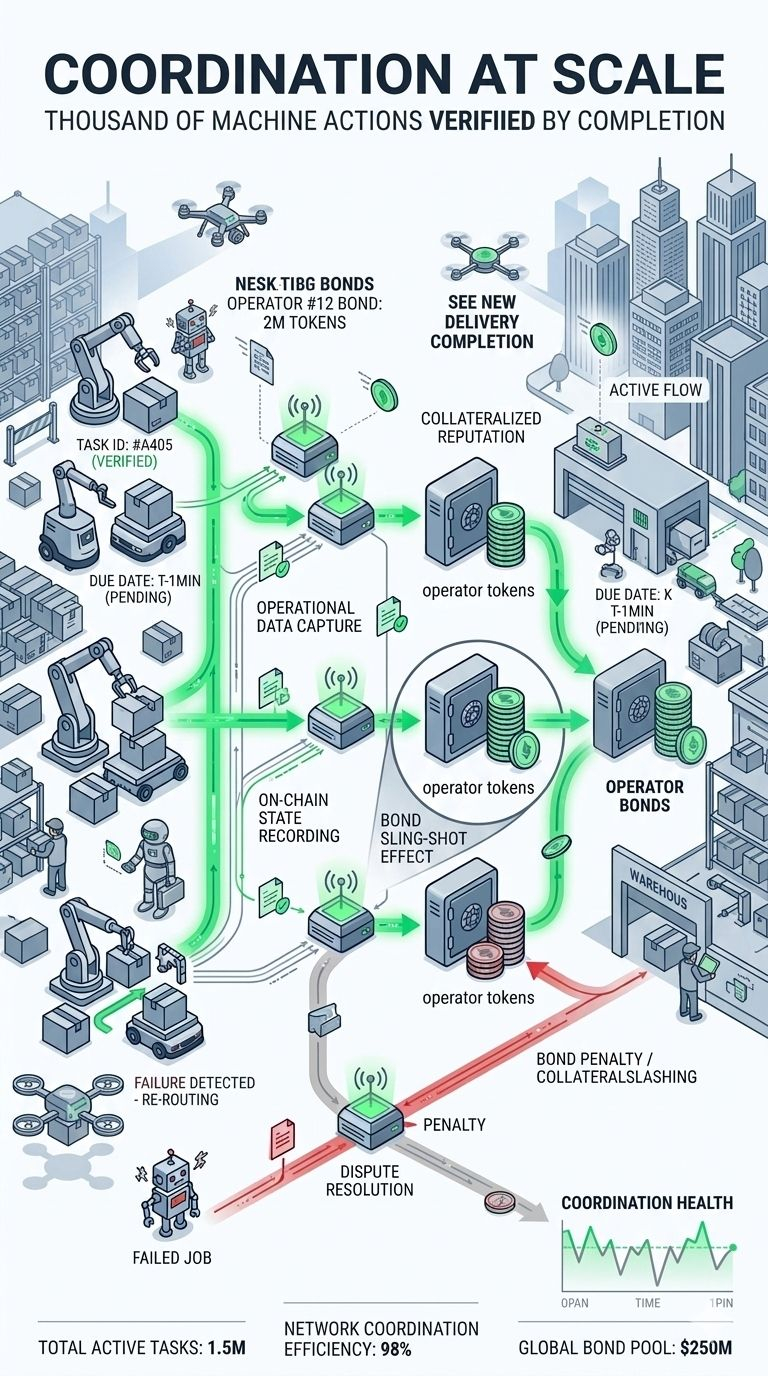
Imagine success. A logistics company uses delivery robots. The robots create identities on Fabric. They post ROBO bonds. They get the delivery tasks on the network. They do the delivery and create telemetry, which is verified by some independent nodes. The network has records of all the deliveries, and in case of an argument, the network records will have the evidence. If the robot does not perform well, it loses some of its bonds. The company expands, and it buys more ROBO bonds for collateral.
The company does not need to understand crypto. They just need to know that the system works, the disputes are resolved, and they are not locked into a contract that gives all of its value to the platform.
This is the quiet success that does not get the headlines. It creates sustainable fee volume, which creates sustainable buy pressure, which creates value for ROBO, regardless of the retail attention.
The Right Standard
The most boring evidence, and the best of all, is time.
Registry growth showing actual machines, not just wallets. Slashing events proving penalty mechanisms work. Task volume reflecting real economic activity, not testnet noise. Fee generation demonstrating sustainable demand. Dispute resolution proving verification works under pressure.
None of this arrives in a quarter. None gets priced efficiently by markets moving on six-month horizons. That's the opportunity for anyone watching closely.
Fabric Protocol is either invisible infrastructure underpinning significant machine labor, or a well-documented footnote in ambitious projects that couldn't bridge design and reality.
Both outcomes remain possible. The evidence is just starting to arrive.