
I’ve noticed that when new infrastructure platforms emerge, they often talk about empowering developers. It’s a familiar phrase, sometimes used so loosely that it loses meaning.
When I look at Fabric Protocol, though, I try to interpret that promise through a more practical lens. What does empowerment actually look like for developers working with robotics systems that exist in the physical world rather than purely digital environments?
Robotics development has always been complex. Engineers deal not only with software but also with sensors, hardware limitations, unpredictable environments, and safety constraints.
Unlike purely digital applications, robotic systems must operate in environments where uncertainty is constant. From my perspective, any infrastructure that claims to support next-generation robotics has to acknowledge that reality rather than abstract it away.
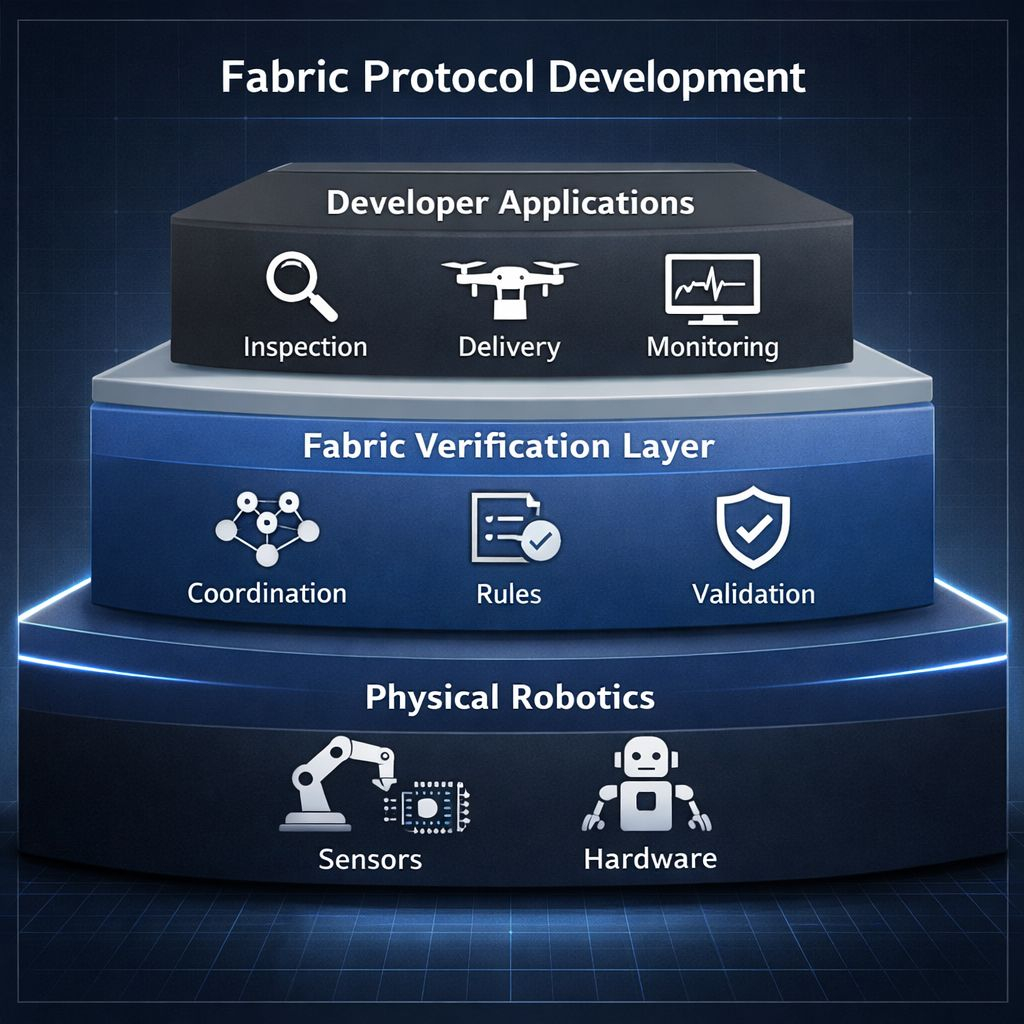
Fabric Protocol seems to approach the problem by focusing on coordination rather than direct control.
Developers building robotics applications on top of Fabric are not necessarily creating new machines or training new AI models.
Instead, they are building systems that verify and coordinate what robots already do.
Tasks performed by robots inspection, delivery, monitoring, and maintenance can be recorded and validated through the protocol’s infrastructure before settlement or recognition occurs.
That design choice is interesting to me because it mirrors how financial infrastructure evolved.
Financial systems rarely dictate what businesses should do. Instead, they verify transactions and enable settlement once activity has occurred.
Fabric appears to apply a similar idea to robotic work. Developers building on the protocol are effectively designing the rules that determine how robotic activity becomes verifiable and economically meaningful.
Still, I remain cautious about assuming that this automatically simplifies development.
Robotics integration rarely follows the neat boundaries that infrastructure frameworks prefer.
Developers often have to work across multiple layers simultaneously hardware drivers, perception systems, AI models, and operational safety logic.
Adding another layer of verification and coordination could create new opportunities, but it could also introduce complexity that teams need to manage carefully.
The success of any developer-focused infrastructure depends heavily on tooling.
If Fabric’s developer environment provides clear interfaces, predictable APIs, and reliable documentation, integration becomes feasible.
If those tools remain immature or overly abstract, developers may struggle to justify the additional effort required to incorporate decentralized verification into their robotics systems.
Another factor I think about is economic alignment. Developers do not operate in isolation; they work within organizations that must manage operational costs.
Running robots involves energy consumption, maintenance cycles, and hardware wear. Any decentralized protocol that coordinates robotic work has to reflect those realities in its incentive structure.
If verification becomes expensive or settlement mechanisms feel disconnected from real-world operations, adoption will likely stall.
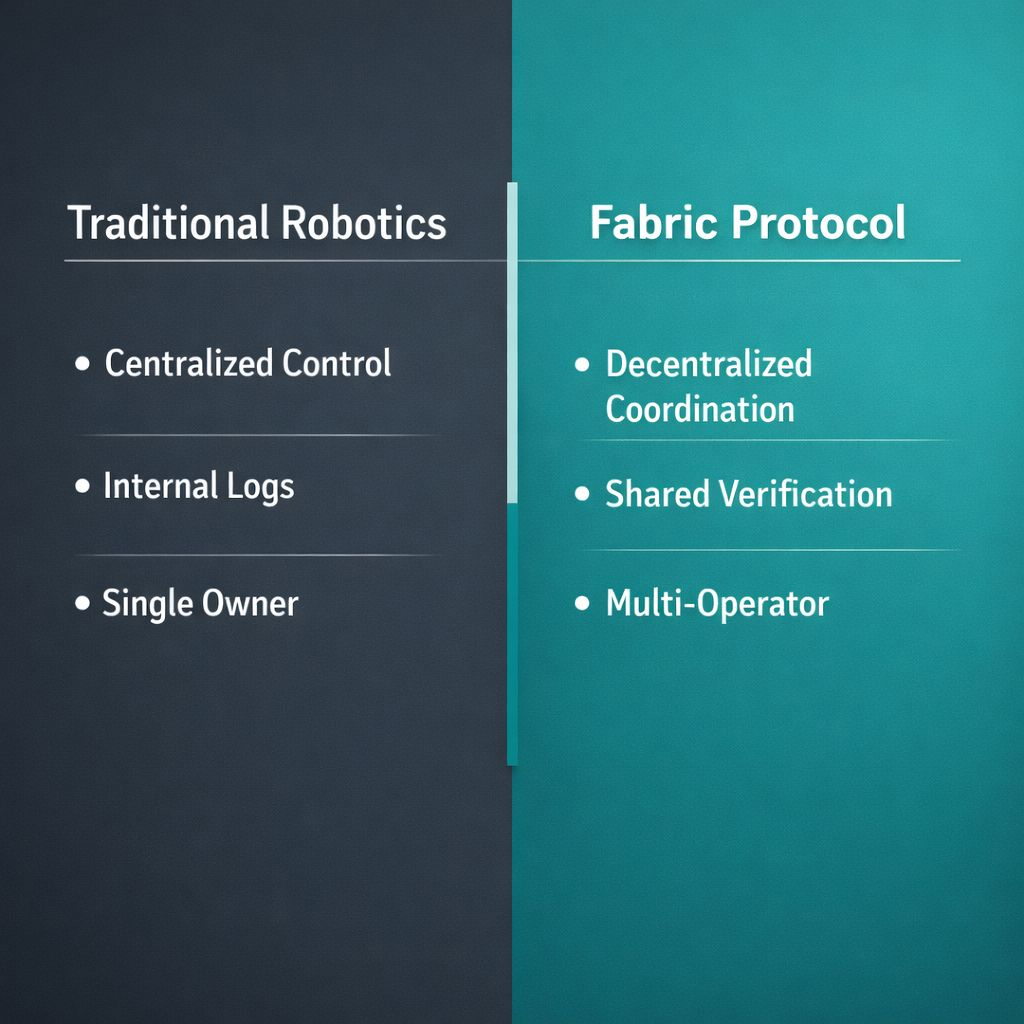
What keeps the idea compelling is the broader trajectory of robotics itself. Autonomous systems are slowly moving beyond single-owner environments. Logistics networks involve multiple operators.
Smart infrastructure projects rely on contractors deploying machines across shared spaces. As these systems interact more frequently, the question of how their actions are verified and coordinated becomes harder to ignore.
In that context, Fabric Protocol’s focus on developer participation feels less like a marketing phrase and more like a structural necessity.
Developers are the ones defining how robotic tasks are represented, verified, and settled within the network. Their decisions shape whether the infrastructure remains theoretical or becomes embedded in real operational systems.
Even so, infrastructure of this kind rarely proves itself quickly. Robotics ecosystems evolve slowly because reliability matters more than novelty.
Developers may experiment with decentralized coordination models for years before those models become routine parts of the technology stack.
For now, building on Fabric Protocol looks less like joining a finished platform and more like participating in an evolving infrastructure experiment.
Developers who engage with it are not simply creating applications; they are helping define how robotic systems might coordinate across organizations and environments that have historically relied on centralized oversight.
Whether that experiment ultimately reshapes robotics development or simply adds another layer of optional infrastructure is something that will likely reveal itself gradually, as more real-world systems attempt to integrate decentralized verification into the messy realities of physical machines.