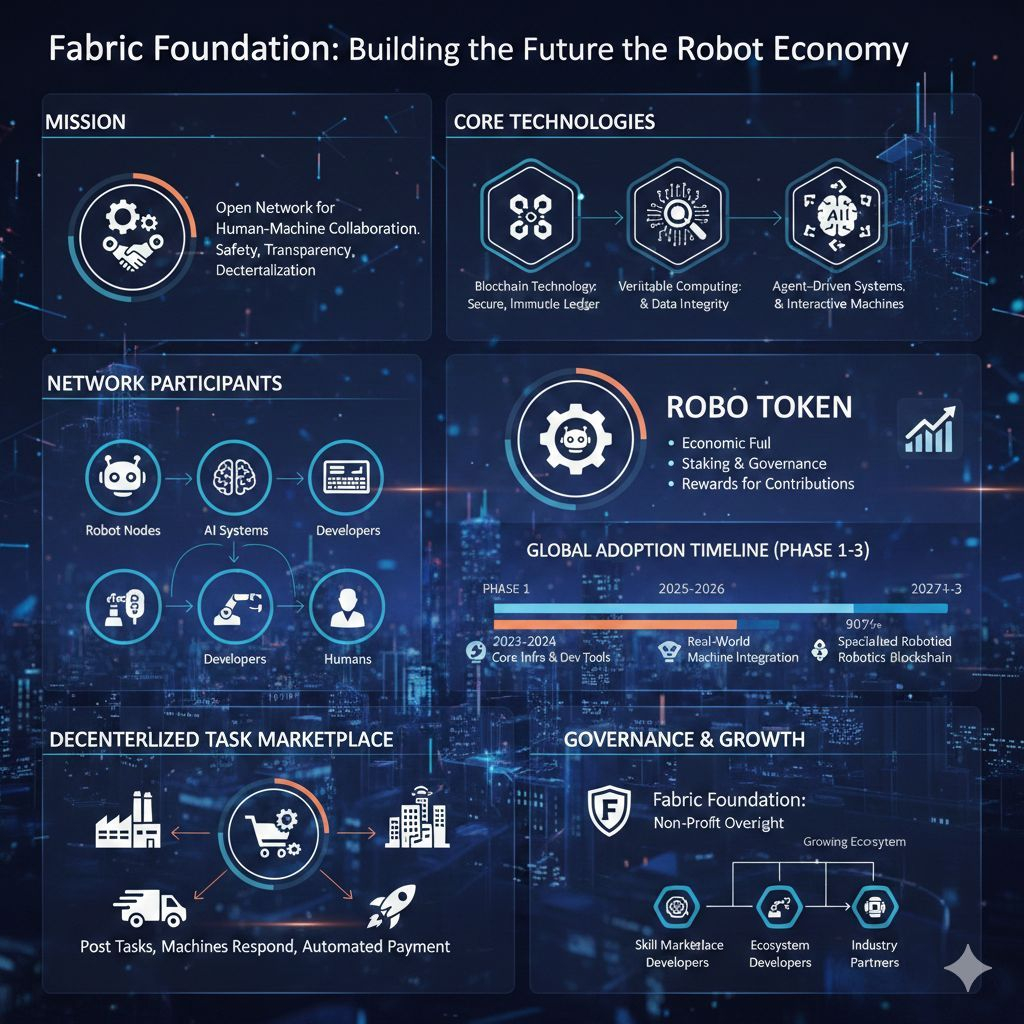
Technology is evolving faster than most people expected. Not long ago, robots were mostly found in science-fiction movies. Today they pack online orders, assist surgeons, inspect factories, and even deliver food. At the same time, artificial intelligence continues to advance, enabling machines to learn, adapt, and make decisions with increasing independence.
Yet despite these breakthroughs, something is still missing.
Many robots and AI systems exist in isolated environments. They are controlled by separate companies, run on closed platforms, and rarely communicate with one another. As a result, they struggle to share knowledge, prove their work, or participate in a truly global digital economy.
This is the challenge Fabric Protocol aims to solve.
Its vision is simple but powerful: create an open network where robots, artificial intelligence, and humans can collaborate safely and transparently. In this system, machines are no longer just tools operating in isolation — they become active participants in a connected ecosystem.
While this idea may sound futuristic, the world is already moving in that direction.
What Fabric Protocol Really Is
Fabric Protocol is an open global network designed to connect robots, AI systems, developers, and humans.
Rather than being a robotics company or an AI laboratory, Fabric acts as infrastructure — a digital foundation that allows intelligent machines to interact, cooperate, and exchange value. Think of it as the backbone for the emerging robot economy.
The network is supported by the Fabric Foundation, a nonprofit organization responsible for guiding the protocol’s development and ensuring it remains open and accessible.
At its core, Fabric Protocol combines several advanced technologies:
Blockchain infrastructure
Verifiable computing
Agent-driven systems
Together, these components allow machines to verify their actions, communicate with other systems, and operate within decentralized environments.
In simple terms, Fabric Protocol is attempting to build the nervous system for a future powered by intelligent machines.
Why This Idea Matters
Robots and artificial intelligence are becoming more capable every year. Machines can now perform tasks that once required human intelligence, from driving vehicles to analyzing medical data and managing complex manufacturing systems.
However, the systems that manage these machines remain limited.
Most robotics platforms operate within closed ecosystems controlled by individual companies. This makes collaboration difficult and restricts the flow of information.
Fabric Protocol introduces a different model — one based on openness and shared infrastructure.
Imagine a world where:
Robots from different industries can safely collaborate
Machines can verify and record the work they complete
Intelligent systems share knowledge and continuously improve
This is the future Fabric Protocol is working to create.
Giving Machines a Digital Identity
One of the most innovative ideas behind Fabric Protocol is the concept of machine identity.
Today, robots do not have a universal identity. They cannot independently prove who they are or verify the tasks they have completed.
Fabric changes this by giving machines a cryptographic identity on the network.
With this identity, a robot can:
Authenticate itself securely
Record the tasks it performs
Communicate with other machines
Receive rewards for completed work
In many ways, this transforms robots into digital participants within the network — not just tools, but contributors to an evolving system.
Building Trust in a World of Autonomous Machines
As machines become more autonomous, trust becomes increasingly important.
If robots are performing tasks without direct human oversight, the system must be able to confirm that the work actually took place.
Fabric Protocol addresses this through verifiable computing. When a robot completes a task, it generates proof that can be validated by the network.
For example, if a robot inspects equipment in a factory, the inspection data can be recorded and verified through the system. This creates a transparent and reliable record of activity.
Instead of relying on centralized oversight, trust becomes embedded directly into the network itself.
A Marketplace for Machine Work
Fabric Protocol also introduces the idea of a decentralized task marketplace.
In this system, tasks can be posted to the network, and machines capable of completing them can respond.
For instance:
A warehouse might need inventory sorted
A logistics company might need deliveries completed
A factory might require inspections or maintenance
Robots with the right capabilities can take on these tasks. Once the work is completed and verified, payment is automatically released.
This creates a new economic model where machines can directly participate in productive activity.
While it may sound futuristic, the early foundations of such systems are already emerging.
The Role of the ROBO Token
Like most decentralized networks, Fabric Protocol uses a token to coordinate value across the ecosystem.
In this case, that token is ROBO.
ROBO functions as the economic engine of the network. Participants use it to interact with the protocol, support operations, and reward contributions.
It can be used for:
Network transactions
Staking and security
Governance decisions
Incentives for developers and machine operators
Robots that complete tasks can earn tokens, while developers building new tools or robotic capabilities can also receive rewards. Token holders may also participate in governance, helping shape the future direction of the network.
The goal is to create an ecosystem where incentives encourage collaboration, innovation, and growth.
A Growing Ecosystem
Fabric Protocol is designed to support a wide range of participants.
Robot nodes represent the machines connected to the network. These machines perform tasks and contribute valuable data.
Developers play another important role by building software modules and robotic skills that expand what machines can do.
A skill marketplace allows new capabilities to spread across the network. If someone creates a useful robotic function, it can be shared and used by compatible machines worldwide.
This structure encourages innovation because builders from anywhere in the world can contribute to the ecosystem.
Over time, the network could grow into a rich environment of machines, developers, and organizations working together.
The Road Ahead
Fabric Protocol is still in its early stages, but its long-term vision is ambitious.
The first phase focuses on building core infrastructure and providing tools for developers.
Next comes the integration of real machines, testing how robots can coordinate tasks within the network.
Eventually, the project aims to develop a specialized blockchain designed specifically for robotics operations.
If successful, the network could one day support millions of machines interacting across industries and borders — forming a global machine economy.
The Challenges Ahead
A vision this ambitious comes with significant challenges.
Connecting robotics with blockchain infrastructure is complex. Systems must be reliable enough for real-world operations while maintaining security and decentralization.
Adoption is another critical factor. For Fabric Protocol to succeed, companies and developers must choose to build within its ecosystem.
Regulation may also play a role as governments continue developing policies for artificial intelligence and autonomous machines.
While these challenges are real, they are also part of building something entirely new.
A Glimpse Into the Future
The idea behind Fabric Protocol goes beyond technology. It represents a future where humans and machines collaborate in ways we are only beginning to imagine.
Robots are not replacing human creativity or intelligence. Instead, they are expanding what humanity can achieve.
An open network that allows machines to work together responsibly could unlock enormous possibilities:
More efficient factories
Smarter cities
Safer handling of dangerous jobs
Faster innovation across industries
Fabric Protocol remains an experiment, but it is a bold step toward that future — a future where technology connects systems instead of isolating them.
And where humans and machines move forward together.
#ROBO #RobotEconomy #AI #FabricProtocol