1. Opening (Hook with Insight, Not Hype)
Over the past few years, I’ve noticed something subtle in crypto. The loudest projects tend to orbit liquidity and speed, while the quieter ones wrestle with responsibility. In easier cycles, speed wins. In tighter cycles, responsibility starts to matter more.
We’re in one of those transitions now. Capital isn’t chasing every narrative. Builders are more selective. And the conversation has shifted from “what can we launch?” to “what can we maintain?” That shift feels especially relevant as AI systems move from generating text and images to coordinating tasks, managing operations, and interacting with physical environments.
When intelligence leaves the screen and starts influencing machines, governance stops being abstract. It becomes practical. Who is accountable when something fails? Who sets the rules? Who can audit the behavior of systems that act on their own?
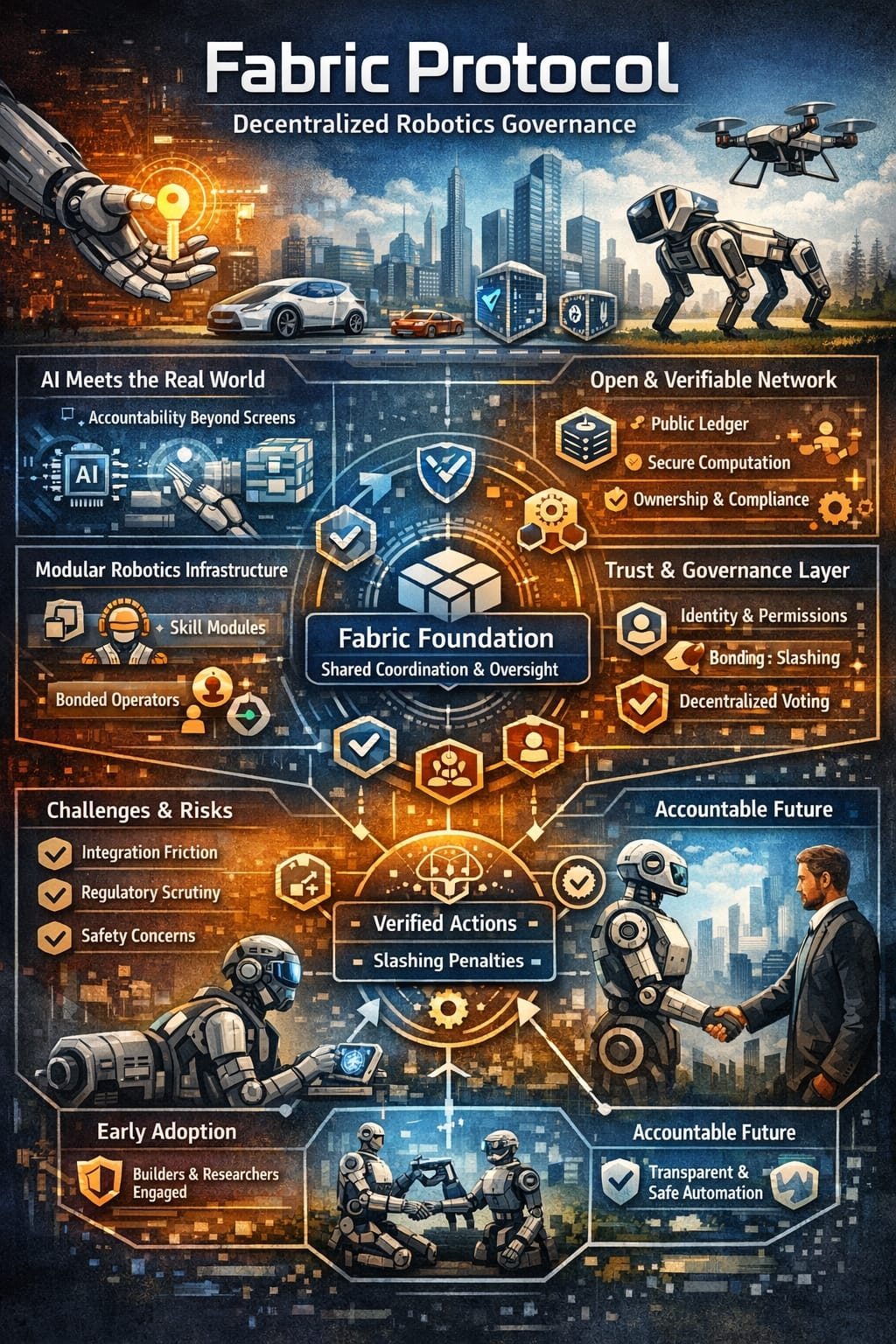
Fabric Protocol, supported by the Fabric Foundation, lives inside that question. It doesn’t feel like a bet on hype. It feels more like an attempt to build the responsibility layer for a world where robots and AI agents are no longer experimental.
2. The Core Thesis
Fabric’s core idea is grounded: if general-purpose robots are going to operate in open environments, there needs to be a shared infrastructure that makes their behavior legible and their incentives enforceable.
Today, most robotics systems are vertically integrated. Hardware, software, updates, and data are controlled by a single company. That works in early stages, but it concentrates power and obscures accountability. If something goes wrong, the public relies on internal reports, not shared verification. And as robots become more capable, that opacity becomes harder to justify.
Fabric proposes a different structure. Instead of treating robots as isolated products, it frames them as participants in a network. Data, computation, and governance are coordinated through a public ledger. Operators bond capital. Actions can be verified. Governance rules are transparent rather than implied.
Why now matters is less about technological novelty and more about timing. AI systems are improving quickly, but the guardrails around them are fragmented. Regulatory conversations are accelerating. Open-source robotics tools are lowering barriers to entry. That combination creates a window where coordination standards can still be shaped.
What differentiates Fabric is that it doesn’t approach robotics purely as hardware or purely as AI. It approaches it as a coordination problem. And coordination, at scale, is something blockchains have spent a decade experimenting with.
3. Architecture & Design
Fabric’s architecture is modular by design. Instead of imagining a single monolithic robot stack, the protocol introduces the idea of composable capabilities. Skills can be added or removed. Modules can evolve independently. That framing feels closer to how software ecosystems grow than how traditional robotics has been structured.
On the blockchain side, Fabric takes a pragmatic route. Early components can live on established EVM-compatible chains. Over time, a specialized Layer 1 tailored to machine coordination is part of the roadmap. That sequencing shows restraint. It avoids unnecessary reinvention while acknowledging that robotics coordination may eventually require infrastructure tuned for different performance and security needs.
The economic layer is where Fabric becomes more interesting. Instead of relying solely on staking for passive rewards, the design centers around bonding and slashing. Operators commit capital that can be penalized for fraud, poor performance, or malicious behavior. Challengers are incentivized to detect issues. Governance uses time-based locking mechanisms to weight long-term alignment over short-term speculation.
These design choices don’t guarantee success, but they signal intent. Fabric is trying to price accountability, not just participation. That’s a harder problem.
In terms of ecosystem positioning, Fabric doesn’t present itself as a robotics manufacturer. It positions itself as coordination infrastructure. That distinction matters. It reduces direct competition with hardware companies and instead focuses on becoming a layer others can integrate with.
4. Market Positioning
Narratively, Fabric sits at the intersection of AI, DePIN, and governance infrastructure. But it doesn’t lean heavily into buzzwords. The framing is more structural than promotional.
In this cycle, infrastructure projects are judged differently. Markets are less forgiving of empty narratives. They look for evidence of real alignment between token design and network function. Fabric’s emphasis on bonding, governance, and modular growth fits the current appetite for substance over spectacle.
Compared to other decentralized physical infrastructure networks, Fabric’s focus on responsibility is its distinguishing feature. Many networks coordinate resources—storage, compute, bandwidth. Fabric aims to coordinate behavior. That’s a narrower but deeper niche.
Risks are real. Robotics is slow, complex, and capital-intensive. Integrating blockchain-based verification into physical systems introduces friction. Governance decisions in machine coordination could face regulatory scrutiny. And the network effect challenge is significant: coordination layers only become meaningful when credible participants adopt them.
There’s also the practical tension between decentralization and safety. In robotics, quick intervention can matter. Balancing distributed governance with operational responsiveness will test the model.
Balanced analysis here is essential. Fabric’s ambition is broad. Execution will determine whether it becomes infrastructure or remains an experiment.
5. Real-World Signal
Early signals are less about headlines and more about structure.
The token design allocates meaningful portions toward ecosystem growth and long-term development, with vesting schedules that extend over multiple years. That suggests a longer time horizon rather than short-cycle extraction. Liquidity provisioning and exchange access provide surface-level visibility, but what matters more is who builds.
The whitepaper’s attention to slashing conditions, validator incentives, and governance weighting indicates a deliberate attempt to align economics with behavior. These details are not marketing-friendly, but they are foundational.
Community quality is still forming. The real indicator will be whether robotics engineers, safety researchers, and standards-focused builders engage meaningfully. If discussion centers only on price, the thesis weakens. If it centers on coordination, policy, and implementation, the foundation strengthens.
Liquidity flows matter, but they’re secondary. Fabric’s credibility will depend more on developer adoption and institutional conversations than short-term trading volume.
6. Forward Outlook
For Fabric to justify attention over the next few years, several things must happen.
First, the protocol needs to demonstrate that verifiable coordination can be implemented without crippling usability. If bonding and governance introduce too much friction, participants may default to centralized alternatives.
Second, it must attract early integrators willing to experiment publicly. Standards are rarely adopted because they are perfect; they are adopted because credible actors choose to align around them.
Third, governance must remain credible under stress. When incidents occur—and they will—the response mechanism will reveal whether the system is symbolic or functional.
Invalidation scenarios are clear. If robotics remains predominantly closed and vertically integrated, open coordination layers may struggle for relevance. If regulatory constraints make decentralized oversight impractical, the design could be forced into compromise.
Still, Fabric is attempting something that feels necessary. If machines are going to operate with increasing autonomy, society will eventually demand transparency and accountability that extend beyond corporate disclosures. Building that infrastructure early is difficult and often underappreciated.
Fabric Foundation’s work sits in that quieter category of crypto: not optimized for immediate excitement, but structured around a longer horizon. In a market that is slowly rediscovering the value of durable infrastructure, that approach feels aligned with the direction of travel.
It’s not a guaranteed success. But it is a serious attempt to address a problem that will only become more visible with time.
#ROBO @Fabric Foundation $ROBO