The convergence of Artificial Intelligence (AI) and Robotics promises a future where autonomous machines perform complex tasks—from manufacturing and logistics to personalized healthcare. However, a major hurdle remains: the lack of a standardized, secure, and decentralized infrastructure for coordination.
Fabric Foundation addresses this challenge by introducing a specialized coordination layer designed to enable seamless, trusted interaction between AI models and physical robotic systems. This article explores the core components and the transformative potential of the Fabric Protocol.
The Challenge of Modern Robotics
Currently, robotics development relies heavily on siloed, proprietary systems. A robot built by one manufacturer typically cannot "talk" to or learn from a machine built by another. Furthermore, the sensitive data these machines use raises serious privacy and security concerns. Deploying AI at the "edge" (directly within the machine) adds complexity, requiring secure identity management and robust verification.
A standard internet connection isn't enough. We need a mechanism for decentralized data exchange and secure identity verification—a true machine-to-machine (M2M) economy.
Traditional Siloed Systems vs. Decentralized Coordination
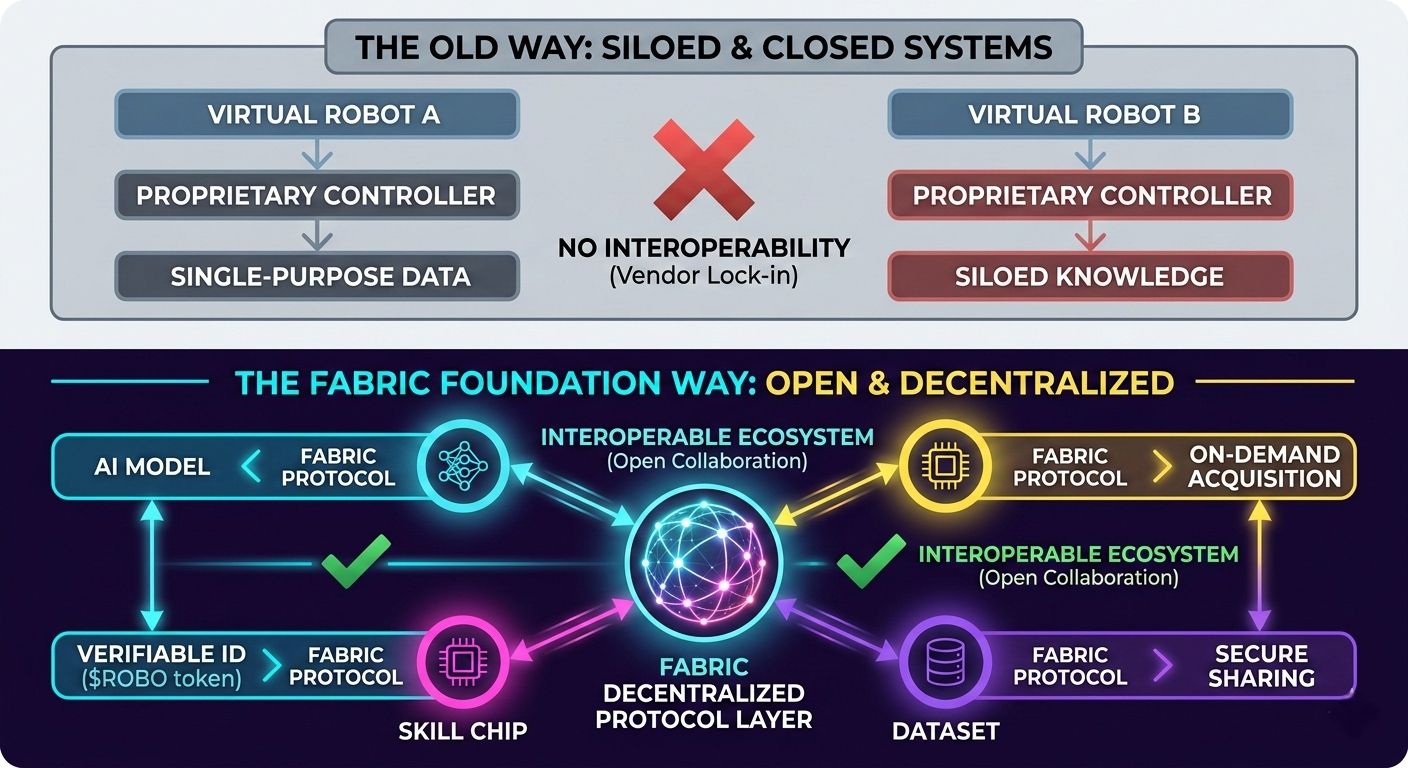
As shown in the diagram, the Fabric Protocol creates a unified layer where any robot, AI model, or data source can connect securely. This enables "Skill Chips," where a robot can dynamically acquire new capabilities, such as advanced navigation or specialized manipulation skills, all verified on-chain.
The Fabric Protocol: A Decentralized Operating Layer
Fabric Foundation isn’t building the physical robots; it’s constructing the underlying digital architecture. This protocol serves three critical functions:
Verifiable Identity (VID): Every participating entity—whether a robot, an AI model, or a data source—receives a unique, blockchain-based identity via the $ROBO token ecosystem.
Modular Skill Chips: These are digital assets representing specific capabilities. They can be traded or rented on an open marketplace, allowing operators to upgrade machines instantly.
Secure Coordination: The protocol manages complex interactions, such as multi-agent swarm coordination, using cryptographic proofs to ensure integrity and privacy.
Conclusion
The Age of Robotics and AI requires a new infrastructure to thrive. We cannot build a truly autonomous world on the fragmented systems of the past. Fabric Foundation is providing that missing link—the coordination and marketplace layer that allows intelligent machines to cooperate securely. As this ecosystem matures, it will redefine the nature of industry and human-machine collaboration.