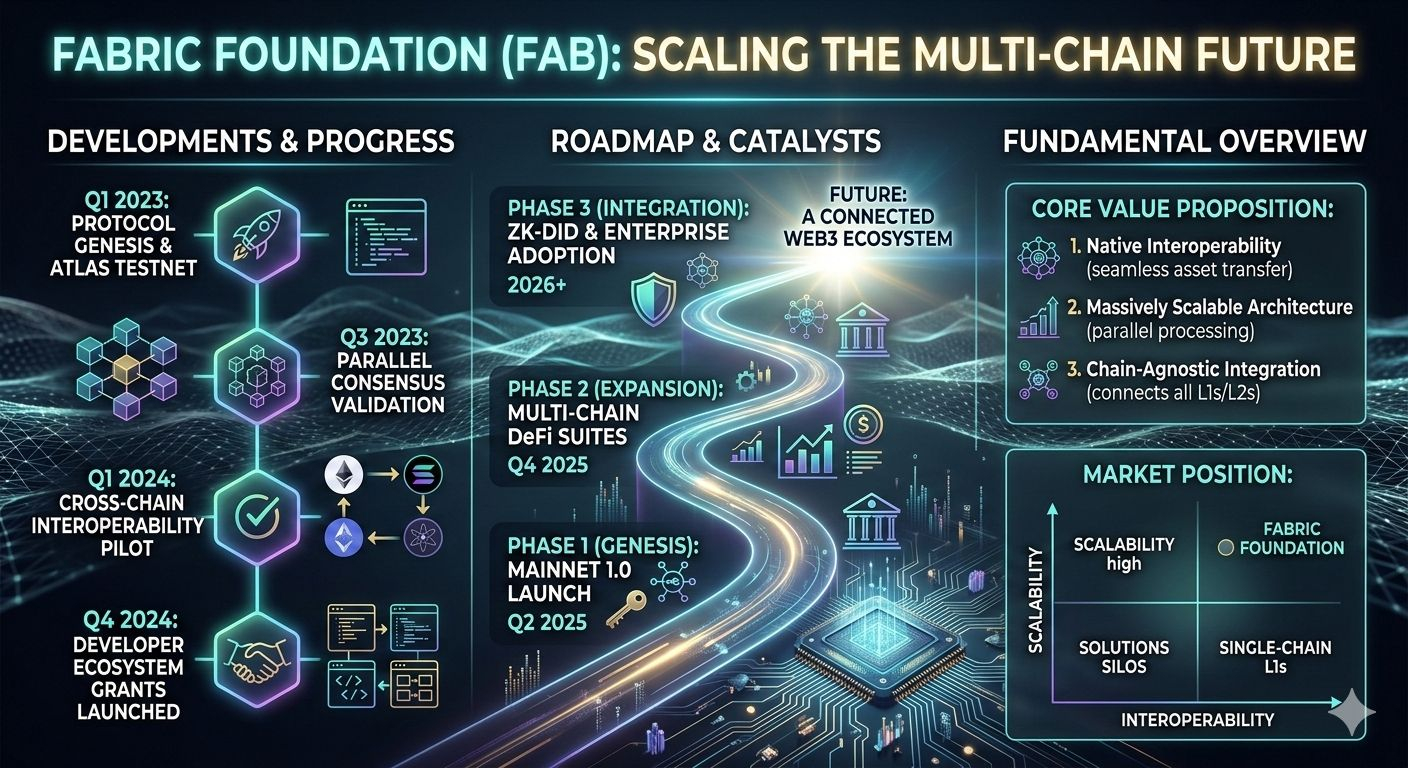
$ROBO @Fabric Foundation (FAB) is not just another blockchain; it positions itself as a specialized protocol designed to solve the scalability and interoperability bottlenecks inherent in current layer-1 blockchains, particularly those processing complex data and high-frequency transactions. Its fundamental value proposition is that of a "multi-chain protocol designed to connect every blockchain, regardless of their native architecture, via a highly scalable, parallel-processing layer."
Unlike general-purpose blockchains that aim to do everything, Fabric is fundamentally an infrastructure play. It uses a unique "sharding-of-shards" architecture to parallelize transaction processing, potentially allowing it to achieve a scale that single-chain systems cannot match, specifically targeting high-throughput sectors like decentralized finance (DeFi), gaming (GameFi), and data-heavy enterprise applications.
Market Demand and Position:
The demand for what Fabric offers is undeniable. As the Web3 ecosystem grows, the cost of transactions and the slowness of settlement on networks like Ethereum have become critical friction points. Many "Layer 2" solutions exist, but they are often silos themselves, limited to a single ecosystem (e.g., L2s for Ethereum). Fabric’s multi-chain, interoperable design positions it as a potential "internet of blockchains," connecting different L2s, sidechains, and alternative L1s into a cohesive network.
This positioning is high-risk but high-reward. If successful, Fabric becomes a vital utility, a fundamental layer for cross-chain value transfer.
Key Technology and Competitive Edge:
Fabric’s technological edge centers on its unique architecture:
Massive Parallel Processing: The core innovation is its parallel consensus mechanism, which allows multiple transactions to be validated simultaneously. This is a crucial step beyond sequential processing.
Native Interoperability: Unlike wrapped tokens or complex bridges, Fabric aims to provide direct, native cross-chain communication, reducing security risks associated with traditional bridging solutions.
Agnostic Integration: Fabric is designed to be chain-agnostic, meaning it can facilitate communication and data flow between EVM-compatible chains (like Ethereum) and non-EVM chains (like Solana or Cosmos). This breadth is a strong competitive differentiator.
Developments and Traction (Highlights):
Fabric is still relatively early in its lifecycle, but its progress has been consistent:
Testnet Validation: The launch of their "Atlas" testnet demonstrated early-stage capabilities for parallel transaction processing and cross-chain messaging, achieving impressive transactions-per-second (TPS) metrics in controlled environments.
Partnerships and Ecosystem Growth: Fabric has secured strategic partnerships with several emerging L1 and L2 protocols, as well as liquidity providers. These partnerships are critical for generating initial utility and proving the interoperability use case. The formation of the Fabric Grants Program has also encouraged developer activity and the creation of early dApps.
Governance Model: The introduction of the $FAB token as not just a utility token for fees but also a governance token allows the community to direct the development of the protocol, a vital step for a decentralized foundation.
Roadmap and Future Catalyst:
The future of Fabric hinges on the successful execution of its mainnet roadmap. Key upcoming milestones include:
Mainnet 1.0 (Phase: Genesis): The critical transition from testnet to mainnet, focusing on security, stability, and the first live cross-chain transactions. This will be the true test of the parallel consensus model.
Cross-Chain DeFi Suites: The development of native DeFi tools and interfaces on top of Fabric that allow users to, for example, yield farm across different blockchains through a single interface, utilizing Fabric’s native interoperability.
Developer SDK Enhancements: Simplifying the process for new projects to integrate with Fabric, lowering the barrier to entry for ecosystem expansion.
Decentralized Identity (DID) Integration: Later stages of the roadmap focus on privacy and identity, incorporating ZK-proofs (zero-knowledge proofs) to provide identity verification across integrated chains without exposing sensitive data. This expands Fabric's utility into the broader Web3 and enterprise sectors.
Conclusion and Outlook:
Fabric Foundation represents an ambitious, technical solution to a fundamental problem facing the blockchain industry. Its potential value is tied directly to the growth of the multi-chain ecosystem and the need for scalable interoperability.
The risks are execution and competition. Delivering a complex parallel processing system on a live mainnet is exceptionally difficult, and other interoperability protocols are also competing for market share. However, if Fabric can execute on its roadmap and continue building a strong ecosystem of integrated chains, its native interoperability and scaling capabilities could make it a cornerstone of the future Web3 infrastructure. Its position as a foundational layer, rather than an end-user dApp, gives it a robust, long-term narrative for utility.