@Fogo Official It was 1:17 in the morning—fan clicking above my desk—when I found myself staring at the terminal, sending little test swaps and limit orders into Fogo and tracking the ping wobble. The numbers were fast, but not always consistent, and that gap is what keeps pulling me back—what does “fair execution” even mean when milliseconds decide outcomes?
Fogo is suddenly part of more trader conversations because its mainnet is live and it is explicitly built for latency-sensitive DeFi, including on-chain order books and real-time auctions. A new chain also reopens an old anxiety: who gets filled first once incentives turn real. Wormhole shipped as the ecosystem’s official bridge at launch, so capital can arrive quickly, and so can the strategies that live off small timing edges.
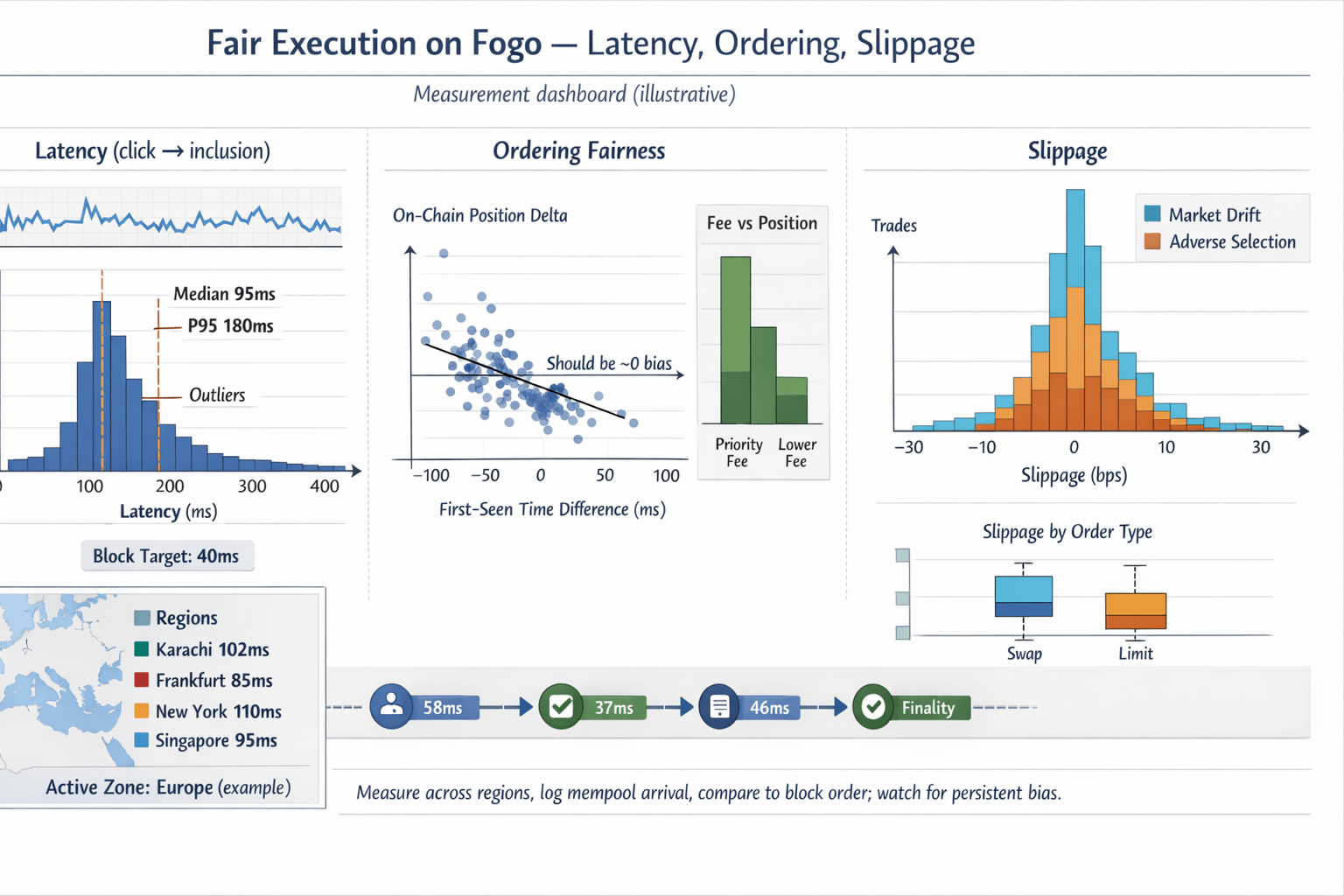
When I talk about “fair execution on chain,” I keep it concrete. I care about latency, ordering, and slippage. Latency is the time between my click and inclusion. Ordering is whether my transaction sits where it should among others that hit the network around the same moment. Slippage is the difference between the price I expected when I signed and the price I actually receive. Those three are linked; a small delay can become a big price move if ordering is manipulable.
Latency looks simple until I try to measure it honestly. Fogo’s testnet targets 40-millisecond blocks and uses short leader terms, with epochs that move consensus between zones. The architecture leans on multi-local consensus: validators co-locate inside geographic “zones” to cut network delay, then rotate zones across epochs to keep any single region from owning the whole story. Mainnet currently runs with a single active zone, which makes my physical location part of the experiment, not background noise. I time-stamp when I sign, when my RPC accepts the packet, when I see the signature in a block, and when I feel safe acting on it. The slow outliers matter most, because they are where liquidation bots and re-pricers live.
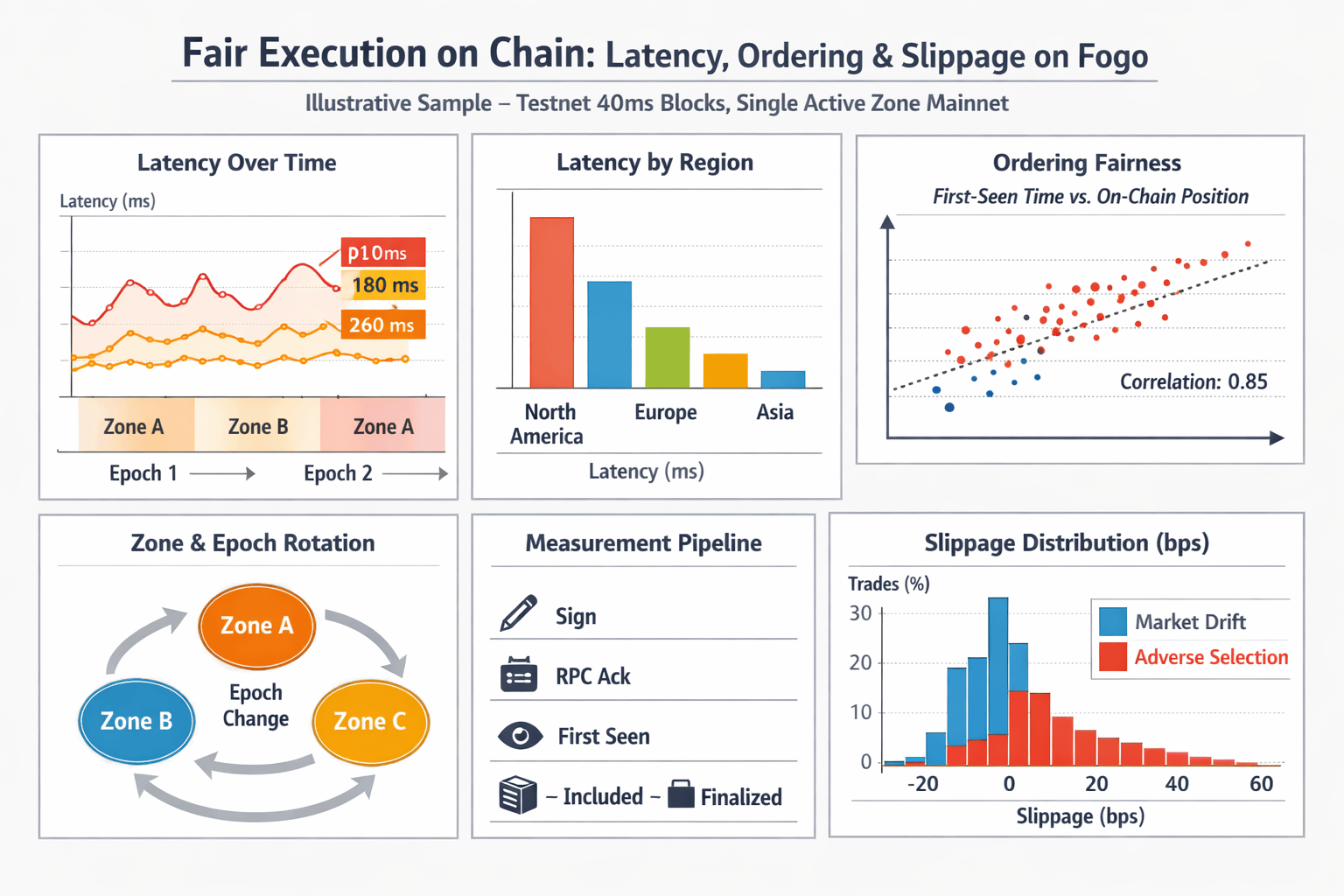
Zone design also changes how I think about “same rules for everyone.” When validators co-locate, traders with servers nearby can shave milliseconds off the path and sometimes win the tie. I don’t blame physics, but I want that advantage visible and measured.
Ordering is where “fairness” stops being philosophy and turns into money. Flashbots defines MEV as value extracted from reordering, inserting, or censoring transactions within a block, and that definition fits any chain that has someone deciding the sequence. Fogo’s design points toward reduced MEV extraction, and its curated validator model explicitly calls out “MEV abuse prevention,” including ejecting validators for harmful behavior. I can’t verify intent, but I can test outcomes. I run watchers in different regions, log when each one first sees a transaction, then compare those arrival times to the final on-chain order. If a pattern keeps favoring one path beyond what fee rules explain, I treat it as a signal.
Slippage is the part most people notice, and it is also the easiest to misread. Sometimes the market just moves. Sometimes I get sequenced into a worse price. I snapshot the best quote at signing time and again right before inclusion, then separate “market drift” from “adverse selection.” Faster blocks can shrink drift, but faster blocks also tighten competition, and competition rewards micro-advantages. That’s why Fogo’s focus on order books and precise timing appeals to me and worries me in equal measure: speed raises expectations for transparency.
I liked that Fogo’s public testnet launch in 2025 made performance a first-class discussion instead of a footnote. Now that mainnet is live, I’m watching for the harder proof: stable latency across geographies, ordering that matches disclosed rules, and slippage distributions that don’t hide a tax in the noise. I can live with tradeoffs. I just don’t want to relearn, one fill at a time, that “fast” and “fair” only line up when someone measures them.