
Crypto began with a promise of open finance, but the experience of trading on blockchain has often felt different from professional markets. Orders can take time. Execution may change. Network congestion can impact results. For traders and institutions, this gap has been one of the biggest barriers to moving serious capital fully on-chain.
Fogo emerged from this reality. It is a specialized Layer 1 blockchain built to support real time financial markets rather than general blockchain activity. The protocol runs on the Solana Virtual Machine and focuses on ultra low latency, predictable execution, and infrastructure designed specifically for trading applications.
The story of Fogo is not simply about faster transactions. It represents a broader shift in blockchain design where infrastructure is optimized for a specific economic function rather than trying to support every possible use case equally.
The protocol was created by contributors with trading and financial market experience who saw a persistent mismatch between decentralized infrastructure and professional trading requirements. Their goal was to replicate institutional execution standards while preserving the transparency and composability of decentralized systems.
On-chain trading faces several structural challenges that Fogo attempts to address. Latency remains a core problem because slow confirmation times can change trade outcomes. Execution fairness is another concern due to MEV and front running. Liquidity fragmentation and unpredictable settlement further complicate high frequency trading strategies. Fogo was built with these challenges as primary design constraints rather than secondary optimization targets.
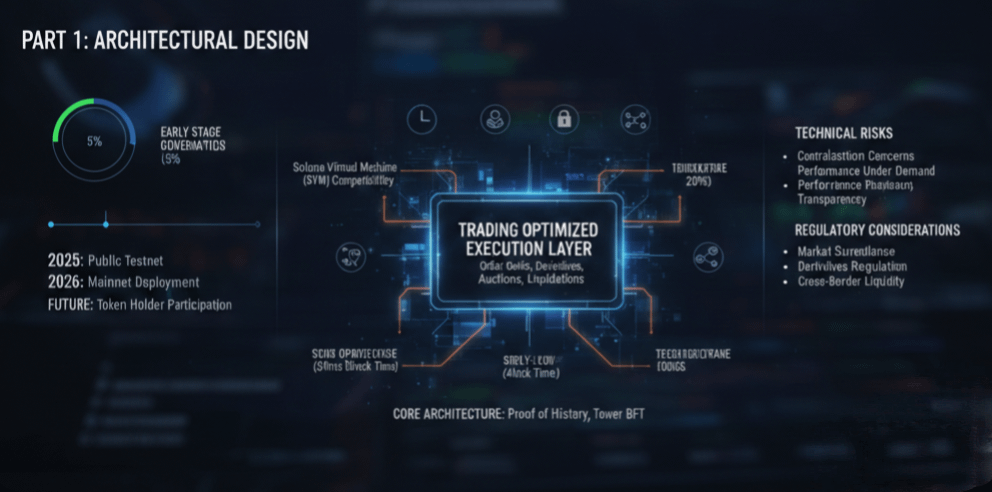
At the infrastructure level, Fogo relies on Solana Virtual Machine compatibility, which allows developers to deploy existing Solana applications and tooling without rewriting smart contracts. This compatibility lowers developer friction and accelerates ecosystem expansion while preserving performance benefits.
A major component of the architecture is a Firedancer based validator client optimized for parallel execution and efficient networking. This design enables block times near 40 milliseconds and sub second confirmation, creating an environment where transactions settle quickly and predictably.
The protocol also experiments with validator colocation near liquidity hubs and exchange infrastructure. This approach reduces physical network distance and improves deterministic execution timing, although it introduces decentralization trade offs that remain part of ongoing debate.
Fogo inherits core architectural elements from Solana including Proof of History time synchronization and Tower BFT consensus while modifying their implementation to prioritize performance consistency. This combination aims to deliver a trading optimized execution layer capable of supporting order books, derivatives markets, auctions, and liquidation sensitive applications.
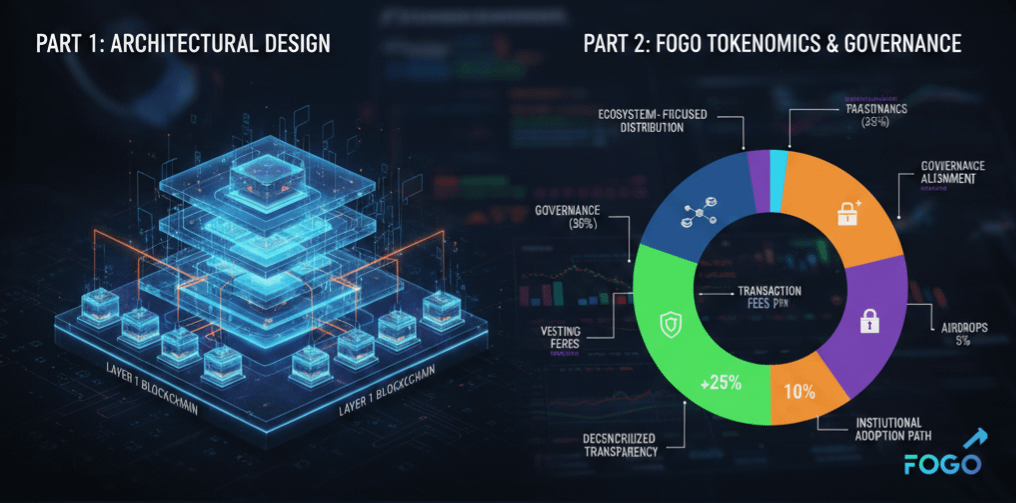
The FOGO token serves as the economic backbone of the network. It is used for transaction fees, staking participation, governance alignment, and ecosystem incentives designed to support long term growth. Community focused tokenomics emphasize airdrops and vesting structures rather than purely speculative distribution models.
Governance remains in an early stage. Public information about leadership and decision making processes is still evolving, and future development is expected to move toward token holder participation and validator coordination as the ecosystem matures. This area will be particularly important if institutional adoption increases.
Ecosystem activity around Fogo centers on trading and financial infrastructure. Developers are building on-chain order book exchanges, derivatives protocols, auction systems, and latency sensitive DeFi primitives that rely on predictable execution timing. Because the chain maintains SVM compatibility, migration from the Solana ecosystem can occur with minimal friction, supporting faster developer onboarding.
The project’s development timeline reflects a steady infrastructure first approach. After launching a public testnet in 2025 designed to demonstrate traditional finance level speed within DeFi, the protocol moved to mainnet deployment in January 2026 following extensive testing and transaction throughput validation.
Funding details remain partially undisclosed, although the protocol has attracted attention from institutional investors and market participants interested in high performance blockchain infrastructure. This quieter funding strategy suggests a focus on building foundational technology before aggressive market expansion.
Despite its ambitious design, Fogo faces several technical risks. Validator colocation may introduce centralization concerns. Maintaining extreme performance under heavy demand remains an open challenge. Limited transparency around team structure can affect institutional trust. Competition from other high speed Layer 1 networks adds additional pressure. These risks highlight the complexity of balancing performance, decentralization, and security.
Regulatory considerations also play a critical role because Fogo targets professional trading markets. Issues related to market surveillance, derivatives regulation, custody frameworks, cross border liquidity rules, and fair execution monitoring could shape the pace and direction of institutional adoption.
Looking ahead, the long term implications of Fogo extend beyond faster DeFi. If ultra low latency blockchains succeed, they could enable fully on-chain derivatives markets, tokenized traditional asset trading, decentralized prime brokerage infrastructure, and hybrid liquidity systems connecting traditional finance with decentralized ecosystems.
The broader narrative emerging from Fogo is one of specialization. Rather than positioning itself as a universal blockchain, the protocol focuses on becoming a dedicated execution layer for real time finance. This design philosophy reflects a maturation of the blockchain industry where infrastructure begins to mirror the functional specialization seen in traditional financial systems.
Ultimately, the significance of Fogo lies in its attempt to remove invisible friction that has historically limited decentralized trading. Speed is not the only objective. Predictability, fairness, and execution quality are equally important components of institutional grade markets.
If the protocol succeeds, it may help reshape how liquidity moves across global financial systems and redefine expectations for decentralized trading infrastructure. If it struggles, it will still contribute valuable insights into the trade offs required to build performance optimized blockchain networks.
The journey of Fogo represents an evolving experiment at the intersection of technology and financial market structure. It reflects a growing recognition that open finance must not only be transparent and accessible but also precise and reliable at scale. In that sense, Fogo is less a finished solution and more a step toward a future where decentralized markets feel as natural and responsive as the systems they aim to replace.
