
Here’s an uncomfortable thought:
Most chains are designed for when everything is going right.
Vanar feels like it’s designed for when things go wrong.
That distinction matters more than people realize.
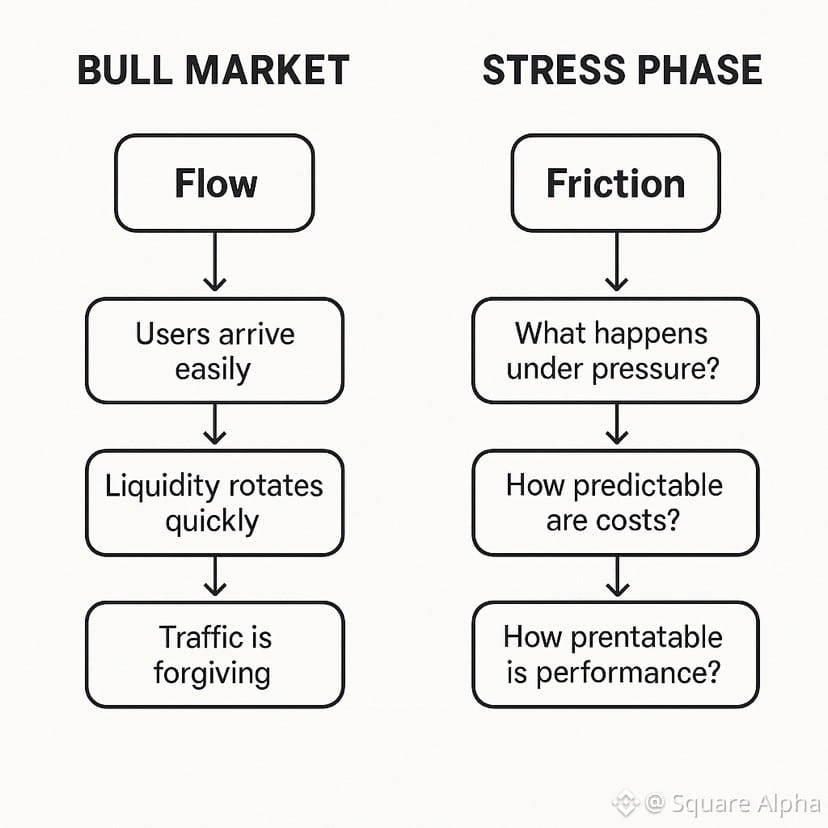
Bull markets create flow.
Users arrive easily. Liquidity rotates quickly. Traffic is forgiving.
But real infrastructure proves itself under friction — when load increases, when partners demand guarantees, when applications depend on stability instead of speculation.
That’s the environment Vanar appears to be preparing for.
Not the easy phase.
The stress phase.
Most retail analysis focuses on velocity:
How fast is it growing?
How loud is the narrative?
How quickly is capital moving?
Institutions ask different questions:
What happens under pressure?
What breaks first?
How predictable are costs?
How controllable is performance?
Vanar’s positioning around gaming ecosystems makes this even more critical.
Gaming isn’t tolerant.
If a DeFi app lags, users complain.
If a game lags, users leave.
And when users leave games, they don’t usually come back.
That’s why gaming infrastructure demands consistency over excitement.
And consistency rarely looks exciting on-chain.
Here’s the contrarian part:
If Vanar doesn’t dominate retail discourse right now, that might actually be alignment with its long-term target.
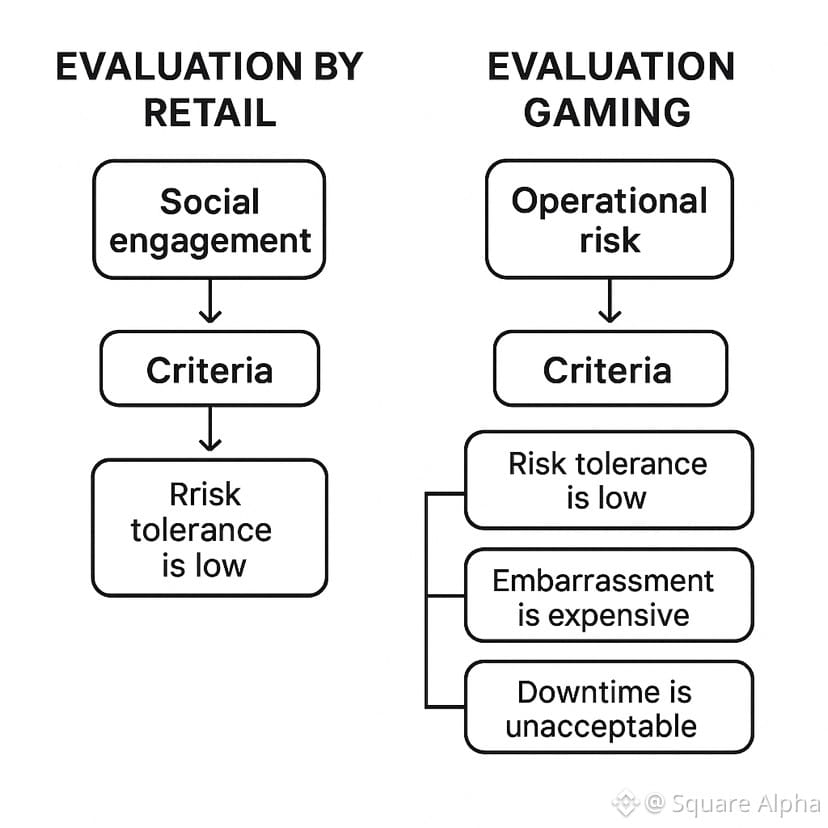
Because gaming studios and brands don’t evaluate chains based on social engagement.
They evaluate based on operational risk.
Risk tolerance in consumer-facing products is low.
Embarrassment is expensive.
Downtime is unacceptable.
If Vanar is quietly optimizing for controlled performance rather than explosive throughput marketing, it’s building a different kind of asset.
An asset that becomes harder to displace over time.
Another layer most people miss:
Once a gaming ecosystem integrates wallet flows, asset minting, and transaction rails into a specific chain architecture, switching costs become real.
Migration isn’t ideological.
It’s technical and economic.
That’s where durable value forms.
Not in attention spikes — in embedded infrastructure.
Right now, Vanar feels like it’s choosing embedded depth over surface growth.
That decision suppresses short-term enthusiasm.
But it increases long-term defensibility.
The market doesn’t reward defensibility until it’s tested.
And by the time it’s tested, repricing usually happens faster than accumulation.
I’m not saying Vanar is guaranteed to win.
I’m saying it’s playing a different game.
One optimized for friction.
And in infrastructure, the chains that survive friction don’t need to chase flow.
Flow eventually finds them.
