
In a joint interview, Quinn Campbell and YGG co-founder Gabby Dizon delved into how YGG's newly established publishing department can help game studios reach the player demographics in the Web3 space that have yet to be fully tapped by creating the games players truly want to play.
YGG's newly established publishing branch YGG Play aims to help third-party studios launch Web3 games targeting the global 'Casual Degens' audience, achieve commercialization, and scale. 'Casual Degens' refers to crypto-native players who value fun, social gameplay, and true digital ownership. Leveraging years of community-building experience, YGG Play offers end-to-end support from go-to-market strategies, token economics design, community building, to player retention, with a focus on providing a frictionless experience to meet the evolving needs of the Web3 gaming ecosystem.
The establishment of YGG Play reflects the goal of YGG co-founder Gabby Dizon to serve a large but underserved market. He believed early on that gaming is the entry point to Web3, which propelled YGG to rise as the preferred community partner for user introduction to the field. Today, YGG is positioning itself as the preferred publisher, dedicated to creating a new category that fills the gap between crypto-native mechanics and mass market playability.
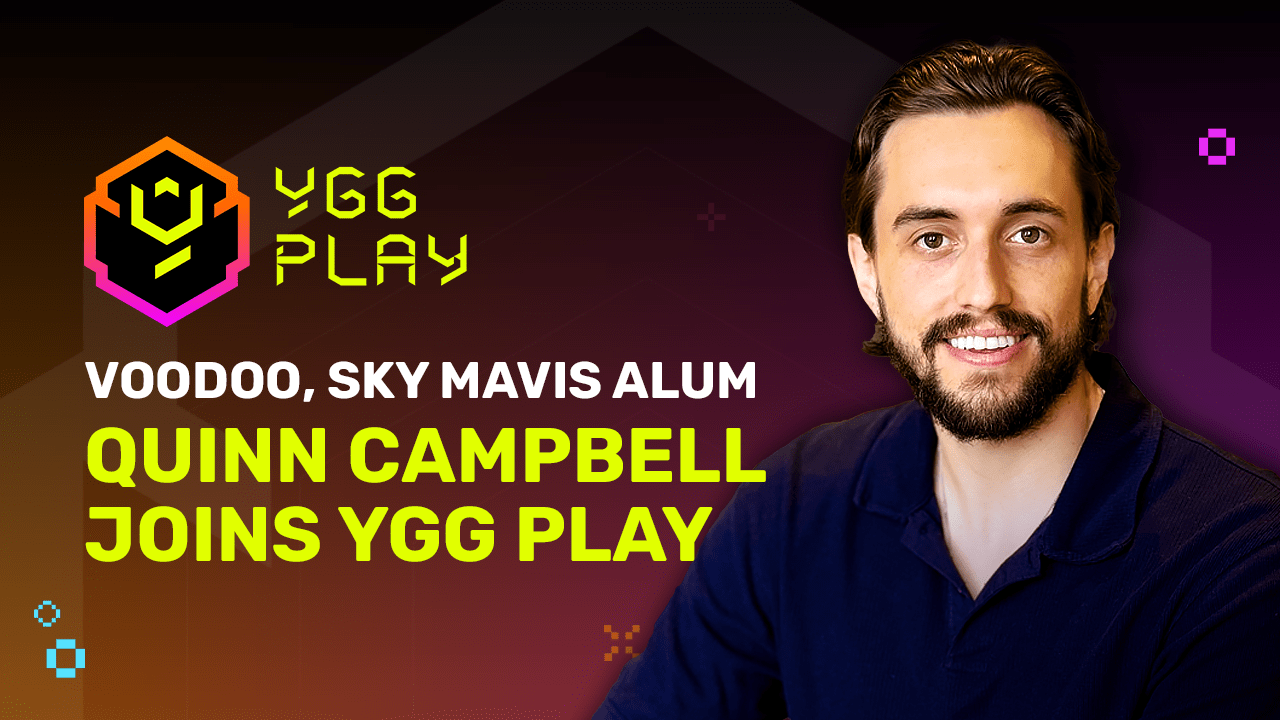
To support the strategy of YGG Play, YGG has hired former employees from Voodoo and Sky Mavis, Quinn Campbell, as a third-party publishing consultant. Quinn has a successful track record in both Web2 and Web3 gaming, and he will play a key role in making YGG Play the industry gold standard in the casual gaming space.
French mobile game publisher Voodoo is a pioneer of hyper-casual games, launching hits like (Helix Jump) and (Cube Surfer). During my time at Voodoo, Quinn helped the company discover and launch game products in a highly competitive mobile gaming market. The annual revenue of this mobile gaming giant grew from 1 million euros in 2016 to about 380 million euros by the end of 2020—Quinn joined the company in 2020 as a publishing manager.
In 2021, Quinn embarked on his Web3 gaming journey by joining Sky Mavis at the height of (Axie Infinity). He was the first employee in the growth department of Sky Mavis, working closely with Chief Growth Officer Jeffrey “Jihoz” Zirlin to release the first six third-party games on the Ronin chain. By the time Quinn left Sky Mavis, the department had expanded from 2 to over 30 people.
In the following interview, Gabby and Quinn shared why they view the 'Casual Degen' category as the sleeping giant in the Web3 gaming space, why they believe the success of (LOL Land) can be replicated, and the efforts YGG is making to lead the next metaverse.
Why does YGG choose this moment to venture into game publishing?
Gabby: Before entering the crypto space, I had over 20 years of experience in game development, so returning to the game publishing field under the YGG banner feels like a full circle moment. Over the past few years, we’ve interacted with hundreds of Web3 games—playing these games, evaluating them, investing in them—and during this time we kept discovering a problem: a disconnect between the content the development teams are building and what crypto users actually want.
There are many users in the crypto space, and not everyone will identify themselves as gamers, but as long as the gaming experience is fun, light, and has short loops where each step brings rewards, many people are actually willing to give it a try. This audience is what we call 'Casual Degens'. We see a gap in the market: these users are ready to invest in games, but very few games meet their needs. They just want a fun and easy game that can integrate with their existing Web3 interactions.
We established YGG Play because Web3 games have yet to tap into their largest potential player base. With Quinn's addition, we are ready to grow the 'Casual Degen' category and help game teams reach those players who have been waiting for games that truly understand them.
Quinn: For me, the most obvious reason is the success we've already achieved with (LOL Land). On one hand, we've pioneered a new genre of gaming. This is very exciting because the 'Casual Degen' category might be the second area I've seen in blockchain gaming where product-market fit is actually being realized. Since the Web3 gaming boom in 2021, many early theories have gradually faded away. 'Play-to-earn', 'earn by playing', 'play and own'—none of these models have stood the test of time. But what we see now in the 'Casual Degen' category is different. Its validity is unquestionable, and there are indeed real revenues and business models supporting it.
On the other hand, (LOL Land) has already driven demand for these types of games. With YGG's community infrastructure, we are also able to meet this demand. Therefore, we have cultivated a group of players who truly love 'Casual Degen' games, which is precisely why YGG is transforming into a publishing entity.
The key in the Web3 gaming space is to first have a demand for games, and then find the supply that meets that demand. The supply side is relatively easy to solve; the challenging part is the demand side. And we have successfully captured the demand through (LOL Land), which provides us with an excellent starting point.
'Most practitioners in the Web3 gaming space actually do not understand the publishing business. But this is not because they are unwilling to try; in fact, everyone wants to understand. For every studio, being able to publish their own game is like reaching Valhalla.' — Quinn Campbell
Looking at the current state of Web3 gaming development, what shortcomings still exist in game discovery and monetization? How does YGG plan to adopt different strategies to address this?
Gabby: We have seen various narratives dominating the industry to the point that we ultimately forgot the original promise of Web3 gaming—player-driven economic systems and open ecosystems. We once became overly obsessed with the 'fun first' narrative, neglecting the game mechanics that truly keep players engaged. Now, we want to refocus on those fundamentals.
YGG has already built a system to push games to targeted audiences. We hope to expand on this foundation to help games reach the right players and ensure that those players' investments are rewarded.
Quinn: I even think that the outcomes of past narratives have led to the fact that Web3 games are actually not as interesting as Web2 games. And for 'Casual Degen' games, we are returning to the mechanisms that make Web3 stand out. We want to publish more games that integrate token economics into their core loops, designing more systems that embed crypto features into the gaming experience. This is the biggest breakthrough that blockchain and crypto technology bring to the gaming industry.
Quinn, what lessons have you learned from your experiences at Sky Mavis and Voodoo that you will apply to the publishing of 'Casual Degen' games?
Quinn: Most practitioners in the Web3 gaming space actually do not understand the publishing business. But this is not because they are unwilling to try; in fact, everyone wants to understand. For every studio, being able to publish their own game is like reaching Valhalla.
I was fortunate to start my career in the game publishing department at Voodoo. An article on (Deconstructor of Fun) mentions that Voodoo tests about 2,000 game prototypes each year. When I was there, we tested about four times that number, and the number of rejections was also four times that. It was an extremely data-driven model. I think this model is crucial—and it actually aligns very well with the work we are doing at YGG, because the games we want to publish are very similar to the globally beloved hyper-casual games from Voodoo.
As for Sky Mavis, I was involved in the launch of the first six Ronin chain games there. That’s where I truly stepped into the Web3 gaming space. I spent nearly two years there starting from the early days of (Axie Infinity). All the knowledge I gained about Web3 game development and Web3 game growth comes from (Axie Infinity)—also from Jihoz, who might be the best in the field of Web3 game growth. I was the first person hired by Jihoz. Before I joined, the entire growth department consisted of just him. By the time I left, there were about 30 people in that department. That experience was like riding a rocket; I take immense pride in everything I accomplished while working there.
So, everything I've learned about publishing, business building, and working with studios to develop and publish games can now be put to use. It feels great.
'The real opportunity in Web3 gaming lies in the casual category. When a single round of a game takes only a few seconds, with low investment but high rewards, it can attract everyone.' — Gabby Dizon
In YGG's first third-party publishing collaborations, what types of games, developers, or even teams do you hope to work with?
Gabby: Currently, we are looking for Web3 game studios that have already developed products with short and easy-to-play core game loops.
Quinn: So, if someone comes to us with a 10-minute-long game loop, that's too long. You can play a round of (LOL Land) in about 30 seconds. It's like eating a mini Snickers, it's over quickly. We want to focus on studios that have developed such games. They are already thinking with a 'geek' mindset, viewing token economics as a core part of gameplay rather than an add-on.
For those studios that have not yet reached that level, we are also willing to lend a helping hand. We want developers to see the new monetization loops we have created.
What industry practices do you think YGG has the ability to drive or completely reshape?
Gabby: In the past few years, a major goal in the industry has been to create an AAA Web3 game that can enter the mainstream spotlight. We already have a few games that have become popular among Web3 players, but they haven’t garnered much attention from Web2 players.
The real opportunity in Web3 gaming lies in the casual category. When a single round of a game takes only a few seconds, with low investment but high rewards, it can attract everyone—whether they are gamers, crypto enthusiasts, or even moms who enjoy games like (Candy Crush).
Quinn: Right now, everyone is obsessed with battle passes and leaderboard rewards, so when we introduce them to the concept of 'Casual Degen', that's what they think of. This is the current mainstream trend. When people think of 'geek' mechanisms, they think of these. But this is a meta-game loop that lasts an entire season.
Every time we sit down with a studio and explain the differences, we can see the moment they realize it. Those studios that understand will come to us with fantastic interpretations of the 'Casual Degen' model, some of which we had never even thought of before.
What does success look like for the broader ecosystem of YGG?
Gabby: We are establishing 'Casual Degen' as a mainstream trend. We are building a platform that allows more games developed for crypto geeks to launch, reach target players, and build real communities around these games. If we achieve this goal, we can serve the crypto community well. And if we can do even better, we can open the door for a broader audience to try out Web3 games.
Quinn: First, we aim to quickly launch a series of exciting games this year. That means we plan to release 3 to 5 games by the end of the year, which is entirely achievable. Secondly, all these games need to have excellent key performance indicators (KPIs). Not just user engagement but also revenue. Finally, we want to really build YGG Play well so that we can handle the high demand for our services.
To achieve this, we must become the publishers of 'Casual Degen' games, leaving our mark on the Web3 gaming space through our 'Casual Degen' games. We will have significant influence in our work, able to conduct extensive experiments through the games we review and ultimately collaborate with, continuously refining our processes. This will be our Valhalla.