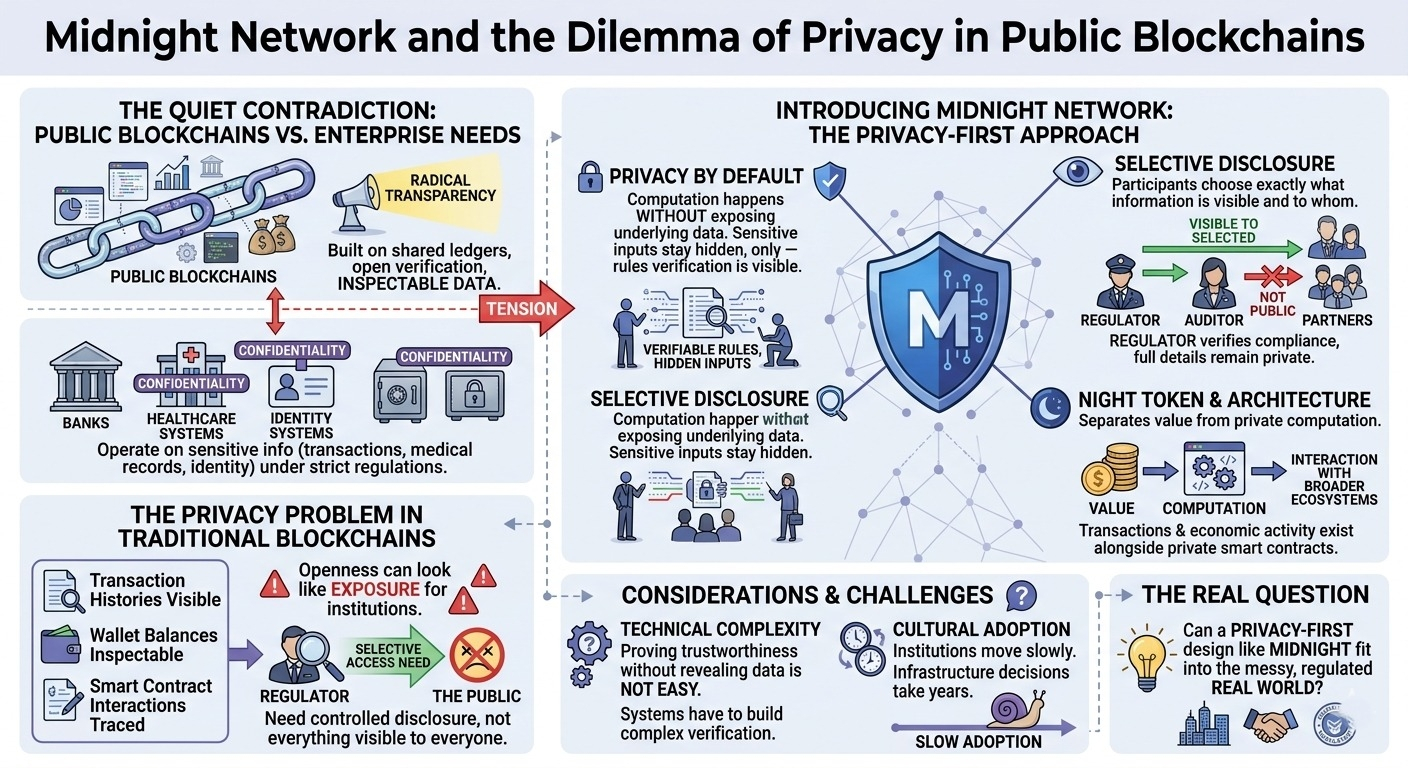
Every time the conversation turns to blockchains in the enterprise world, the same quiet contradiction tends to surface. Public blockchains were built on the idea of radical transparency — shared ledgers, open verification, and systems where anyone can inspect the data. In theory, that transparency is what removes the need for trust. But when you think about how real institutions operate, the idea starts to feel a little awkward.
Banks, for example, are built on layers of confidentiality. Financial institutions move enormous volumes of sensitive information every day: transactions, customer records, internal risk assessments. Healthcare systems are even more strict. Patient records, insurance data, and medical histories live under strict privacy regulations. Identity systems deal with some of the most delicate information of all.
None of these sectors function in an environment where everything is visible to everyone.
That’s where the tension begins.
Traditional public blockchains make transaction histories visible by default. Wallet balances can be inspected. Smart contract interactions can be traced. For open decentralized systems, this is part of the appeal. Transparency becomes the mechanism that keeps the system honest.
But for a bank or a healthcare network, that same openness can look less like innovation and more like exposure. Regulatory frameworks often require selective access to data — regulators might need visibility, while the public definitely should not. The problem is that most blockchains weren’t built with this kind of controlled disclosure in mind.
And honestly, that’s where things start to get complicated.
The promise of blockchain for enterprises has always sounded compelling: shared infrastructure, tamper-resistant records, automated contracts. But the reality is that very few institutions are willing to move sensitive operations onto a system where information could potentially be visible forever.
This is the gap that Midnight Network is trying to explore.
Rather than treating transparency as the default, Midnight approaches blockchain design from the opposite direction. Privacy comes first. The network focuses on privacy-preserving smart contracts that allow computation to happen without exposing the underlying data. In practice, that means sensitive inputs can remain hidden while still allowing the system to verify that rules were followed.
One of the core ideas behind Midnight is selective disclosure. Instead of revealing everything to everyone, participants can choose exactly what information becomes visible and to whom. A regulator might be able to verify compliance conditions, for example, without seeing the full details of every transaction.
When you think about it, this kind of design starts to resemble the way real institutions already operate. Information isn’t fully public or fully secret. It exists in layers.
Another interesting piece of the architecture is the role of the NIGHT token. In Midnight’s model, the token functions within a broader system that separates value from computation. Transactions and economic activity can exist alongside privacy-focused smart contracts without forcing all information into the open.
The separation sounds technical, but conceptually it’s pretty straightforward. Instead of mixing everything into a single transparent layer, Midnight attempts to allow private computation while still interacting with broader blockchain ecosystems.
Of course, none of this automatically solves the larger challenge of enterprise adoption. Privacy can help compliance in some ways — regulators often care more about verifiable rules than public visibility. But introducing privacy also introduces complexity. Systems have to prove they are trustworthy without revealing the underlying data, which isn’t always easy.
And there’s also the cultural side of the equation. Institutions move slowly. Infrastructure decisions can take years, sometimes decades. Even if privacy-first blockchains make sense technically, that doesn’t guarantee organizations will adopt them quickly.
Still, the question Midnight raises is an interesting one. For years the blockchain industry assumed transparency was the ultimate feature. But the reality of the world is messier than that. Most large systems operate somewhere between openness and confidentiality.
So the real question might not be whether privacy belongs in blockchain infrastructure. The more interesting question is whether a privacy-first design like Midnight can actually fit into the complicated, regulated, and very human systems that make up the real world.#night @MidnightNetwork $NIGHT