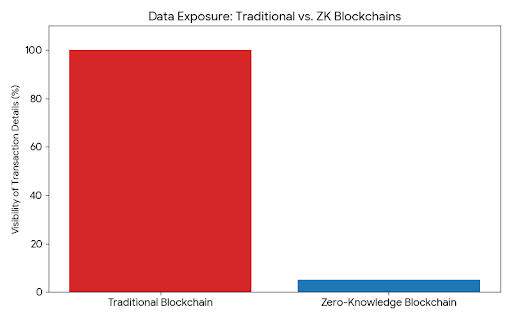
People like to talk about blockchain as if it already solved the problem of digital ownership. I don’t buy that. Not completely, anyway. Sure, the technology introduced a powerful idea: no central authority controlling the ledger. That was huge. But there’s a catch most people notice sooner or later. Blockchains, especially the early ones, are radically transparent. Everything sits there in the open. Transactions, addresses, flows of money. Anyone with enough patience can track it all.
That’s not exactly privacy.
In fact, if you think about it long enough, it starts to feel strange. A technology meant to give people control over their assets also exposes their financial behavior to anyone willing to analyze the chain. That tension has been sitting in the middle of the blockchain world for years. And honestly, it’s a massive hurdle.
This is where zero-knowledge proofs enter the story. Not as a trendy feature. More like a necessary correction.
At first the concept sounds almost ridiculous. Prove something without revealing the information behind it. That shouldn’t work. Yet mathematically it does. Cryptographers figured out a way for someone to demonstrate that a statement is true without exposing the data that proves it. So you can verify the claim, but you don’t see the underlying details.
Strange idea. Powerful idea.
Imagine walking into a bar and proving you’re over eighteen without showing your exact birth date. Or proving you can pay for something without revealing your entire bank balance. Same principle. The system confirms the rule was followed, but the private data stays hidden.
That simple shift changes everything about how blockchains can operate.
Traditional blockchains rely on transparency for trust. Everyone sees the data, so everyone can verify it. Zero-knowledge systems flip that logic a bit. Instead of publishing raw information, the network verifies cryptographic proofs. The proof says the transaction followed the rules. The network checks the math. If it holds up, the transaction is accepted.
No personal data required.
The more I think about it, the more this feels like the direction the whole industry has to move. Transparency alone just doesn’t scale socially. People expect privacy in normal life. They expect it with money, identity, medical data, all of it. Blockchains that ignore that reality will eventually hit a wall.
And some already have.
Look at financial activity on public chains today. Analysts can map entire networks of wallets. Companies specialize in tracking funds. Governments do it too. Now, there’s value in that transparency, especially when fighting fraud. But let’s be honest. It also means users lose a big chunk of their financial privacy.
Zero-knowledge technology tries to fix that.
Instead of revealing transaction details, the system proves that certain conditions were satisfied. For example: the sender owns the funds. The funds weren’t spent twice. The transaction follows the rules of the network. All of that can be confirmed without exposing amounts or identities.
It’s a cleaner model. At least in theory.
But theory is the easy part. Implementation is where things get messy.
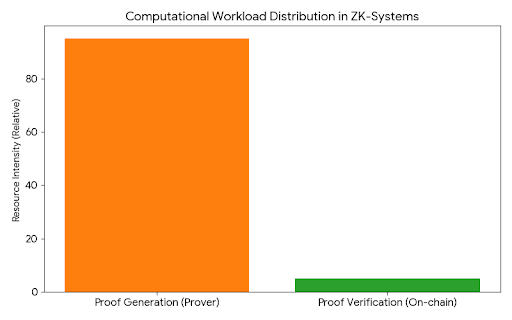
Generating zero-knowledge proofs is computationally heavy. Really heavy. Early systems took ridiculous amounts of time to produce proofs. Minutes. Sometimes longer. That’s obviously a problem if you want a global financial network running in real time.
Things have improved a lot. Better algorithms, better hardware, smarter architectures. But the workload didn’t disappear. It just moved around the system.
In many networks, specialized nodes handle proof generation. They crunch the math and submit compact proofs to the blockchain. The chain itself only verifies the proof, which is relatively fast. That’s how thousands of transactions can be validated with a tiny amount of on-chain computation.
Efficient. Elegant.
Still complicated.
And there’s another issue people don’t always talk about. If generating proofs becomes expensive, it risks centralization. Big operators with powerful hardware might dominate the proving process. That’s not what decentralization was supposed to look like.
So the economics matter. A lot.
Networks need incentive structures that reward provers without letting them take over the system. Easier said than done. Token rewards help, but they’re not a magic fix. Designing these systems is a constant balancing act.
Privacy itself also brings technical headaches.
When data is hidden, you lose some of the simple auditing tools that transparent systems rely on. Developers have to be extremely careful about side channels. Small details can leak information. Transaction timing. Network patterns. Even gas usage.
Sounds minor. It isn’t.
Those tiny signals can reveal more than people expect. So privacy-focused chains often standardize transaction formats or batch operations together to make patterns harder to detect. It’s extra work, but it’s necessary.
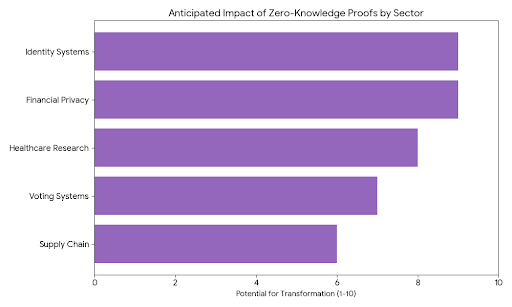
Identity systems are another area where zero-knowledge proofs could really shine.
Right now digital identity is a mess. Passwords everywhere. Verification documents scattered across dozens of platforms. Every service asks for personal data, and most of them store it indefinitely. That’s not just inconvenient. It’s risky.
A zero-knowledge identity model flips that structure.
Instead of sending raw documents, users hold their credentials privately and generate proofs about them. Need to prove you’re over eighteen? Generate a proof. Need to show you have a certain certification? Another proof.
No document uploads. No central databases collecting everything.
The user stays in control.
That idea connects closely with something called self-sovereign identity. The concept is simple: individuals own their credentials. Not corporations. Not governments. Systems verify the authenticity of those credentials without storing them.
It sounds ambitious. Maybe it is. But the pieces are slowly coming together.
Healthcare is another interesting example. Medical data is incredibly sensitive. At the same time, researchers need access to large datasets to develop treatments and understand diseases. That tension has slowed down collaboration for years.
Zero-knowledge proofs offer a potential workaround.
Researchers could run calculations on encrypted datasets while generating proofs that the analysis was done correctly. The results become verifiable without exposing patient records. It’s not a perfect solution, but it opens doors that traditional systems keep locked.
Voting systems are often mentioned in this conversation too. And for good reason.
Elections require both secrecy and trust. Voters must remain anonymous, but the results must be verifiable. That balance is difficult even with physical ballots. In digital environments it becomes even harder.
Zero-knowledge voting systems attempt to solve that. Each voter could prove eligibility and submit a ballot that is counted without revealing the choice they made. The system verifies everything mathematically.
But look, this isn’t a solved problem yet. Not even close. Security requirements are brutal, and usability has to be flawless. One mistake and public trust collapses.
So yeah. It’s a make-or-break challenge.
Governance also complicates things.
Privacy sounds great until regulators step in. Financial systems, for example, operate under strict laws related to money laundering and fraud. Completely opaque transactions can trigger serious concerns from governments.
Some networks try to compromise. They build systems where data is private by default but can be revealed under certain legal conditions. Maybe a court order unlocks access. Maybe oversight keys are distributed across multiple parties.
It’s a tricky balance.
Too much transparency and users lose privacy. Too much secrecy and regulators push back hard. Finding the middle ground is going to be one of the defining battles for blockchain in the next decade.
Developer tools are slowly catching up as well.
A few years ago building zero-knowledge applications required deep cryptography expertise. That limited innovation. Now we’re seeing programming frameworks that compile regular code into circuits suitable for proof systems. It’s still technical, but it’s getting more approachable.
That matters because ecosystems grow when developers can experiment freely.
But none of this matters if regular people can’t use the technology.
User experience remains one of the biggest challenges in crypto overall. Managing private keys already confuses newcomers. Adding cryptographic proofs into the mix could easily make things worse.
Good design will hide most of the complexity. Ideally users shouldn’t even notice the proofs being generated. They just perform an action, and the system quietly verifies it behind the scenes.
That’s the goal anyway.
Stepping back for a moment, it’s interesting how the internet got here. For years the dominant model was simple: collect as much user data as possible. Store it. Analyze it. Monetize it. That approach powered massive tech companies.
Zero-knowledge technology questions that entire assumption.
What if systems didn’t need the data in the first place?
What if they only needed proof that certain conditions were satisfied?
It’s a subtle shift. But it changes the economics of information.
Supply chains could verify product authenticity without revealing proprietary details. Universities could issue credentials that graduates prove anywhere without exposing personal records. Marketplaces could match buyers and sellers without exposing strategy or identity.
Proof instead of disclosure.
That idea keeps coming back.
Of course, we’re still early. The technology is evolving, standards are forming, and plenty of challenges remain. Scalability, governance, regulatory acceptance, user education. None of those problems disappear overnight.
But the direction feels clear.
Blockchains started as transparent ledgers. That worked for a while. Now the industry is realizing transparency alone isn’t enough. People want ownership, yes. But they also want privacy.
And honestly, that’s reasonable.
If zero-knowledge systems mature the way many expect, the phrase “private blockchain transactions” might stop sounding exotic. It might simply become the normal way digital systems operate.
Utility stays. Verification stays. Trust stays.
But the data?
That finally stays with the people who created it.
@MidnightNetwork #night $NIGHT