
@Fabric Foundation I was rereading Fabric’s white paper just after midnight while my laptop fan buzzed and a coffee ring dried beside the trackpad, because this topic has started to feel less abstract to me. If robots are moving toward real jobs and real payments, what actually keeps that world legible?
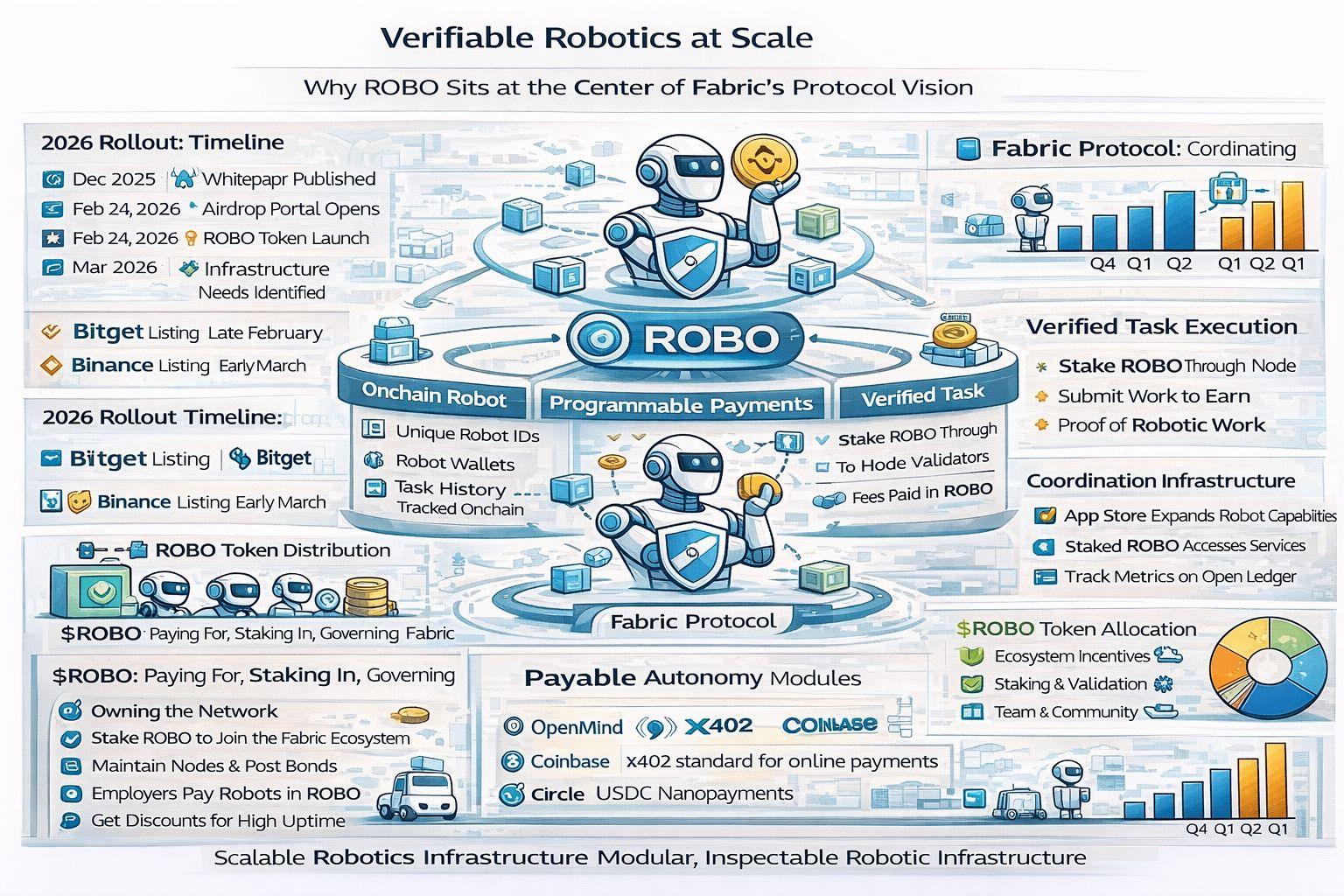
I think that question explains why ROBO sits so close to the center of Fabric’s protocol vision. Fabric does not present ROBO as a decorative asset attached to a robotics story. It places the token inside identity, verification, settlement, coordination, and access. In Fabric’s framing, robots need persistent identity, wallets, and transparent coordination before they can act as economic participants. ROBO is meant to pay network fees, support staking, and govern the system as it grows. That choice shifts the token from a side note into infrastructure, at least on paper.
I also think the subject is trending now for practical reasons. Fabric published its white paper in December 2025, opened a ROBO airdrop eligibility portal in February 2026, introduced ROBO publicly on February 24, and then followed with a March argument that the real bottleneck in robotics is coordination infrastructure rather than the robot alone. Around the same time, Bitget listed ROBO in late February and Binance listed it in early March. That sequence gave the project wider visibility and pulled more attention toward the bigger idea behind it.
What keeps my interest is that Fabric is trying to solve a familiar robotics problem, which is trust at scale. I have noticed that many robot demos look impressive until the conversation turns to accountability. Who verified the machine, who can inspect its history, how is it paid, and who gets rewarded when the system improves? Fabric’s answer is an onchain registry tied to programmable payments and contribution tracking. I While I may not agree with every element of that stack, I can see the rationale that holds it together.
I see the clearest progress when the idea stops sounding philosophical and starts looking operational. The white paper outlines a 2026 roadmap that starts with robot identity, task settlement, and structured data collection. From there, it expands into incentives tied to verified task completion and data submissions, wider app store participation, and a limited set of multi-robot workflows. It is still a roadmap, not evidence of mass adoption, but it is notably more concrete than vague promises. Fabric is also leaning on OpenMind technology. OpenMind’s BrainPack material describes a plug and play autonomy module for humanoids and quadrupeds, and coverage of its robot app store says the ecosystem includes more than 1,000 developers.
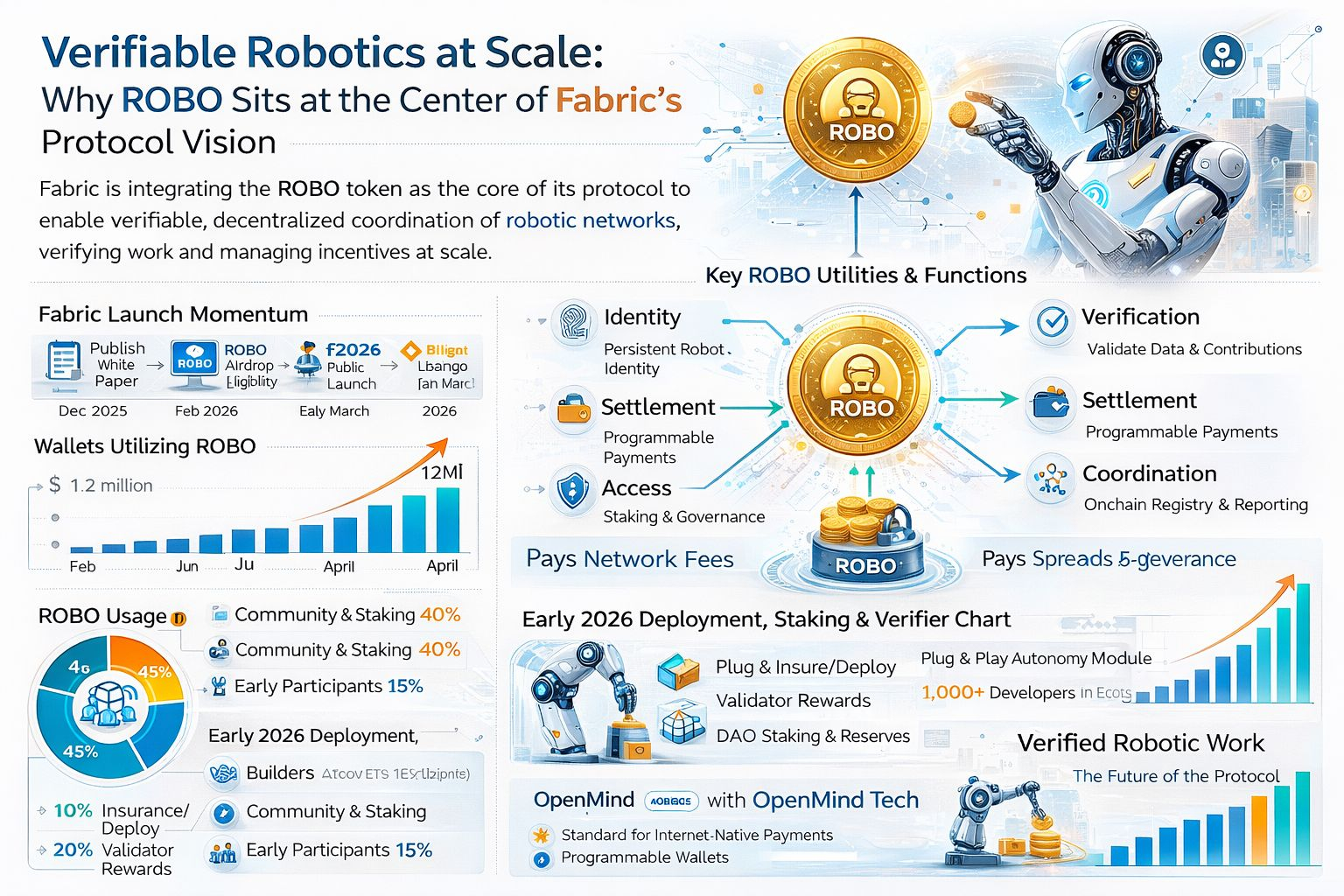
To me, that adjacent progress explains why ROBO matters inside the protocol rather than outside it. If robots are going to carry wallets, request services, buy electricity, and submit verified work, the network needs a common unit for fees, access, and incentives. Fabric says employers pay for robot labor in ROBO, builders stake ROBO to join the ecosystem, and early participants stake it to help coordinate hardware deployment. The project also ties a large ecosystem allocation to what it calls Proof of Robotic Work. The ambition is to reward verifiable activity rather than simple ownership.
I’m cautious because the hard part is not writing the economic loop. The hard part is proving that verification remains honest once real money, messy environments, and edge cases arrive. Fabric itself says it is early and acknowledges that larger fleets will require deployment partnerships, insurance frameworks, uptime guarantees, and more operational maturity. I take that admission seriously. The governance questions in the white paper are revealing as well, because it still leaves open questions around validator design, decentralization timing, and how to measure outputs that are difficult to fake.
My other reason for taking the project seriously is that payment infrastructure is starting to catch up with the story. OpenMind’s documentation shows OM1 integrating x402 modules so robots can manage wallet balances and make autonomous purchases. Coinbase describes x402 as a standard for internet-native payments, and Circle’s Nanopayments material presents programmable USDC flows for agents. I do not read that as proof that a robot economy has arrived. I read it as proof that one excuse for delay is starting to disappear.
I come away thinking ROBO sits at the center of Fabric’s vision because Fabric is trying to make robotics auditable before it becomes ordinary. That strikes me as the right instinct. The token only deserves that central place if verified work, open participation, and real-world reliability actually materialize. Right now, I see a structured framework, signs of momentum, and a substantial number of key tests that still remain. That is enough to hold my interest, though not enough to fully settle my doubts.