
@MidnightNetwork I was at my desk just after 11 p.m., with my laptop fan buzzing and a cold mug of tea beside me, reading updates about Midnight. I cared more than I expected because privacy talk in crypto usually feels abstract, and this time it felt operational. Was something finally changing?
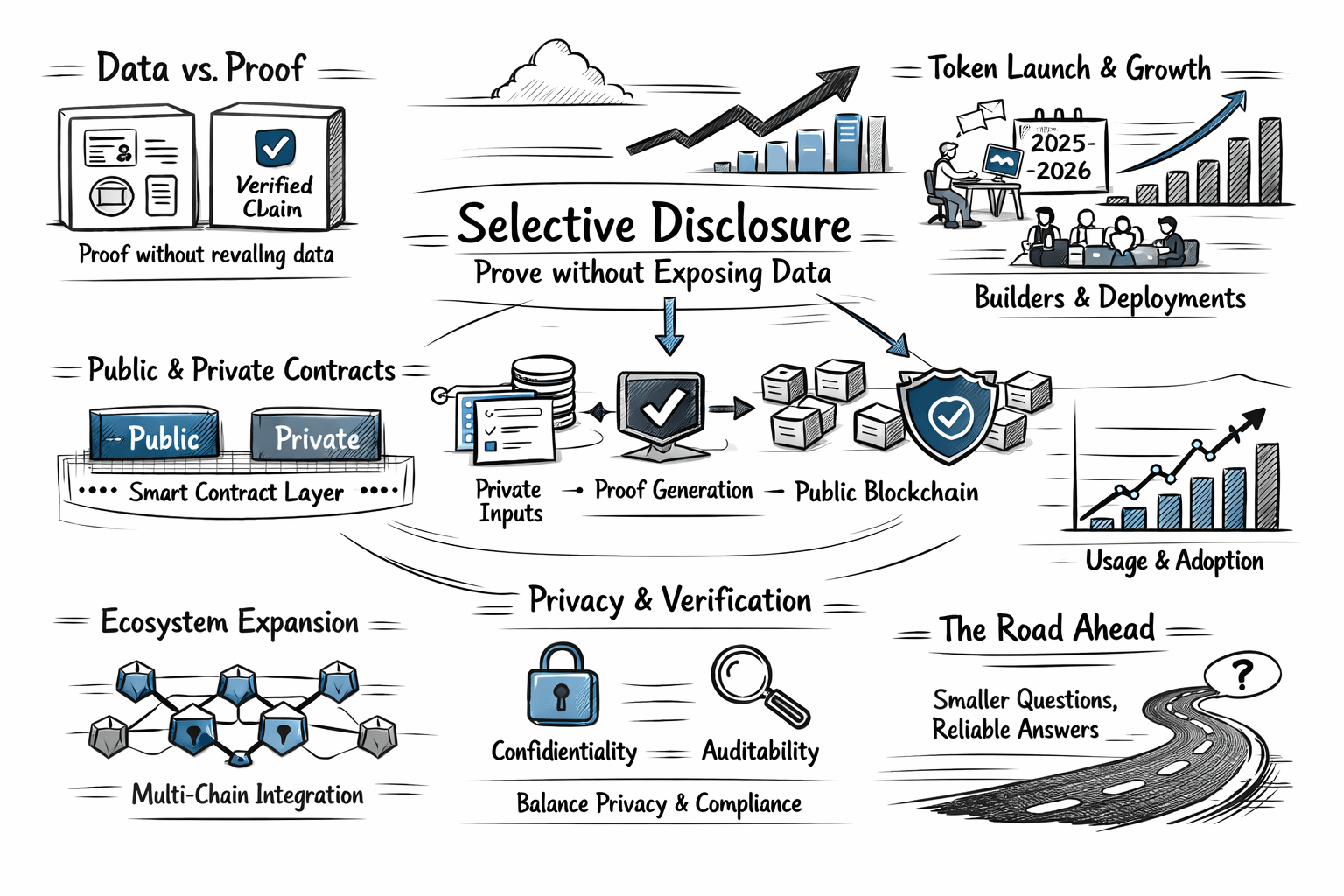
What pulls me toward Midnight is not the usual blockchain pitch about speed or scale or some vague future. It is a smaller idea. To me it is also a more useful one. Midnight is built around selective disclosure. That means I can prove something about my data without giving the data away. It sounds technical at first. The plain version is easier to grasp. If I need to show that I meet one condition then I should not have to expose every detail in the record just to pass one check.
That difference between data and proof sits at the center of the story for me. Data is the raw material. It is my balance. My identity details. My transaction history. A medical file. A business document. The private state inside an application. Proof is something else. It is the evidence that a claim about that data is true. Midnight’s own documentation describes transactions as a public transcript paired with a zero-knowledge proof that the transcript is correct. So the network can verify that the rules were followed without reading the sensitive inputs behind the action.
I think that helps explain why Midnight is drawing more attention now. The project moved more visible phase in late 2025 and early 2026. The NIGHT token launch followed a broad distribution effort across eight blockchain ecosystems. The network then entered its Hilo phase while mainnet preparation became the next serious focus. Around the same time Midnight pointed to higher builder activity and more smart contract deployments. It also rolled out more training resources and pushed the roadmap closer to production use. That kind of shift changes the mood around a project. Developers start building. Skeptics start paying closer attention. Institutions begin to look at it less as an idea and more as a system that may soon face real demands.
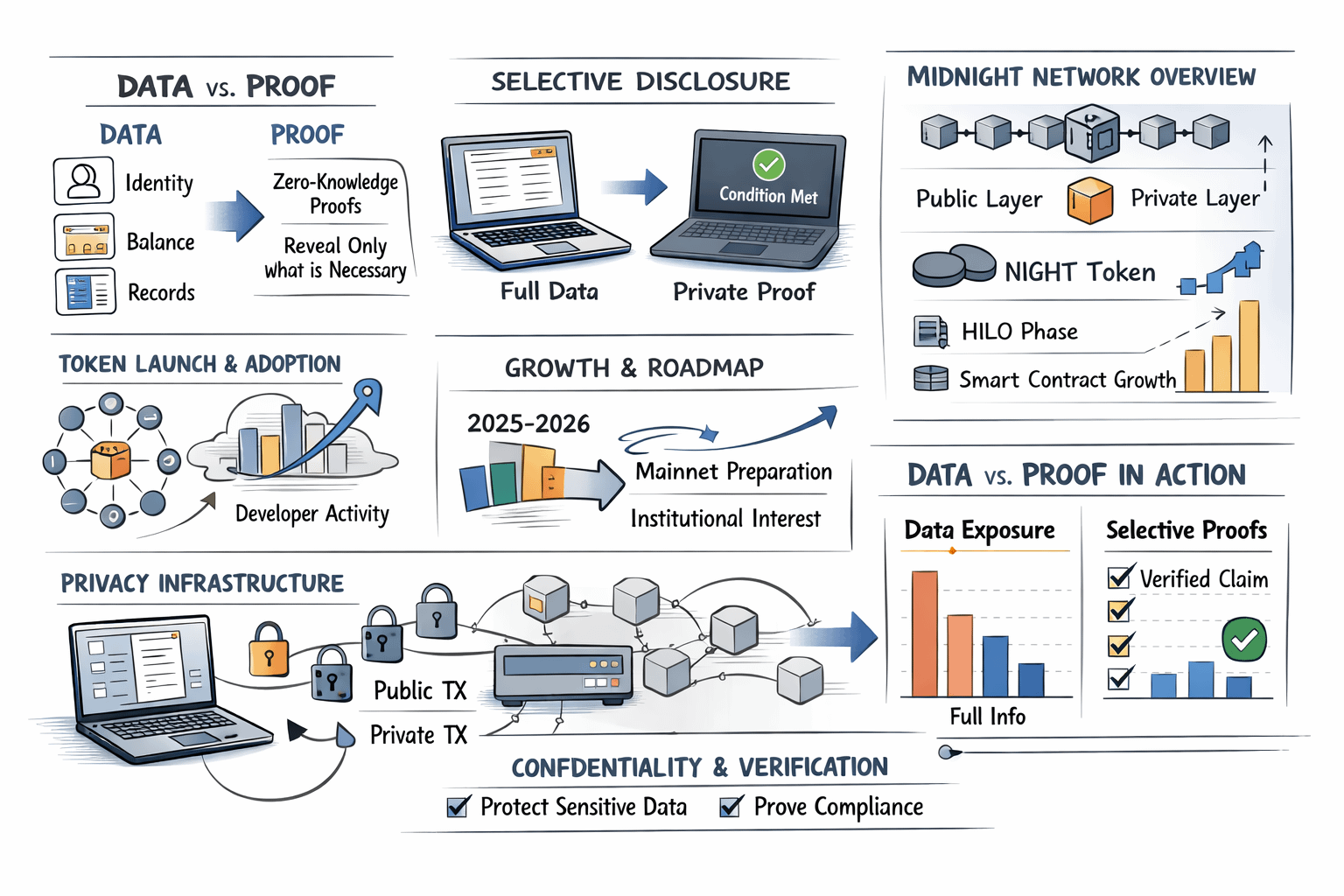
What interests me more than the token story is the architecture under it. Midnight separates public and private elements instead of forcing everything into one model. Its smart contracts use public and private transcripts. The chain stores verifier keys rather than all of the sensitive logic and inputs. The proof can also be generated locally through a proof server. Midnight recommends running that server on a machine I control because the requests may include private ownership details or a DApp’s private state. That detail stands out to me. Privacy here is not just a feature of the chain. It becomes part of the way I use the system.
That also helps explain why Midnight does not fit neatly into the older category of a privacy coin. The team has been careful about calling it a data protection blockchain instead. I think that wording matters. Blanket secrecy makes regulators uneasy and I understand why. Total exposure is not much better when the information is personal or commercially sensitive. Midnight is trying to work in the difficult middle. It aims for confidentiality in specific places while keeping verification intact. That is harder to build and probably harder to explain. Still it feels closer to how real institutions already operate.
I do not see this as a solved problem. I also do not trust anyone who talks as though it is. Zero-knowledge systems still come with usability costs. Local proving infrastructure adds friction. Developers need tools that feel normal. They do not need a system that reads like a cryptography exam. Midnight seems aware of that. Its materials keep stressing TypeScript-based tools and more familiar contract patterns. Even so the real test is not whether the explanation sounds elegant. The real test is whether teams can deploy applications that protect users by default. They also need to satisfy audits when necessary and avoid turning privacy into one more expert-only feature.
That is why the difference between data and proof feels bigger to me than one network or one token cycle. I already live in a world where every signup form and every platform asks for more than it needs. Midnight is making a different bet. It is betting that software can ask smaller questions and still get reliable answers. I do not know whether it will become the standard. I do know the question feels worth taking seriously now. Once data is exposed good intentions rarely pull it back.