

Let’s be honest about the state of things. In the crypto space, I’ve been promised the moon more times than I can count. I’ve watched the industry burn through billions of dollars on ideas that sounded revolutionary in a whitepaper but turned out to be fundamentally broken in practice. We were sold on the dream of financial freedom and a decentralized utopia, but for the average person, the reality has often been a confusing, expensive, and frankly, exposed experience.
I’m not here to pump a token or sell you on a fantasy. I’m here to share why, after a decade of watching this space, I find myself quietly observing a project called Midnight Network. It’s not the loudest project in the room, and that’s precisely what caught my attention. The conversation around it isn't about "moon shots" or "get-rich-quick" schemes. It's about infrastructure, about privacy, and about finally bridging the gap between the promise of blockchain and the practical needs of the real world.
My perspective is that of a perpetual student of this technology. I still watch, I still analyze, and I constantly update my views based on what I see actually working. And from where I stand, the approach Midnight is taking—anchored in the practical application of Zero-Knowledge Proofs (ZKPs)—feels less like a hype train and more like a carefully considered evolution.
The Uncomfortable Truth: Our Blockchains are Glass Houses
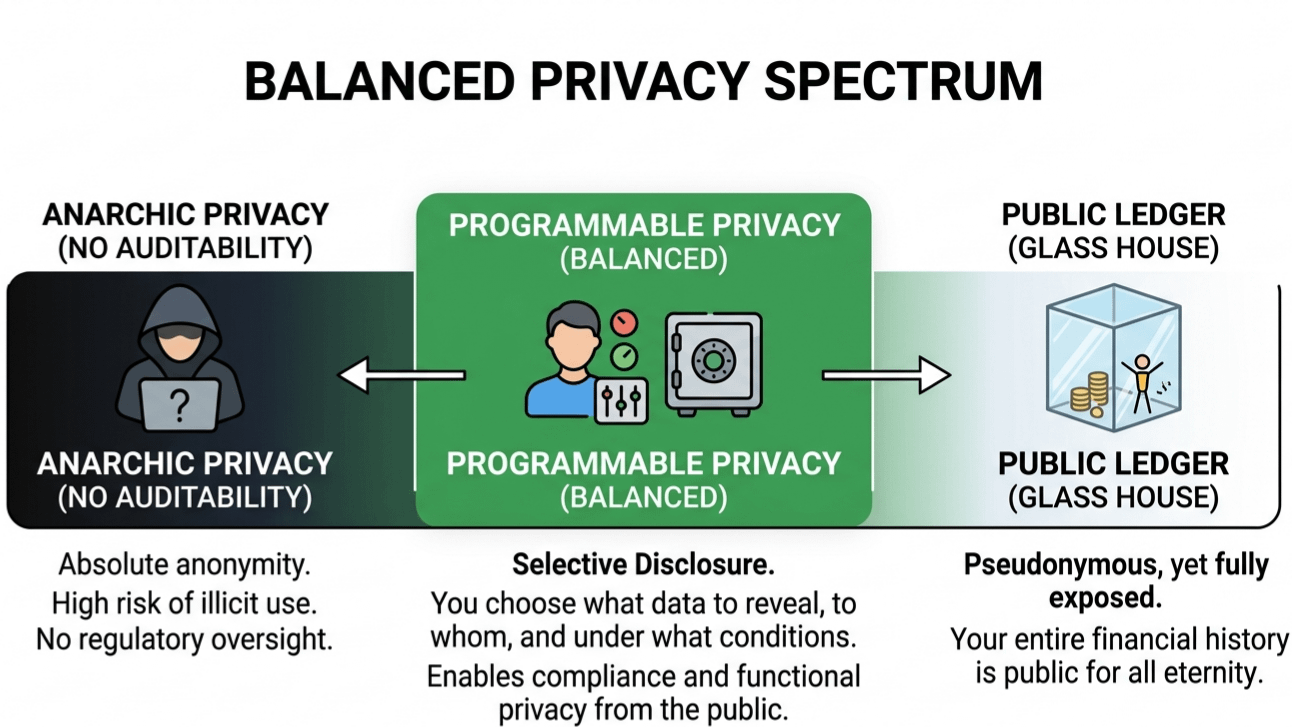
To understand why Midnight matters, we first have to confront the uncomfortable truth about most blockchains today. They are, for all intents and purposes, gigantic public ledgers. Every transaction you make, every interaction you have with a decentralized application (dApp), is written in stone for all eternity for anyone to see.
We were told this was "transparency," a feature. And in some contexts, like verifying the supply of a token, it is. But for the average person, it’s a privacy nightmare. We’ve become comfortable with the idea of pseudonymity—where my name isn't attached to my wallet address. But we’ve learned, often the hard way, that pseudonymity is a very thin veil. With a little bit of sleuthing, on-chain analysts can link addresses, track spending habits, and build a frighteningly detailed picture of your financial life. Your salary, your savings, who you pay, and what services you use—it’s all there, just waiting to be connected back to you.
This isn't the freedom we were promised. It’s like living in a house made of glass. You can see everyone, but everyone can also see you. For blockchain to move beyond speculation and into sensitive, high-stakes areas like healthcare, corporate finance, or personal identity management, this simply won't do. You can't put your medical records on a public ledger, and a corporation cannot run its payroll on a system where every employee can see the CEO's compensation. The need for a better way is not just a "nice-to-have"; it's the fundamental barrier to mainstream, institutional adoption.
The Magic of Zero-Knowledge: Proving You Know Without Showing Your Hand
This is where the quiet magic of Zero-Knowledge Proofs comes in, and it's the core reason I'm so interested in Midnight. The technology isn't new—it's been a concept in cryptography for decades—but its application on a functional, scalable blockchain network is what finally feels ripe.
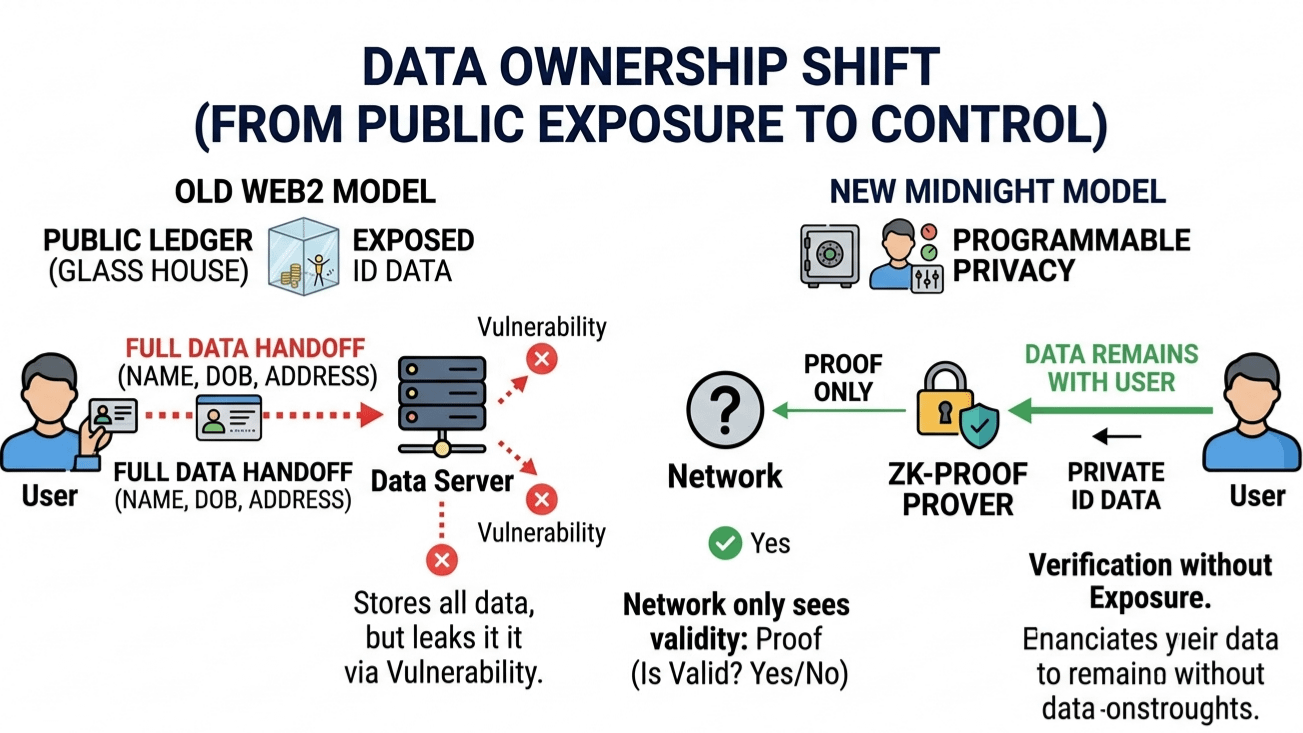
Think of it like this: imagine you're at a bar, and you need to prove you're over 21 to get a drink. Today, you hand the bouncer your driver's license. In that one act, you've given them your full name, your exact birthdate, your address, your height—a whole host of information they simply don't need. They only need a binary answer: yes or no.
A Zero-Knowledge Proof is the cryptographic equivalent of a magic bouncer who can look at you and say, "Yep, you're over 21," without you ever having to show your ID. You have proven a statement is true without revealing the underlying data. It’s a way to say, "Trust me, I know the secret," and have the network mathematically verify you're telling the truth, all while keeping that secret completely to yourself.
This is the foundation of Midnight. It allows you to prove you have sufficient funds for a transaction without revealing your total balance. It allows you to prove you are a citizen of a certain country to access a service without revealing your passport number. For me, this is the "balanced privacy" that resonates. It’s not the absolute, anarchic privacy of a shadowy figure in a hoodie. It's a controlled, programmable privacy. You, the user, are in the driver's seat.
More Than Just Privacy: The Engine of Scalability and Trust
What excites me even more is that ZKPs aren't just about hiding information. They are also an incredibly powerful tool for verification and efficiency. This is where the technology pulls double-duty and starts to solve some of blockchain's other persistent headaches.
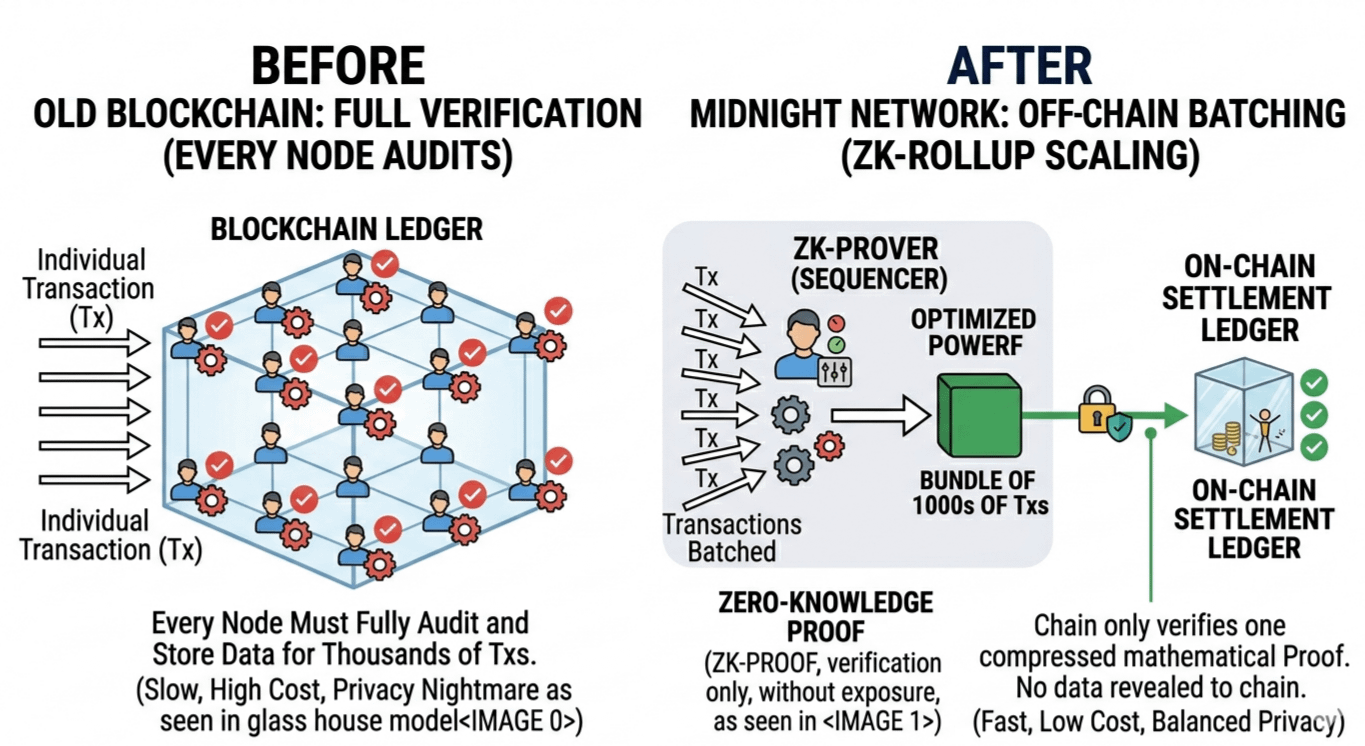
Think about the problem of scale. Most blockchains require every single node in the network to verify every single transaction. This is what makes them secure, but it’s also what makes them slow and expensive. It’s like having every citizen in a country personally audit every single bank transfer before it’s approved.
Zero-Knowledge Proofs flip this model on its head. Instead of verifying each transaction individually, a "prover" can take thousands of transactions and bundle them into a single, tiny cryptographic proof. This one proof is then submitted to the main chain. All the other nodes only have to verify that one single proof to be certain that all the thousands of underlying transactions were valid.
This is the magic of ZK-rollups, and it’s a concept that Midnight is built to leverage. It dramatically reduces the amount of work the main network has to do. The result, at least in theory, is a network that can be significantly faster and cheaper. It gives us the best of both worlds: the speed of a centralized system with the trustless security of a decentralized one.
The Developer Experience and the "DUST" Economy
A technology is only as good as the applications built on it, and this is another area where Midnight's approach feels refreshingly pragmatic. I’ve seen too many promising blockchains die because they required developers to learn an esoteric, brand-new programming language from scratch.
Midnight seems to understand this. From what I’ve gathered, a key part of their strategy is to allow developers to build privacy-enabled dApps using familiar tools. They’re aiming to create an environment where a developer doesn't need a PhD in cryptography to implement a ZKP. If they can pull this off, it opens the door to the millions of developers worldwide who can now start integrating meaningful privacy into their applications.
This thoughtful design extends to their economic model, which introduces a fascinating concept: the separation of the network's currency (NIGHT) from the resources needed to run computations (DUST). In many blockchains, you pay fees in the native coin. If the price of that coin goes up, your cost to use the network goes up. This creates a terrible user experience. Midnight’s model with DUST attempts to decouple network usage from currency speculation. DUST is a resource, not a speculative asset. This is designed to make costs more stable and predictable.
My Lingering Questions and the Reality of the Hype
Now, after all of this, you might think I'm a convert. I'm not. I'm an observer. And my job as an observer is to question. The biggest question mark for me is always the same: efficiency versus hype.
Zero-Knowledge Proofs are computationally expensive. Generating them takes time and power. While the verification is incredibly fast, the proving process is heavy. The question remains: can it hold up under truly massive, global-scale usage? When there are millions of transactions happening every second, will the proving systems become a bottleneck? The theory is sound, but the large-scale, real-world stress test is yet to come.
My other point of focus is the inevitable tension with the regulatory world. Midnight is building a tool for balanced, controlled privacy—the idea is to give users privacy from corporations and other users, but with the potential for compliance when required by law. This is an incredibly delicate tightrope to walk. Can a system be truly private if it has a path for regulators? And if it doesn't, will it be allowed to operate in major economies? Watching this play out will be one of the most fascinating stories in the next decade of technology.
Conclusion: The Quiet Observer's Verdict
So, where does that leave me? My general feeling is not one of boisterous excitement, but of quiet, sustained curiosity. I’ve been burned by too many promises in this industry to get loud about anything anymore. But Midnight Network is different. It’s not promising a revolution; it’s proposing an evolution. It’s addressing the most fundamental, broken aspects of our current digital world—the complete lack of privacy and the terrible efficiency of our systems—with a tool that is mathematically elegant.
It acknowledges that for blockchain to be truly useful, it must be able to interact with the real world, which means handling sensitive data and respecting the need for both transparency and confidentiality. The ideas are sound. The design is thoughtful. The technology, while still maturing, is the most promising I’ve seen in years.
The "Midnight" in the name feels apt. It’s not the blazing, blinding light of a new dawn. It’s a more subtle shift, a network that operates in the background, allowing for private, secure interactions beneath the surface of the public chain. I’m still watching, still analyzing, and still asking the hard questions. I don’t know all the answers yet, but for the first time in a long time, I’m genuinely interested in finding out.
#night #NIGHT @MidnightNetwork #marouan47
