

I’ve been embedded in the intersection of blockchain and AI for years. We’ve watched the narrative shift from digital agents to autonomous contracts and the rise of DePIN (Decentralized Physical Infrastructure Networks). But there’s one specific corner of this evolution I keep coming back to, squinting at whitepapers and charts, trying to separate the genuine signal from the marketing noise.
I’m talking about the physical world. The robots.
For a decade, the robotics industry has looked like a landscape of "walled gardens." Most people don’t realize it, but today’s robots are basically isolated mainframes on wheels. You’ve got a logistics fleet run by Company A and another by Company B in the same city, yet they’re totally mute to one another. They live in data silos. If a robot from one brand needs a sensor reading or a path cleared by a robot from another brand, it’s a non-starter. The infrastructure for collaboration simply doesn't exist.
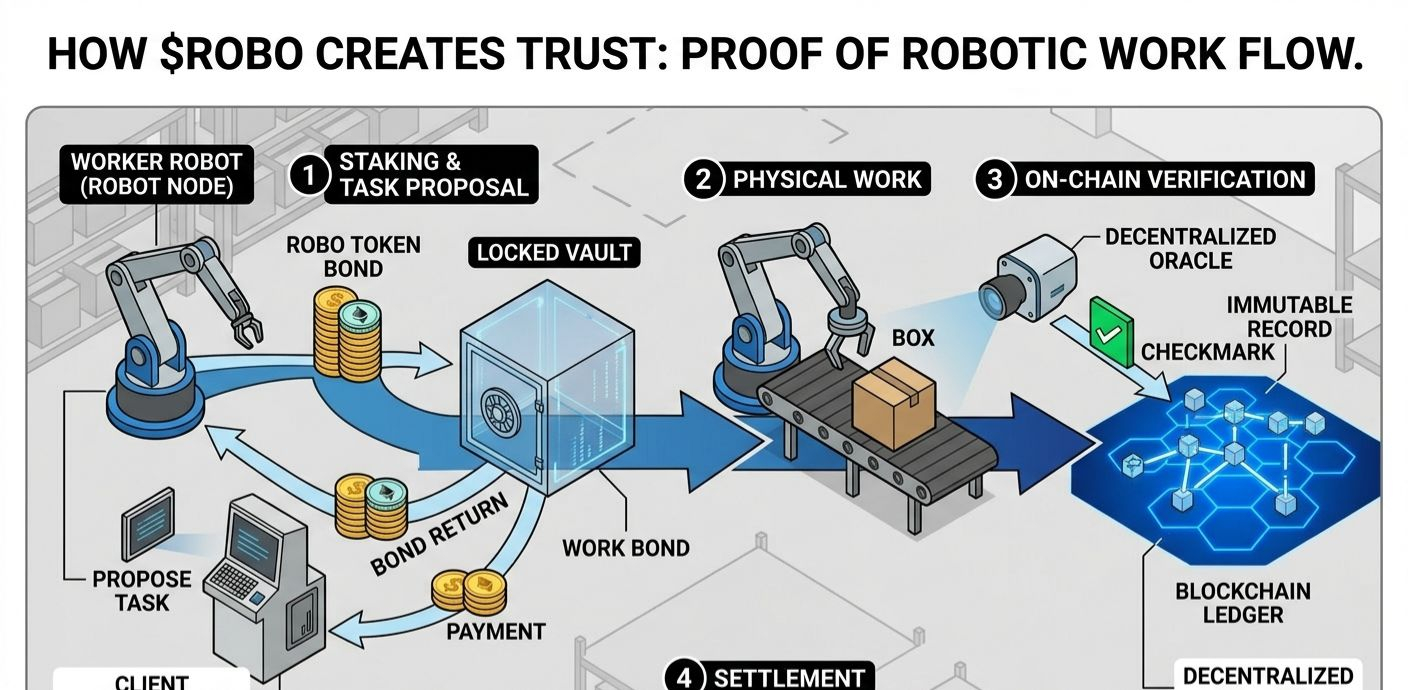
This is the "coordination itch" I can’t stop scratching. We’re building brilliant machines but forcing them to work in solitary confinement. We’re heading toward a future filled with thousands of smart devices that are functionally "dumb" the second they have to talk to a competitor.
Then I found Fabric and its native token, ROBO. My first instinct? Skepticism. It smelled like another project trying to hitch a ride on the AI hype train. But the deeper I dug, the more I realized they’re attacking the exact problem that’s been bothering me: the isolation of the machine.
The Thesis: Moving Beyond Corporate Fleets
Fabric’s core idea is a total vibe shift in how we see robots. Instead of viewing a robot as a closed application owned by a corporation, Fabric treats them as nodes on an open infrastructure.
Imagine a delivery drone, a warehouse arm, and an autonomous tractor all living in the same economic ecosystem. They aren’t owned by the same entity, but they can talk, verify tasks, and trade with each other because they speak a common protocol. This is a coordination layer for the physical world, built on the back of a blockchain.
The architecture is the "meat" here. It’s not just a crypto wallet duct-taped to a drone. It’s a network of Robot Nodes and Coordination Pools. If a robot hits a snag—say, a blocked path—it can broadcast a micro-task to the pool. Other machines or human operators can bid to solve it. It’s a move from top-down command to a fluid, open marketplace.
ROBO : The "Skin in the Game" for Machine
When I look at a token, I always ask: Does this need to exist, or is it just a fundraiser? With ROBO, it feels like the former. It’s the economic glue holding the machine economy together.
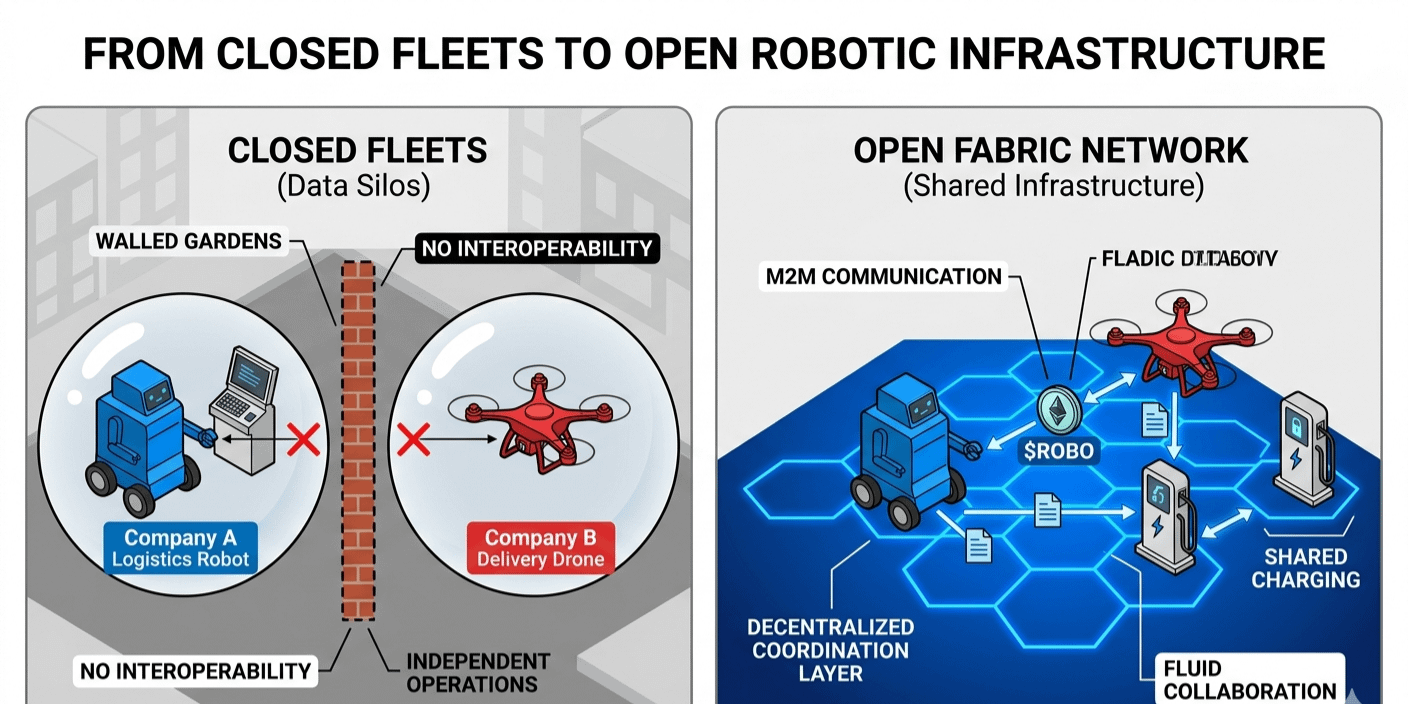
Work Bonds: This is the clever bit. In a decentralized network, how do you stop a robot from "lying" or ghosting a job? You force them to stake $ROBO. If they fail the task, they lose the bond. It’s "skin in the game" for machines, creating accountability without a central boss.
M2M Payments: This is where things get sci-fi. A security bot might pay a third-party charging station for juice, or a drone might pay a sensor-hub for weather data. To make this work, you need a frictionless, native currency. That’s ROBO.
Governance: The "rules of the road" for a mixed-human/robot society shouldn't be written by a single CEO. $ROBO holders get a vote on how the protocol evolves.
The "Proof of Robotic Work" concept is also worth watching. It tethers the digital token to actual physical utility—rewarding bots for doing real stuff in the real world, not just sitting in a wallet.
The Verification Problem: Why Blockchain?
People often ask: “Why not just use an API?” Because of the Verification Problem. In a closed system, you trust the company’s database. In an open network, you need a source of truth that no one owns. How do you prove a robot actually swept that floor or delivered that box without a middleman taking a cut?
Fabric uses a decentralized consensus to "sign" physical actions into the ledger. It turns a physical movement into a cryptographic fact. That is the "aha!" moment for me. It’s not about speed; it’s about trustless auditing.
ROBO vs. The Field (Fetch.ai / ASI)
I often see people lump ROBO in with Fetch.ai (now ASI). While they share the AI/Crypto DNA, they’re playing different sports.
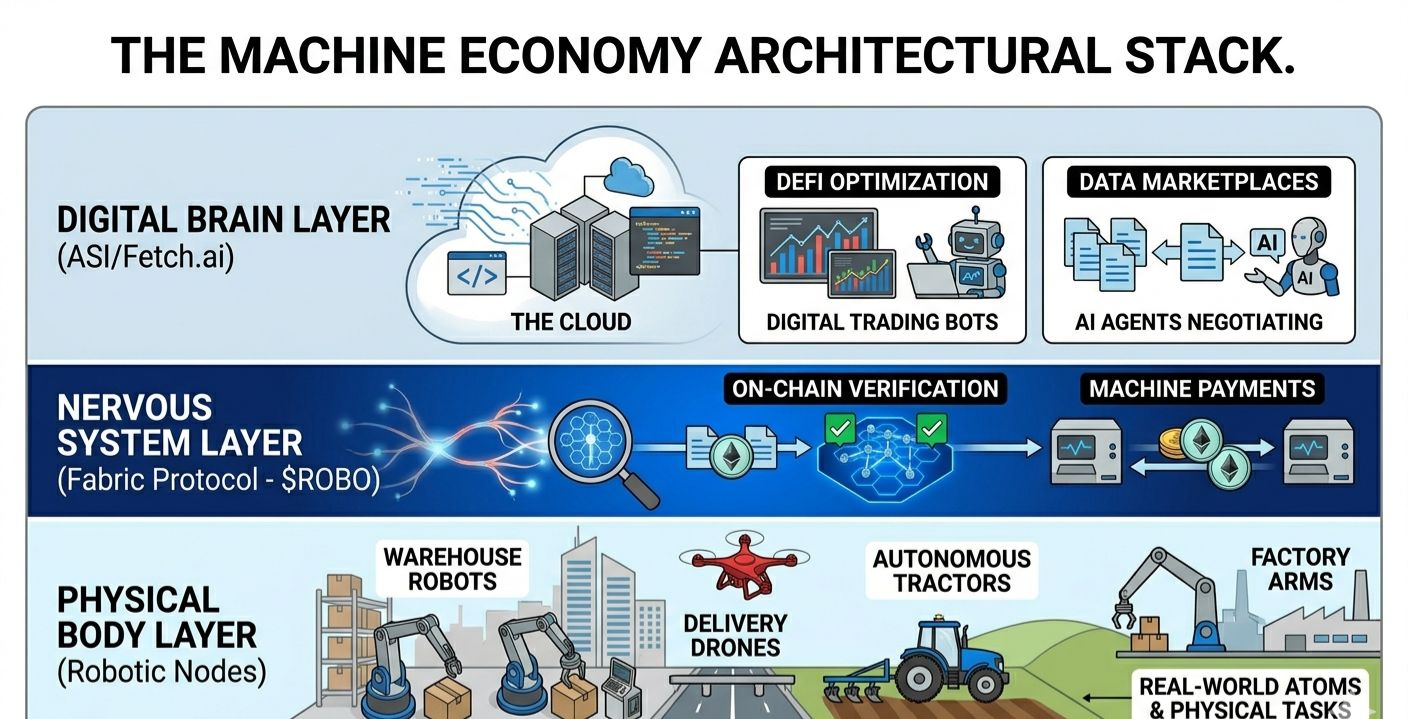
Fetch.ai (ASI) is about the digital brain. It’s software agents negotiating with software agents—optimizing trades or booking flights. The "work" is bits and bytes.
Fabric (ROBO) is about the physical body. It’s the nervous system for things with motors and sensors. The "work" is moving atoms in a warehouse or on a farm.
They aren't competitors; they’re layers. Fetch is the brain; Fabric is the spine.
The Reality Check: What I’m Actually Tracking
Right now, ROBO is in its infancy. With a market cap around $80–90M and only about 20% of the supply circulating, we’re in the "early promise" phase. But I don't care about exchange volume. I care about ground truth.
Here are the three metrics I’m obsessively watching:
Service Fees: Are there on-chain records of robots actually paying for services? I want to see a bot spending ROBO to unlock a gate, not just speculators moving tokens.
Wallet Retention: Are "robot wallets" coming back? One-off tasks are experiments; recurring tasks are a business.
The Post-Incentive Hangover: What happens when the "farming" rewards dry up? Does the network still hum when people (and machines) have to pay full price for the coordination?
The Bottom Line
I’m still in observation mode. The vision is massive—giving machines economic agency—but the engineering hurdles are just as big. Verifying a digital trade is easy; verifying that a robot arm didn't drop a box in a dusty, chaotic warehouse is incredibly hard.
If Fabric pulls this off, they aren't just a "crypto project." They become the foundational layer for 21st-century labor. If they fail, they’ll be a fascinating case study in why the physical world is so much harder to disrupt than the digital one.
I’m keeping my eyes on the transaction data. Let’s see if ROBO can truly hold together a world made of steel and code.
$ROBO @Fabric Foundation #ROBO #robo #marouan47
