
@Fabric Foundation I was rereading the Fabric whitepaper after 7 a.m. with coffee cooling beside a scratched notebook because the question has stopped feeling theoretical to me. If robots are going to work in public, handle money, and make decisions around people, what exactly am I being asked to trust?
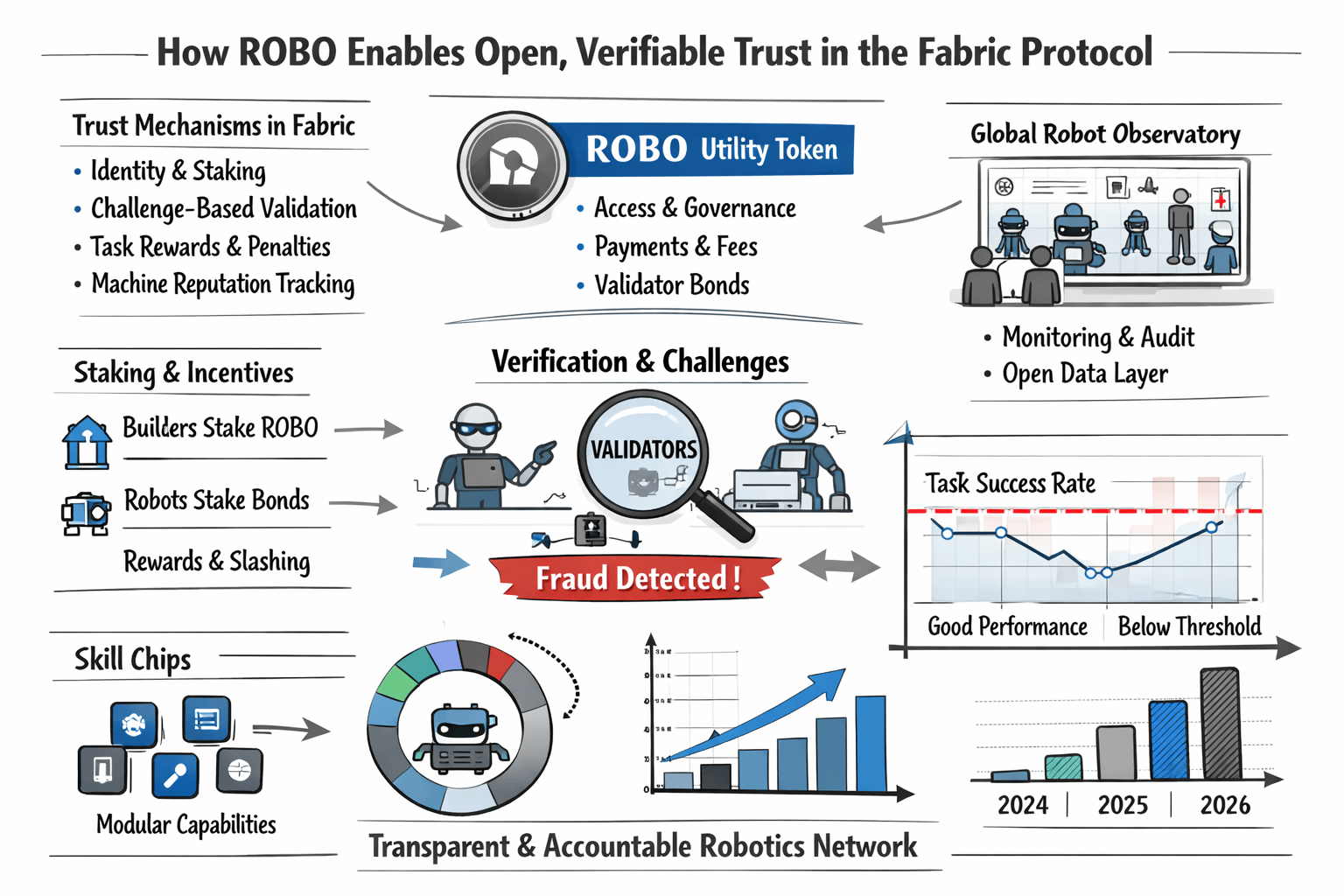
That is why ROBO interests me. I do not see it mainly as a story about price action or listings even if those events helped bring more attention to it. The Fabric Foundation describes itself as a non-profit that is building governance, economic, and coordination infrastructure for humans and intelligent machines. In its own language the goal is to make machine behavior predictable and observable while supporting identity, accountability, machine to machine communication, and payment systems that can work for autonomous agents.
What makes the topic trend now is fairly plain. Fabric opened its ROBO airdrop eligibility and registration portal on February 20 and published its introduction to ROBO on February 24. Soon after that the project moved out of whitepaper territory and into broader market conversation. I do not think attention proves much on its own but it does explain why more people are asking what ROBO is actually meant to do inside the protocol.
My reading is that ROBO matters inside Fabric because it connects trust claims to actual network behavior. The token is presented as the utility and governance asset used for payments, identity, and verification fees. Participants stake it to access parts of the network. Builders who want to develop on the system are expected to buy and stake fixed amounts. Rewards are then tied to verified work across task completion, data contribution, compute, skill development, and validation. I read that as Fabric trying to turn trust into something the protocol can record, check, and penalize when needed rather than leaving it as a vague social promise.
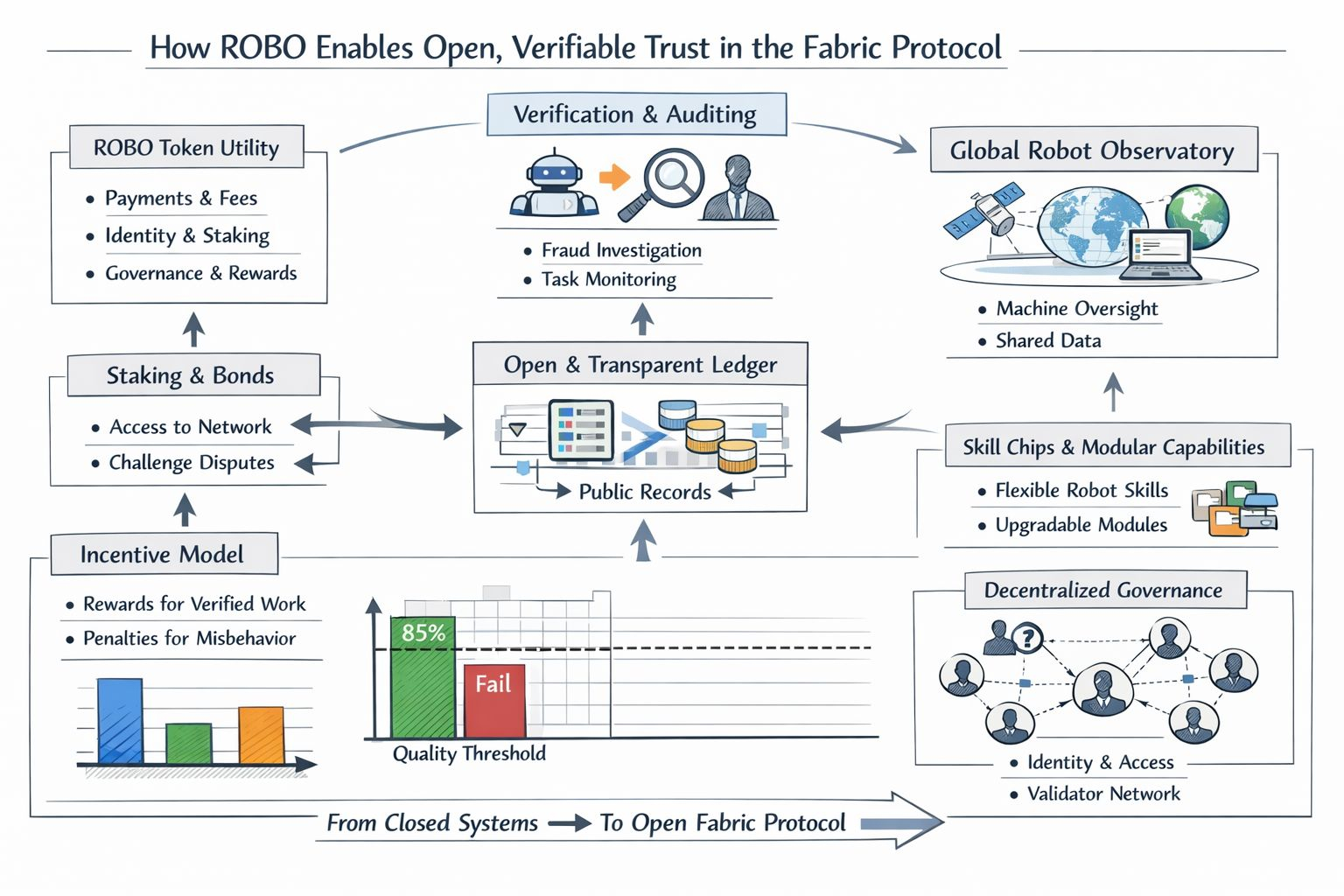
That is the part I find most relevant. Fabric’s whitepaper does not assume that every robotic action can be checked all the time. Instead it describes a challenge based model where validators stake bonds, monitor quality and availability, investigate disputes, and earn fees or challenge bounties when they successfully prove fraud. If bad behavior is proven then part of the task stake can be slashed. Robots that fall below an 85 percent quality threshold can also lose reward eligibility. I like the restraint in that design because it admits that verification is costly and that the system has to make dishonesty expensive instead of pretending that perfect oversight is easy.
The broader trust idea is open in another sense too. Fabric presents itself as a public layer rather than a closed robotics stack. The whitepaper describes skill chips as modular capabilities that can be added or removed like apps. It also outlines a Global Robot Observatory where humans can watch machine behavior and respond to edge cases. On top of that it argues for payment rails that treat humans, agents, and robots on the same network terms. I do not take that as a finished answer. I take it as an effort to move trust away from private logs and company controlled dashboards and toward shared records, shared incentives, and wider review.
Still I would be careful not to overstate how complete this is. Fabric’s roadmap places 2026 around early identity components, task settlement, structured data collection, contribution based incentives, and selected real world multi robot workflows, with a longer term move toward a machine native Layer 1. The governance section also leaves open questions about how the validator set begins and how decentralization expands over time. Open trust is not created by language alone. It depends on who can verify the system, who can challenge it, and whether access really widens after launch.
So when I ask how ROBO enables open and verifiable trust in Fabric my answer stays narrow. It gives the protocol a way to assign identity, collect fees, require bonds, reward useful work, and punish bad behavior on a public ledger. That does not remove the old trust problem in robotics. It changes where the trust sits. Instead of asking me to rely on a company’s internal dashboard Fabric is asking me to rely on visible rules, incentives, and records. For a field that is moving from screens into streets, warehouses, and homes that feels like a meaningful shift even if it is still being tested.