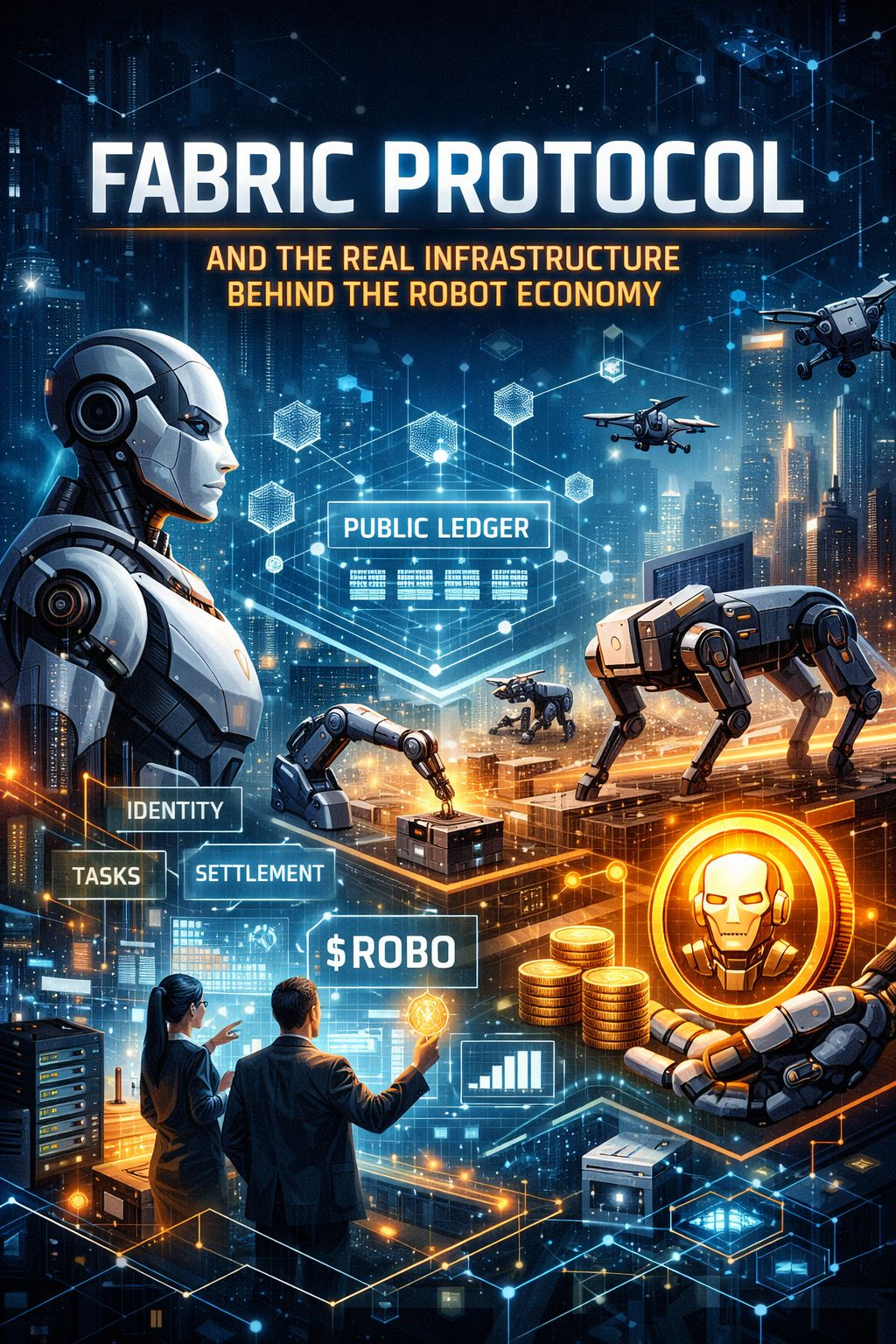
A lot of AI and robotics projects still sound the same. They talk about smarter models, better hardware, faster learning, and bigger breakthroughs, as if that alone will define the future. Fabric Protocol feels different because it starts with a more grounded idea: robots do not become economically useful just because they are intelligent. They become useful when they can actually work inside a system that can identify them, assign tasks, verify outcomes, manage incentives, and keep everyone accountable.
That is what makes Fabric interesting to me. It is not just trying to make robots more capable. It is trying to build the structure around them so they can operate inside an open, shared economy instead of remaining trapped inside closed products and private platforms.
At the heart of Fabric is a simple but powerful belief: if robots are going to become part of everyday economic life, they will need more than software and sensors. They will need coordination. They will need rules. They will need a way to earn, settle, build reputation, and interact with humans and other machines in a system people can actually trust. Fabric is trying to become that system.
That is a much more serious goal than launching another AI-themed token. The protocol is built around the idea that the real challenge in robotics is not only what machines can do, but how their work is organized. A robot that can perform a task is useful. A robot that can be verified, rewarded, governed, and deployed inside an open network is part of something much bigger. Fabric is aiming for that bigger picture.
What stands out most is how the project treats robotics as an infrastructure problem. Instead of focusing only on one machine or one specific product, Fabric is thinking about the broader environment robots will need if they are ever going to scale across industries and use cases. In that sense, the protocol is less about a single robot and more about the economic rails for many kinds of robots. That makes the vision stronger, because the future of robotics will almost certainly be fragmented. Humanoids, drones, quadrupeds, wheeled systems, and industrial robots will all have different roles. If Fabric works, its value will come from connecting that fragmented world through one shared coordination layer.
This is also where the ROBO token starts to make sense. In many projects, the token feels added in later, almost like a branding tool for the narrative. Here, it appears much closer to the protocol’s actual mechanics. ROBO is tied to access, settlement, bonding, delegation, governance, and early participation in the network. Operators need to post bonds to join and provide services. Activity in the network settles through the protocol. Holders can delegate to support operators. Governance works through veROBO, which rewards longer-term alignment rather than shallow participation. That gives the token a more natural place in the system.
To me, that is one of Fabric’s strongest points. It is at least trying to create real reasons for the token to exist beyond speculation. The project’s economic design seems built around a basic truth that many crypto networks never solve: if supply expands while utility stays weak, the token eventually loses credibility. Fabric’s answer is to tie emissions, demand, and incentives to actual network development. Early incentives are meant to help bootstrap activity, but over time the goal is for usage, coordination, governance, and machine-driven work to carry more weight than pure market excitement. That is the right idea, even if execution will be the real test.
The fixed supply of 10 billion ROBO fits that longer-term approach. The token distribution across investors, team, foundation, ecosystem, community, and liquidity looks familiar on the surface, but the more important point is how the protocol tries to create economic balance around it. Slashing, fee capture, and revenue-linked buyback mechanisms suggest that Fabric understands the need for offsetting forces against dilution. That does not guarantee success, but it shows the project is thinking beyond launch optics and into long-term sustainability.
Another part that makes the project feel more mature is its attitude toward verification. Robotics is messy. Real-world tasks are harder to prove than digital actions, and anyone building in this space has to admit that. Fabric does not pretend this problem disappears with clever wording. Instead, it leans into an accountability model where validators and challengers monitor behavior, disputes can be raised, and bad performance can lead to penalties. That approach feels realistic. In a robot economy, trust cannot come from slogans. It has to come from incentives that make dishonest or low-quality behavior expensive.
That realism is probably why Fabric has started to attract attention. The token launch, listings, and early liquidity gave the project visibility, but visibility alone is not what makes it worth watching. What matters is that Fabric is stepping into a space that still feels largely unbuilt. There are plenty of conversations about AI agents. There are plenty of conversations about robotics. There are also plenty of crypto projects talking about infrastructure. Very few are trying to seriously connect all three into one operating framework. Fabric is trying to be that link.
Its ecosystem role could become more important over time if the broader direction of the market plays out. If software agents become more autonomous and physical robots become more deployable, there will need to be a bridge between intelligence and real-world execution. That bridge will require coordination, payments, verification, governance, and interoperable standards. Fabric seems to understand that the next meaningful layer of value may not sit only in the model or only in the machine, but in the system that allows both to work together in a trusted way.
Of course, the ambition here is also the risk. Fabric is not building one narrow product. It is trying to build an entire market structure for robotic participation. That means execution has to happen across many fronts at once: protocol design, token economics, validator behavior, integrations, adoption, and real-world deployment. It is a difficult path, and the biggest challenge will be proving that network activity can grow into the scale implied by the vision. A liquid token can appear before true utility arrives. That gap is where many promising projects lose momentum.
Still, Fabric feels more thoughtful than most projects operating in the AI-crypto narrative. It is not simply selling the future of robots as a concept. It is trying to answer a much harder question: what kind of infrastructure will be needed when robots stop being isolated tools and start becoming economic actors? That question matters, and very few projects are framing it clearly.
What gives Fabric real potential is not just that it talks about the robot economy, but that it recognizes what such an economy would actually require. Machines will need identity. They will need incentives. They will need coordination layers, enforcement systems, and shared rules. Without that, robotics stays impressive but fragmented. With that, robotics starts to look like an open economic network.
That is why Fabric deserves attention. Not because it promises a futuristic world, but because it is trying to build the parts that world would actually need in order to function. And if ROBO ends up capturing real demand from that system, then the token will matter for a simple reason: it will be tied to the machinery of coordination itself. In the end, the real winner in robotics may not be the project that builds the most impressive machine, but the one that makes machines economically usable at scale. Fabric is betting that infrastructure will matter more than spectacle, and that bet feels far more intelligent than hype.
@Fabric Foundation $ROBO #ROBO