
@MidnightNetwork I was at my kitchen table before sunrise with coffee cooling beside a scratched notebook when I noticed how many crypto stories were circling back to privacy. That caught me because I’m tired of systems that ask for too much data just to let me participate. I kept wondering whether Midnight might offer a more workable answer.
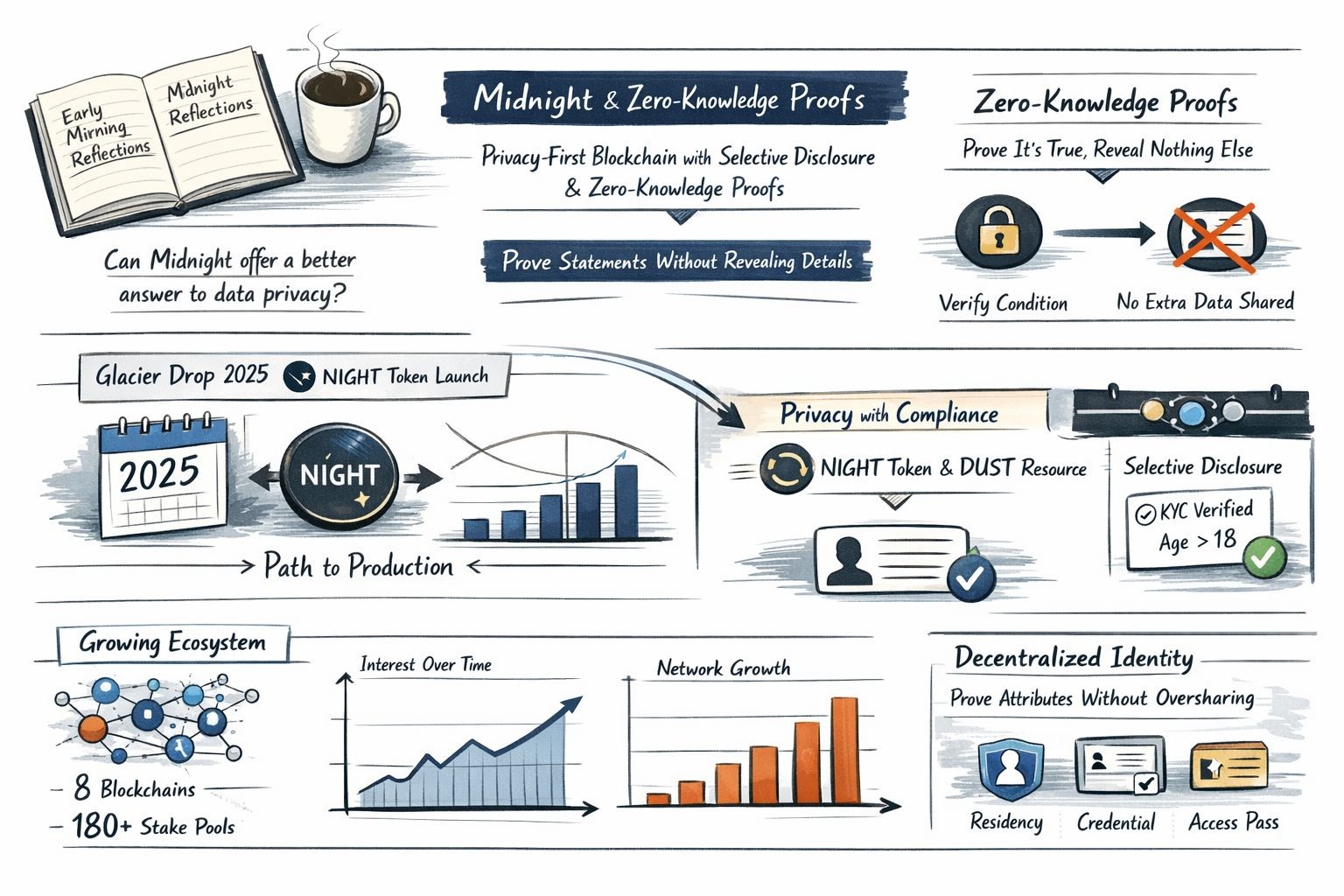
The thing that pulled me toward Midnight is that its idea of privacy feels realistic. It’s not saying nothing should ever be seen — it’s saying people should be able to prove what matters without exposing everything else. Since it’s built as a privacy-first blockchain using zero-knowledge proofs and selective disclosure, it creates a way to confirm truth, share only what’s necessary, and still protect sensitive information in the background. That makes the whole concept feel a lot more practical and human. That matters to me because most blockchains force a blunt choice between public exposure and staying away entirely. Midnight is trying to reduce that tension instead of acting as if it does not exist.
The reason this matters starts to click when zero-knowledge proofs are broken down in simple terms. They’re a cryptographic method that allows one party to confirm a statement is true without revealing anything unnecessary beyond that truth. NIST describes it in almost the same way and frames it as a way to prove a statement without giving away the extra information that might normally come with it. I do not think of that as magic. I think of it as discipline built into mathematics. Instead of handing over my age or balance or legal identity I can prove that I meet a condition and leave the rest untouched. The system gets the answer it needs without collecting a trail of personal detail that it never really needed in the first place.
That shift helps explain why zero-knowledge proofs are getting renewed attention right now. The wider privacy conversation has moved beyond niche crypto debate and into standards work enterprise research and identity systems, while Midnight itself has moved closer to visible infrastructure. In 2025 the Glacier Drop opened claims to eligible wallets across eight blockchain ecosystems and the NIGHT token officially launched on Cardano in December. By January 2026 Midnight was describing the next phase as a move toward a stable federated mainnet designed for the first wave of production applications. In late February the network update pointed to a confirmed mainnet launch window and to work on node partners and developer readiness. That sounds less like abstract ambition and more like a system being prepared for live use.
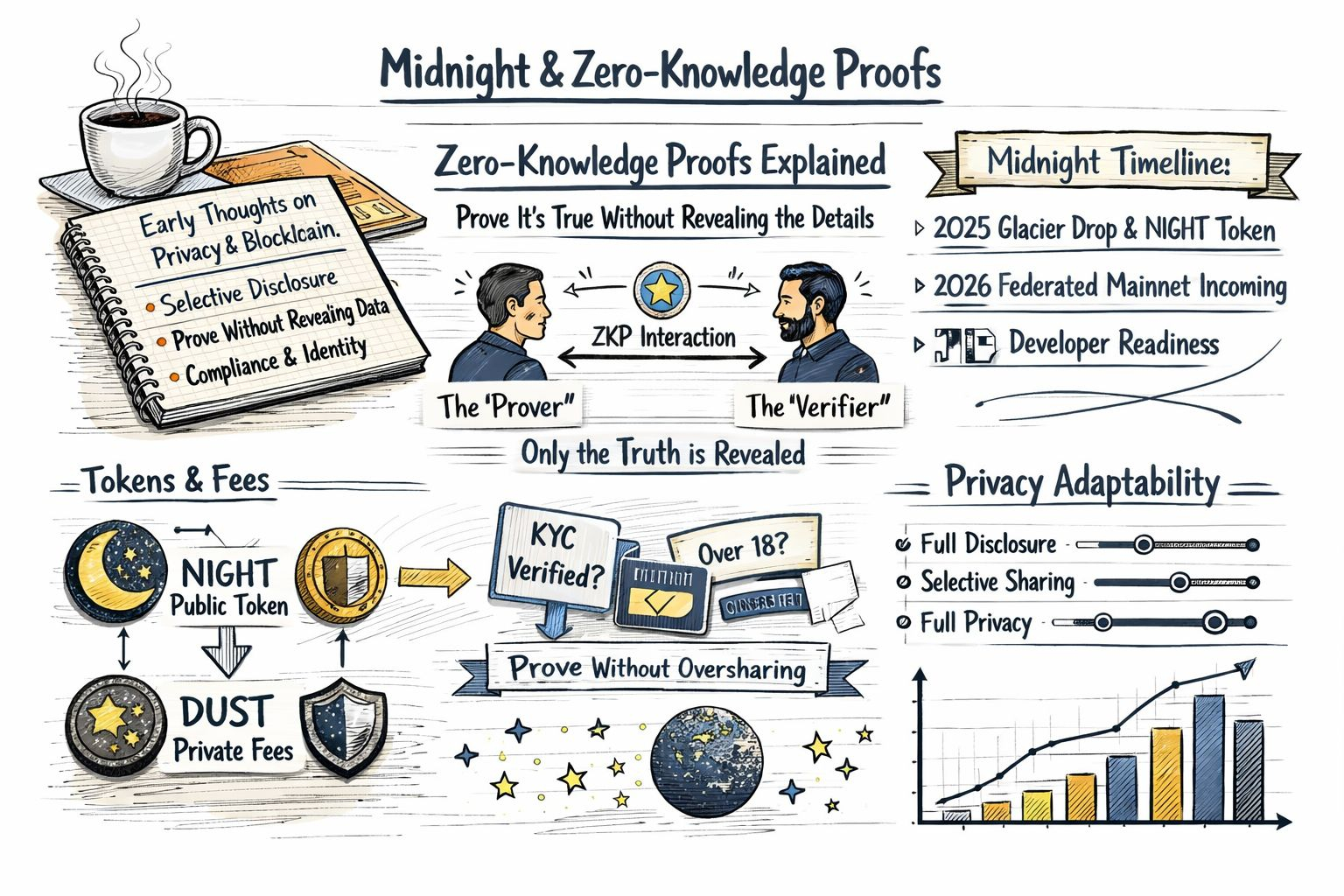
I also think Midnight is getting attention because it avoids one of the usual problems attached to privacy chains. Many people hear the phrase private blockchain and assume regulators auditors or mainstream companies will never get near it. Midnight’s language is different. Its docs and token materials keep returning to selective disclosure compliance paths and a split between the public NIGHT token and DUST, which is the shielded resource used to pay fees and run smart contracts. Holding NIGHT generates DUST over time, and while that can sound unusual at first I can see the practical logic in it. The model separates the asset people hold from the private resource applications consume. For developers that can mean more predictable operating costs and even the option to cover fees for users, which feels like a practical design decision rather than a decorative idea.
The other angle that feels fresh to me is identity. Privacy online is often framed as hiding, but Midnight’s recent work around decentralized identity suggests something more useful. The network’s approach draws on decentralized identifiers verifiable credentials and zero-knowledge proofs so a person can prove a fact about themselves without publishing an entire profile on-chain. Midnight’s own material gives examples like proving KYC status or confirming attributes such as age or residency without exposing the full credential. That feels like a more mature conversation about privacy. I am not trying to disappear. I am trying to stop oversharing by default. In normal life I do this all the time. I show a ticket instead of my inbox and confirm my age instead of revealing my entire history. Good digital systems should let me act with the same sense of proportion.
I’m still cautious because zero-knowledge systems are hard to build hard to audit and easy to romanticize. Midnight does have real progress behind it. The project has highlighted open documentation and developer tooling around Compact, a language based on TypeScript, while recent updates thanked more than 180 Cardano stake pool operators for active participation in Testnet-02 and outlined a clearer route toward the Mōhalu and mainnet phases. That said production privacy is still the standard that matters most. What keeps me interested for now is that Midnight treats privacy as something I can tune and use rather than as an all-or-nothing slogan. That feels closer to how trust works in real life and closer to what blockchain should have learned by now.