

For years, I have been observing a recurring friction point in the world of decentralized finance. On one hand, we praise the radical transparency of public ledgers like Ethereum or Solana. On the other, I see institutional giants—banks, healthcare providers, and supply chain leaders—standing on the sidelines, hesitant to dive in.
Why? Because in the professional world, transparency is often a liability. If a company puts its payroll on a public blockchain, every competitor knows their talent costs. If a hospital puts patient records on-chain, they violate every privacy law in the book. This is where I see the true genius of Midnight, a Cardano sidechain that doesn't just offer "anonymity," but something far more sophisticated: Selective Privacy.
1. My Observations on the "Halo2" Breakthrough
In my research into zero-knowledge cryptography, I’ve noticed that many privacy solutions are either too slow or too "heavy" for real-world scaling. However, when I look at Midnight’s use of Halo2 SNARKs, I see a shift in the paradigm.
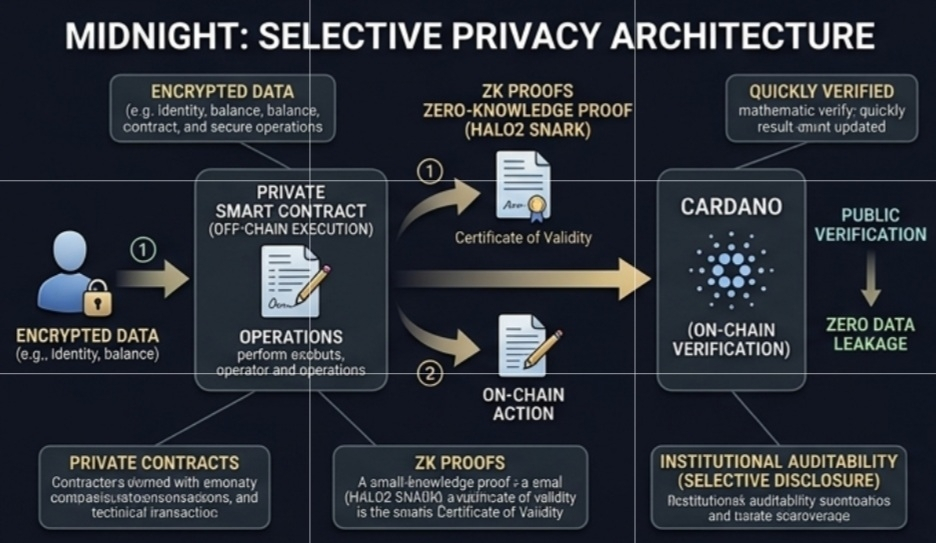
Halo2 allows for the creation of mathematical proofs that are incredibly small and fast to verify. I describe it as a "digital seal of authenticity." It allows a user to prove a statement is true—such as "I am over 18" or "I have enough collateral for this loan"—without ever showing the raw data (the birth certificate or the bank balance). From my perspective, this isn't just a technical upgrade; it’s the bridge that allows blockchain to finally speak the language of modern business.
2. Rational Privacy: Moving Beyond the "Dark Coin" Stigma
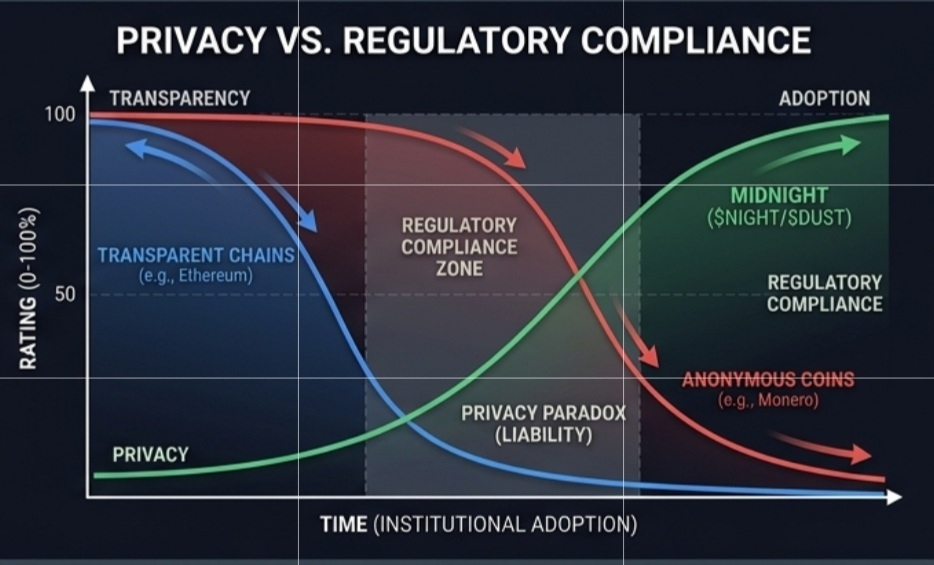
I often read debates about privacy coins like Monero. While I respect the cypherpunk ethos, I also observe the reality of global regulation. Regulators are increasingly hostile toward total anonymity.
This is why I find the concept of Rational Privacy within the NIGHT ecosystem so compelling. It isn’t about hiding from the law; it’s about owning your data. I categorize this as a "Compliance-Friendly" approach. By using ZK-proofs, Midnight allows a corporation to be audited by a regulator (proving they followed AML/KYC rules) without broadcasting their private commercial secrets to the entire internet.
In my view, the winner of the "Privacy Wars" won't be the coin that hides the most, but the protocol that balances privacy with accountability.
3. The Dual-Token Engine: Why I Analyze NIGHT and DUST Separately
When I look at the economic structure of this project, the separation of concerns via two tokens strikes me as a very pragmatic move.
$NIGHT: As I see it, this is the backbone. It handles governance and public-facing operations. It’s the "anchor" to the Cardano ecosystem.
DUST: I observe this being used for the actual shielded transactions.
By decoupling these, the system ensures that the volatility of a governance token doesn't necessarily break the utility of the private transactions. I’m always searching for sustainable tokenomics, and this "separation of powers" is a feature I believe more projects should adopt.
4. The "Compact" Language: A Developer’s Perspective
I’ve spent a lot of time looking at why dApps fail to scale. Often, it’s because the programming languages are too niche. Midnight uses Compact, which is based on TypeScript.
I find this choice brilliant. By allowing developers to write "Privacy-First" applications in a language they already know, the barrier to entry drops significantly. I’ve noticed that when you make privacy easy to code, it becomes a default feature rather than an afterthought. This is how we get private voting, private credit scores, and confidential supply chains.
5. Institutional Auditability: The "Explainability" Factor
One thing I emphasize when talking to institutional players is Liability. If a smart contract makes a decision, a human being at a bank needs to be able to explain why to a judge or a board of directors.
I notice that Midnight places a high priority on Audit & Explainability. It provides a trail—a sequence of authorizations—that can be shown to an auditor without revealing the "raw data" of the participants. From my point of view, this solves the "Black Box" problem of traditional DeFi. You get a provable history that satisfies legal requirements while keeping the underlying wealth and identity of the users protected.
6. Real-World Use Cases: Where I See the Impact
I’m always looking for where the "rubber meets the road." Here is how I see NIGHT changing specific industries:
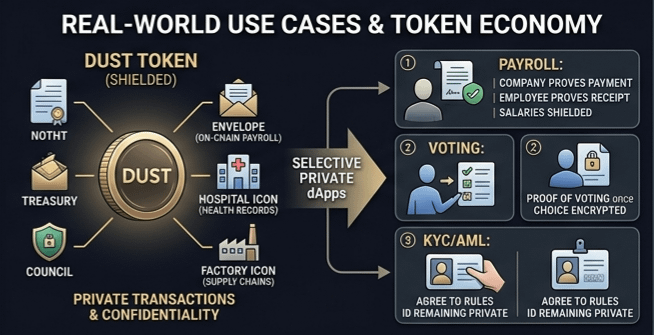
On-Chain Payroll: I imagine a world where a company proves it paid $1M in salaries to a verified list of employees, but no one—not even the employees—can see what their coworkers earned.
Ethical Supply Chains: I see a future where a brand proves their coffee is "Fair Trade" via a ZK-proof from the farm, without revealing the specific, sensitive trade contracts between the supplier and the roaster.
The Voting Revolution: I often think about the flaws in digital voting. With Midnight, I can prove I voted once, and my vote is valid, without anyone knowing who I voted for.
7. My Final Thoughts: The Road Ahead
I am constantly monitoring the regulatory landscape, and it is clear that the "Wild West" era of blockchain is ending. However, I don't believe that means we have to give up our right to privacy.
Through my lens, Midnight (NIGHT) represents a "Middle Way." It uses the security of Cardano, the speed of Halo2, and the familiarity of TypeScript to build a world where we can be both private and compliant. I believe that in the next five years, the most successful blockchain projects will be those that protect the user from the "all-seeing eye" of the public internet while still being "auditable" enough for the real world.
I will continue to watch this space closely. The transition from "Anonymity" to "Selective Privacy" is, in my opinion, the most important shift in the history of Web3.
$NIGHT #night @MidnightNetwork #marouan47
