
@Fabric Foundation I was at my kitchen table before sunrise hearing the radiator click and staring at a notebook where I had written “robots need rules” in the margin. I care about Fabric Protocol right now because it treats that line like an engineering problem instead of a slogan and I keep wondering whether public rules can really keep up.
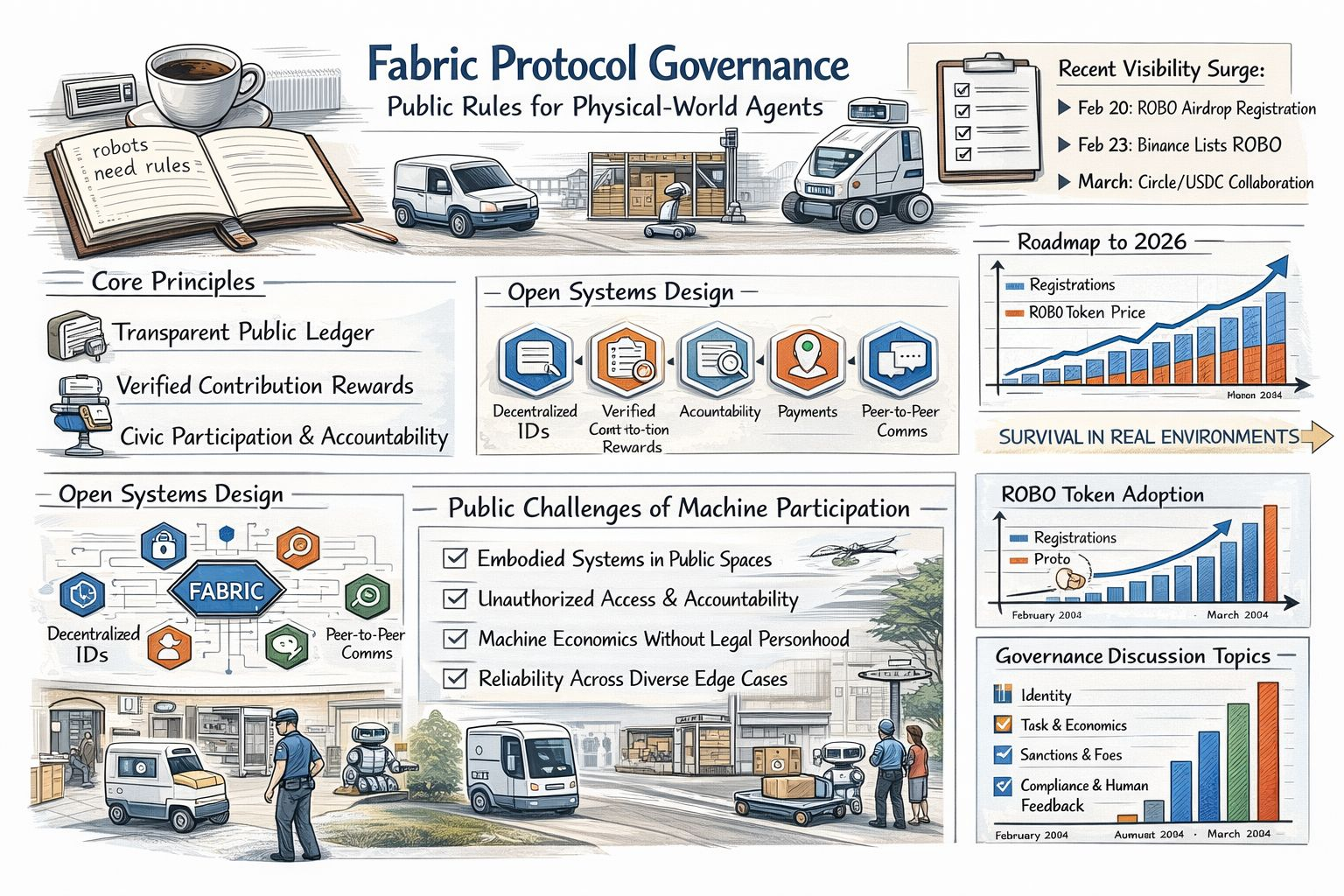
I think that question explains why Fabric is getting attention now. In recent weeks the Fabric Foundation opened a ROBO airdrop registration portal and published new posts about its robot economy thesis while Binance listed ROBO with a Seed Tag. That mix of official documentation and sudden market visibility has pushed a niche governance idea into public view. I do not take that as proof that the project is fully formed. I take it as a sign that more people have started to notice that physical-world agents are moving closer to practical deployment and will need payment rails, identity systems, and visible accountability.
What keeps me interested is that Fabric is not mainly selling the idea of smarter robots. It is making a case for shared infrastructure around them. On its public materials the foundation describes a mission built around making machine behavior more predictable and observable while supporting participation in systems where machines can contribute economically without legal personhood. That language can sound abstract at first. It becomes much more concrete when I picture a delivery robot or a warehouse machine making decisions in a public setting where ordinary people are affected by what it does. Then governance stops feeling theoretical and starts sounding like a basic public requirement.
The official material becomes more persuasive when it explains what these public rules might actually look like. Fabric points to open systems for machine and human identity along with decentralized task allocation, accountability, location-gated payments, human-gated payments, and machine-to-machine communication. Its whitepaper also admits that major design choices are still open. I find that useful rather than worrying. The document says the community still has to decide what should count as a sub-economy, how the initial validator set should be chosen, and which measures should matter beyond revenue. It also points toward harder standards such as legal compliance, efficiency, power use, and feedback from human users.
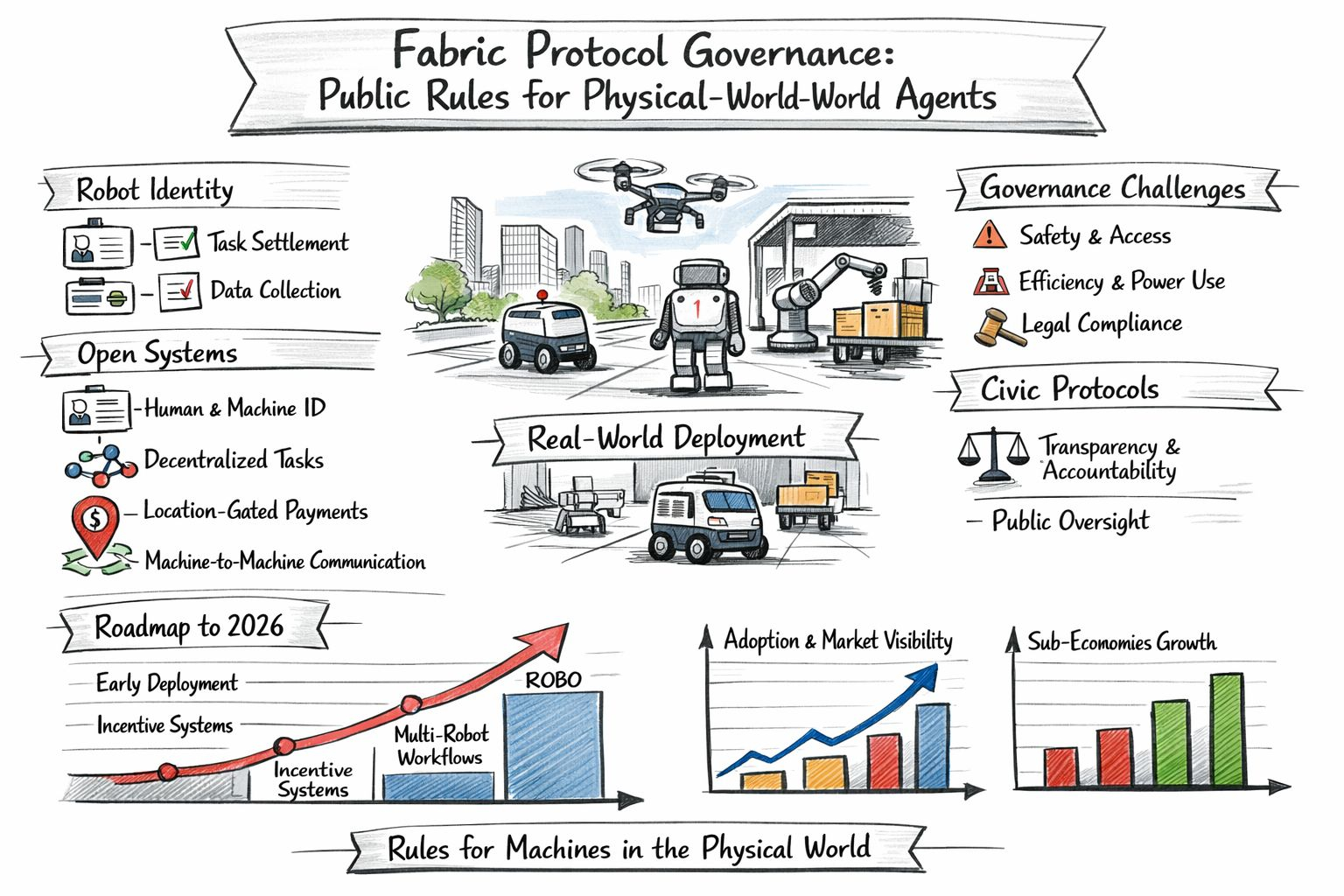
That part matters most to me because too many conversations about agent governance still stay inside software. They focus on access control or model behavior inside a digital product while avoiding the messier question of what happens when an autonomous system takes action in a hallway, on a street, or inside a shared building. Fabric is aimed at embodied systems so the burden is heavier. A bad transaction on a website can be reversed or contained. A badly governed physical agent can block a path, use shared infrastructure badly, enter the wrong place, or normalize forms of surveillance that become hard to unwind once they feel ordinary.
There is also real progress behind the idea even if it is still early. Fabric’s 2026 roadmap starts with robot identity, task settlement, and structured data collection in early deployments and then moves into contribution-based incentives, broader data collection across platforms, selected multi-robot workflows, and a later phase focused on reliability and operational stability. In March the foundation also pointed to OpenMind’s work with Circle on payment rails for autonomous agents. Circle’s public material on Nanopayments says its collaboration with OpenMind points toward robots acting as independent economic actors and describes gas-free USDC transfers for machine-scale use cases.
The angle that feels freshest to me is not mainly financial. It is civic. Fabric is asking whether the rules that shape machine behavior should live inside private platform policy or inside something closer to public protocol policy. I do not think that is a semantic distinction. If physical-world agents are governed only within closed vendor stacks then the public meets them after key decisions have already been made. A protocol approach at least creates a place where identity, audit trails, permissions, fees, and sanctions can be argued over before they disappear into terms that almost nobody reads. That does not guarantee fairness though it does make power easier to inspect.
My hesitation is simple. Public rules are only useful if they survive contact with messy streets, warehouses, schools, and clinics where edge cases are normal and social trust is fragile. Fabric’s own whitepaper makes room for that uncertainty and notes that governance is still evolving. I appreciate that. For now I do not see Fabric as a finished answer. I see it as a serious attempt to write constitutional rules for machines that will do work in the world and that feels timely in a way most infrastructure talk usually does.
@Fabric Foundation $ROBO #ROBO #robo