A few months ago I was watching a wallet tracker late at night, the kind that streams large transactions across multiple chains in real time. It’s oddly hypnotic if you trade crypto long enough. Big swaps appear, tokens move between addresses, liquidity shifts around like small weather systems forming and disappearing. After a while you start recognizing patterns. Certain wallets move early. Others always seem to follow the same addresses.
But one thing slowly became obvious. None of this feels like a normal market.
In most financial systems, traders don’t broadcast their decisions to the entire world while they are making them. If a hedge fund is building a position, the market does not get a public record of every step in real time. On blockchains, though, that is exactly how things work. Every transaction is visible, every wallet balance inspectable, every move permanently recorded. It’s one of the features people celebrate about crypto. Transparency, auditability, open data.
Yet if you spend enough time actually trading in that environment, the experience starts to feel a little strange.
The moment a wallet becomes profitable or well known, its activity turns into a signal for everyone else. Traders copy the address. Bots monitor it. Some dashboards even rank wallets by performance and broadcast their trades across social platforms. Suddenly a person’s strategy isn’t just a strategy anymore. It becomes a public indicator.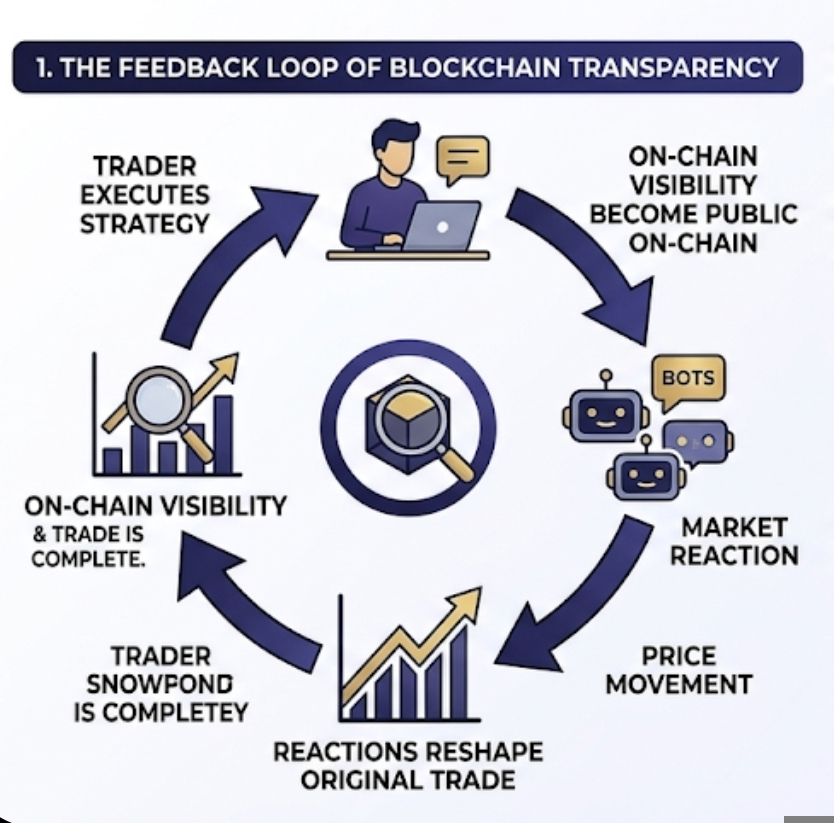
That changes behavior in ways people rarely talk about openly.
You start seeing traders split funds across multiple wallets. They route transactions through intermediate steps, not because they are doing anything suspicious, but simply because they don’t want their intentions visible too early. Sometimes people move trades to centralized exchanges for the same reason. It sounds ironic at first then using a centralized system to gain privacy inside a decentralized ecosystem, but it happens more often than people admit.
That tension is part of why networks like Midnight caught my attention.
Midnight is built around something called zero-knowledge proofs. The term gets repeated a lot in crypto conversations, sometimes in a way that makes it sound mystical. It isn’t really. The core idea is actually simple. A system that can prove rule that has been followed without revealing the underlying information behind that proof.
So imagine verifying a transaction that is valid without exposing every detail of the transaction itself. The network still confirms that the rules are satisfied. Funds exist, signatures match, conditions are met. But the specific data inside that transaction doesn’t necessarily become permanent public information.
For traders who live inside blockchain analytics dashboards, that possibility changes the mental model a bit.
Right now the crypto market runs on observation. There are entire industries built around analyzing wallet flows. You can watch “smart money” wallets, follow early buyers, track liquidity providers, even detect patterns that hint at coordinated activity. It feels like financial forensics happening in public.
And to be fair, this openness helped the ecosystem mature. Early blockchains needed transparency to establish trust. If anyone could verify the ledger, no central authority was required to confirm transactions. That principle was foundational.
But trading isn’t auditing.
The goals are different. Auditors want maximum visibility. Traders usually want controlled visibility. A position that becomes public too early can move the market against the trader before they finish building it. Anyone who has watched bots react to large on-chain swaps has seen this effect.
I remember one particular situation last year where a relatively small wallet started accumulating a mid-cap token across several transactions. Nothing dramatic. Just steady buying. Within an hour, analytics accounts on social media were posting screenshots of the address and labeling it “smart money.” The token price moved before the wallet finished buying.
It’s a strange feedback loop. Visibility creates signals. Signals create reactions. Reactions reshape the original trade.
Midnight, at least conceptually, pushes in the opposite direction. It keeps verification public but allows transaction details to remain private unless someone chooses to reveal them. That subtle distinction matters more than people first realize.
It doesn’t mean the system becomes opaque. The network still validates activity. Smart contracts still enforce rules. But the market doesn’t automatically gain a real-time microscope into every participant’s strategy.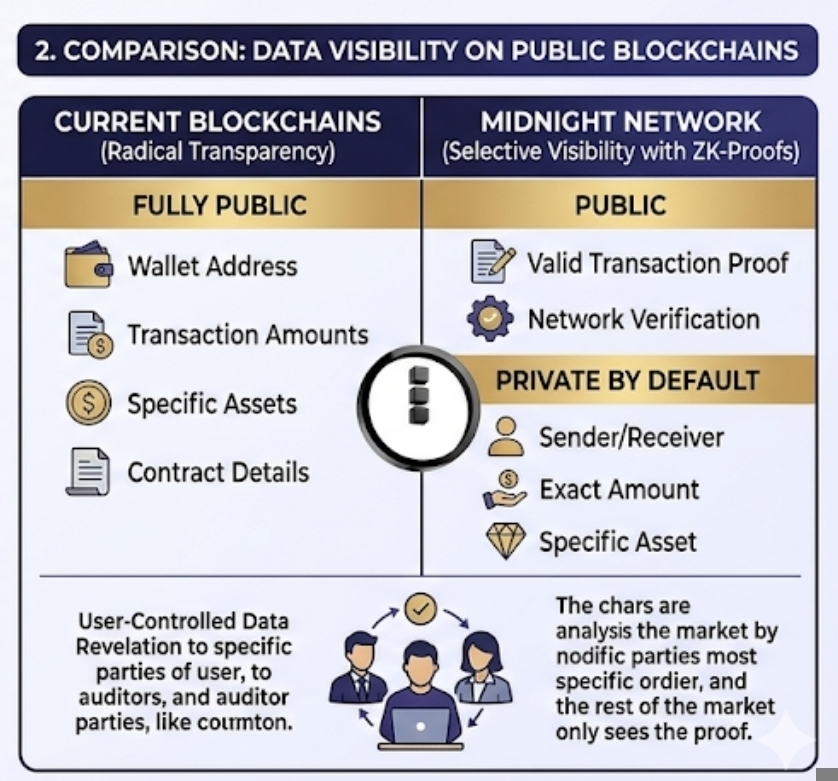
For traders, that could restore something markets normally rely on a little uncertainty.
Markets work partly because not everyone knows everything at the same moment. Information spreads gradually. Prices adjust as participants interpret signals at different speeds. Fully transparent blockchains compress that process. Everyone sees the same raw data instantly.
Which sounds fair in theory. In practice, it often advantages the fastest observers.
Bots monitor the chain continuously. Algorithms react to patterns humans barely have time to notice. A large swap can trigger automated responses within seconds. Privacy layers like Midnight could interrupt that reflexive cycle by limiting what is immediately observable.
Still, I wouldn’t pretend the shift is purely positive. There are real tradeoffs here.
Blockchain analytics has helped expose scams, identify stolen funds, and track suspicious activity across networks. Investigators rely on the openness of the ledger. If too much information disappears behind privacy mechanisms, some of those protections become harder to maintain.
Regulators are already cautious about privacy-focused technologies. A network that hides transaction details will inevitably attract scrutiny, even if its primary goal is simply restoring normal financial discretion.
There’s also the cultural factor inside crypto itself. Many participants have grown comfortable with radical transparency. Watching wallets, analyzing flows, building narratives around on-chain behavior because it has become part of how people understand markets. Removing that data feels almost like removing a layer of visibility traders have learned to depend on.
But markets evolve in quiet ways.
A few years ago most traders barely thought about on-chain data at all. Today it’s central to how narratives form on platforms like Binance Square and other social dashboards. Wallet rankings, profit leaderboards, transaction alerts — these tools shape reputation in subtle ways. If a wallet appears consistently profitable, people treat its movements as signals of intelligence.
That creates a strange situation where credibility comes from visibility.
Privacy networks challenge that dynamic. If transaction histories are no longer fully visible, reputation might shift away from public wallet performance and back toward research, judgment, or long-term results. Or maybe traders will simply invent new ways to measure credibility. Markets tend to do that.
What interests me most about Midnight isn’t the technology itself. Zero-knowledge proofs have been discussed for years. What’s interesting is the timing.
Crypto started with radical transparency because it needed trust. Now the ecosystem is large enough that participants are beginning to ask a different question. Not whether transactions can be verified, but whether every detail needs to be permanently exposed to everyone.
The answer probably isn’t absolute. Complete secrecy doesn’t work well for open systems. But complete transparency doesn’t always work well for markets either.
Somewhere between those two extremes there might be a more natural balance. Midnight seems to be exploring that space. Whether traders actually migrate toward that model is still unclear.
But the fact that people are even reconsidering the role of privacy on public blockchains says something about how the market is maturing.

Artikel
Why Midnight Network Could Change How Traders Think About On-Chain Privacy
0
4
32
Jelajahi berita kripto terbaru
⚡️ Ikuti diskusi terbaru di kripto
💬 Berinteraksilah dengan kreator favorit Anda
👍 Nikmati konten yang menarik minat Anda
Email/Nomor Ponsel