
A few months ago I watched a small warehouse robot move around a loading area behind a grocery store. Nothing dramatic. It just kept carrying plastic boxes from one side of the building to another. What struck me wasn’t the robot itself. It was the quiet dependence around it. The machine needed software updates, mapping data, battery charging, network connectivity. None of those things came from the robot. They came from different systems working somewhere else.
That thought stuck with me longer than I expected.
We usually talk about AI like it lives inside computers, but machines in the real world rely on many outside services just to do basic work. Navigation systems. Data feeds. Cloud computing. Maintenance networks. Right now humans organize all of that. Companies sign contracts. Engineers connect APIs. Payments happen through traditional business systems.
But if machines keep multiplying, that coordination model starts to look awkward.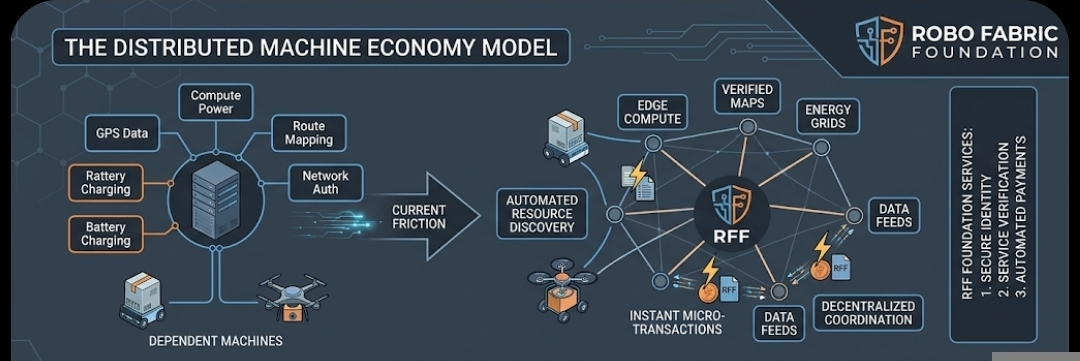
This is where ideas like Fabric Foundation become interesting. Not because of some futuristic “robot civilization” story people sometimes tell, but because of a much simpler possibility. Machines might eventually need a way to buy small services from each other automatically. Not in a dramatic sense. More like constant micro-transactions happening quietly in the background.
Imagine a delivery robot that suddenly needs extra computing power to recalculate a route during heavy traffic. Instead of waiting for a centralized service controlled by one company, it could request that compute from a network. Another node provides it, receives payment, and the robot continues moving. The transaction might last only seconds.
That kind of interaction is basically what people mean when they talk about a machine economy.
The phrase sounds larger than the reality. In practice it just means machines exchanging resources the same way software services already do, except the coordination happens through a decentralized network instead of a single platform. Blockchain systems are useful here because they keep shared records. A transaction can be verified without everyone trusting the same company.
Still, the real story probably isn’t technology. It’s behavior.
Economic systems shape behavior in strange ways. You can see it everywhere online. On platforms like Binance Square, for example, people quickly learn what the ranking algorithms prefer. Posts that generate reactions move higher in visibility dashboards. Writers adapt. Some post more frequently. Others adjust their tone to attract engagement. After a while the algorithm quietly influences how the entire community behaves.
Machines connected to economic networks would respond to similar signals.
If a system rewards reliability, autonomous agents will prefer stable providers even if they cost slightly more. If speed matters most, machines might constantly switch providers looking for faster responses. Reputation metrics, success rates, response times to those numbers start shaping machine behavior the same way social metrics shape human creators.
That part is rarely discussed when people talk about machine economies.
Fabric Foundation seems to focus more on this coordination layer than on flashy narratives. The network tries to solve practical problems first. Devices need identities so other systems know who they are interacting with. Services need verification so machines can confirm that work was actually completed. Payments must move automatically without a human approving every step.
These are not glamorous problems. But they are the ones that matter.
Of course the risks are obvious too. Autonomous systems move quickly, and mistakes multiply faster when machines are involved. A vulnerability in identity verification could allow fake service providers to appear legitimate. Reputation systems might be manipulated. Once automated agents begin interacting at scale, small weaknesses can spread through the network before anyone notices.
Then there’s the economic side. Many crypto projects assume adoption will naturally follow innovation. In reality engineers choose tools that reduce complexity. If decentralized machine coordination adds friction instead of removing it, developers simply won’t use it. The concept only works if the infrastructure becomes easier than the centralized alternative.
Still, I keep coming back to that small warehouse robot.
It didn’t look intelligent. It wasn’t doing anything revolutionary. Just carrying boxes from one place to another. Yet even that simple machine depended on a chain of digital services operating somewhere beyond the warehouse walls. Data providers, compute nodes, maintenance software, mapping systems.
Now imagine thousands of machines like that operating in cities, factories, ports, hospitals.
At some point the real challenge isn’t building the robots. It’s coordinating the invisible services that allow them to function. Humans currently sit in the middle of that coordination, signing contracts and managing infrastructure. Networks like Fabric are experimenting with removing some of that friction.
Maybe nothing dramatic happens. Maybe machine economies grow slowly, quietly, the way internet infrastructure did. Small services exchanging value in the background while people barely notice.
And if that’s the direction things move, the biggest change might not be smarter machines.
It might simply be machines learning how to participate in systems that look a lot like markets.