
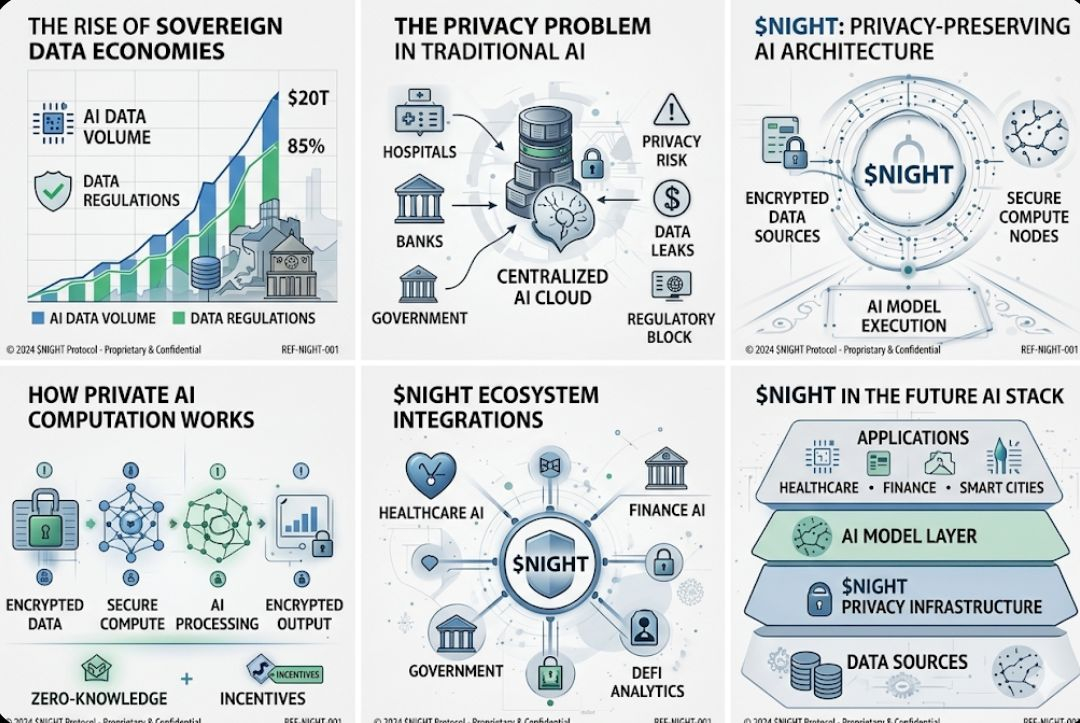
 Artificial intelligence is quietly becoming the new oil of the digital economy. Models need massive datasets, governments want control over their citizens’ information, and corporations are racing to build infrastructure that can process sensitive data without exposing it. That tension — between utility and privacy — is shaping what many analysts now call the sovereign data economy.
I’ve been watching this trend closely because it raises an uncomfortable question: who actually owns the data that powers AI?
Right now the answer is messy. Most AI systems rely on centralized compute clusters where sensitive datasets are aggregated, processed, and stored by a handful of corporations. For enterprises and governments, that model introduces obvious risks. Medical data, financial records, national infrastructure metrics — these aren’t datasets you casually upload to a public cloud.
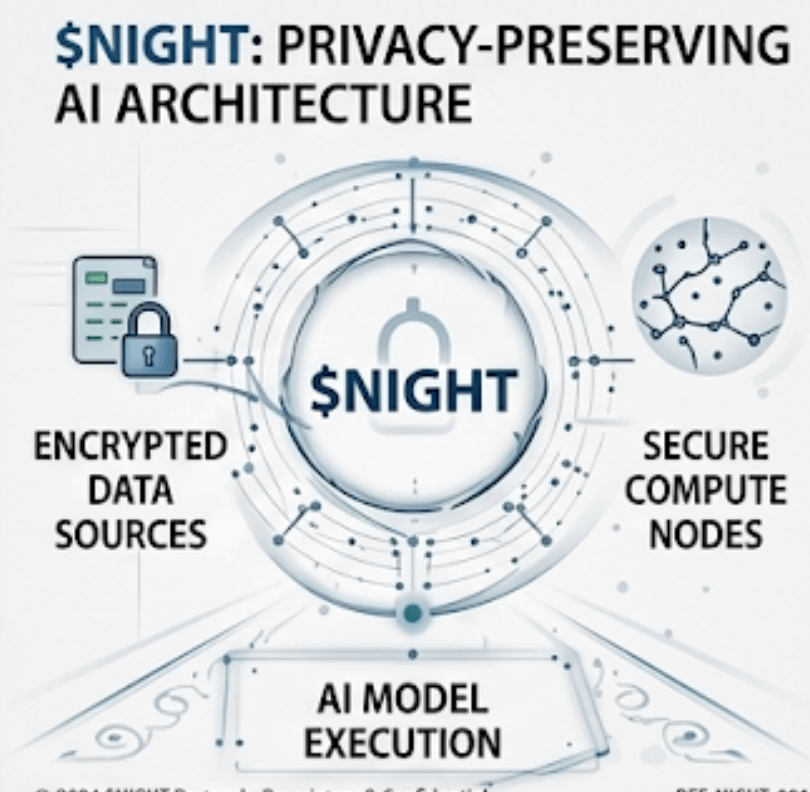
This is where privacy-preserving compute becomes interesting. Instead of sending raw data to an AI model, encrypted computation frameworks allow models to operate on protected information without ever revealing the underlying dataset.
Think of it like a locked briefcase exchange. The model receives the briefcase, performs the calculation while it remains locked, and returns the result without ever seeing the contents inside.
That idea is no longer theoretical. It’s rapidly becoming one of the most important infrastructure layers in the AI economy.
And this is where $NIGHT enters the conversation.
At its core, the Night ecosystem focuses on privacy-preserving computation — infrastructure designed to process sensitive information while keeping the underlying data confidential. In the context of AI, this architecture becomes incredibly powerful.
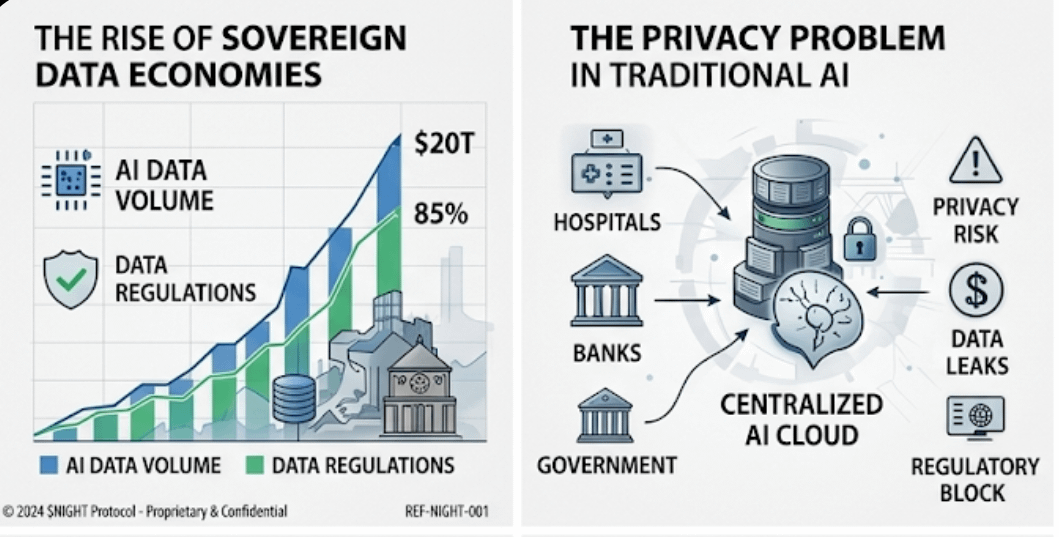
Imagine a government wanting to train a healthcare AI model using hospital data across multiple regions. Traditional machine learning pipelines would require aggregating that data into a centralized repository — a logistical and regulatory nightmare.
A privacy-preserving compute layer changes that equation entirely.
Instead of moving data to the model, the model interacts with encrypted datasets across distributed nodes. The system learns patterns without exposing patient records, regulatory constraints remain intact, and institutions maintain sovereignty over their information.
This is the exact type of architecture sovereign data economies require.
The role of NIGHT in this environment isn’t just symbolic; it sits directly in the infrastructure stack. Tokens in privacy compute networks often function as coordination mechanisms — securing computation, rewarding nodes that process encrypted workloads, and governing protocol parameters.
If AI becomes the engine of future economies, privacy compute networks become the gearbox. And tokens like NIGHT may end up representing the economic layer that keeps that machine running.
What makes the concept particularly compelling is the timing. AI compute demand is exploding, while data privacy regulations are tightening globally.
Europe’s GDPR framework already places strict limits on how personal data can be processed. Similar regulatory models are emerging in Asia and the Middle East. Governments want technological sovereignty — the ability to harness AI without surrendering national data to foreign cloud providers.
That creates a structural demand for privacy-first computation infrastructure.
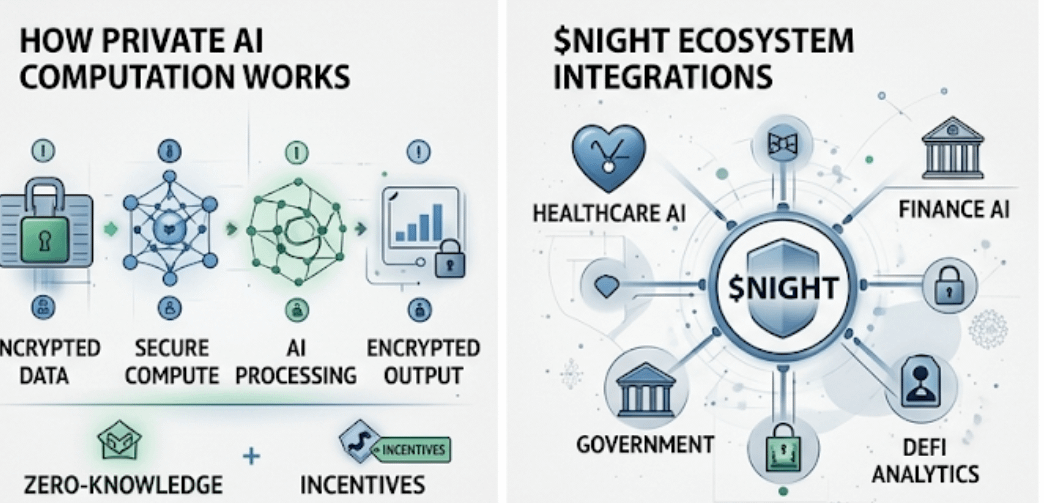
In that environment, NIGHT isn’t competing with traditional AI companies. It’s competing to become part of the foundational layer that enables secure AI deployment.
A useful comparison is the early internet. Protocols like TCP/IP weren’t flashy consumer products, but without them the modern internet wouldn’t exist. Privacy compute networks could play a similar role for AI.
If encrypted computation becomes the standard for sensitive workloads, networks enabling that process effectively become digital utilities.
There’s also a geopolitical dimension that shouldn’t be ignored.
Countries increasingly view data as a strategic resource. Sovereign wealth funds are investing heavily in AI infrastructure, while governments are exploring national data policies. The ability to run AI models on domestic data without exporting it abroad is becoming a national priority.
Infrastructure that supports that capability could become a critical piece of digital sovereignty.
However, the road isn’t risk-free.
Privacy-preserving computation is technically complex and often computationally expensive. Techniques like secure multiparty computation and zero-knowledge proofs can introduce performance overhead compared to traditional processing methods. If these systems cannot scale efficiently, adoption could remain limited to niche use cases.
There’s also the question of ecosystem traction. Infrastructure protocols only become valuable when developers and institutions actually build on top of them. Without meaningful integrations — enterprise partnerships, AI platforms, or government deployments — the theoretical value of privacy compute networks remains unrealized.
Still, the broader trajectory is difficult to ignore.
AI systems are becoming more powerful, data regulations are tightening, and geopolitical competition around digital infrastructure is accelerating. In that environment, privacy-preserving compute networks could shift from experimental technology to essential infrastructure.
If that transition happens, projects like NIGHT may find themselves in an unexpectedly strategic position.
The real takeaway isn’t about token speculation. It’s about the architecture of the future AI economy.
Data sovereignty, privacy-preserving computation, and decentralized infrastructure are starting to converge. And when technological trends converge, entirely new layers of digital infrastructure tend to emerge.
The question is whether $NIGHT becomes one of the protocols powering that layer — or simply one of the early experiments that helped prove the concept.
#night #Night #NIGHT @MidnightNetwork
