Spend enough time around AI discussions and you notice something odd. We argue about model size, training data, compute costs. We compare benchmarks. But almost no one asks a simpler question. Who is this system, exactly
Not what it can do. Who it is in a system of rules.
When a person signs a contract, posts something reckless, or makes a mistake at work, there is context. History follows them. There is reputation. There are consequences that stick. With machines, that thread is thinner. An AI agent executes a task, a bot places trades, a robot completes a delivery, and if something breaks the trail often stops at a company name or an API key.
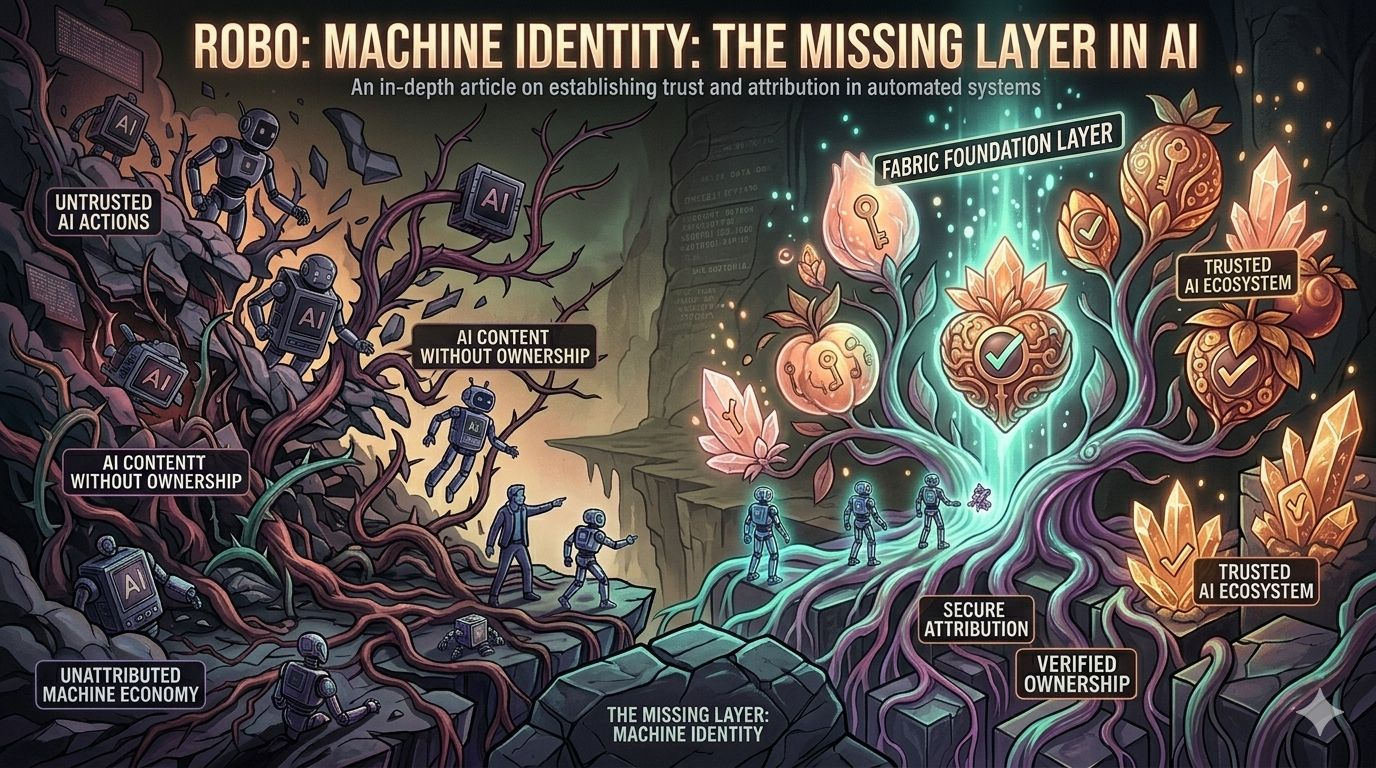
That gap is what Fabric seems to be circling around. On the surface, the project talks about general-purpose robots and agent-native infrastructure. That sounds ambitious, maybe even futuristic. Underneath, though, the more grounded idea is about identity. Persistent, economic identity for machines.
And that’s less flashy, but possibly more important.
The way Fabric frames it, actions taken by agents can be recorded on a public ledger. Not just the outcome, but the validation around it. Who approved the computation. Who staked value behind it. Who had skin in the game. It is a subtle shift. Instead of trusting that a system behaved correctly, the network creates incentives for others to check
I find that interesting because it feels closer to how human systems work. Banks, courts, markets — they all run on layered verification. You rarely trust one actor alone. You trust a structure that distributes responsibility.
Fabric introduces validator roles and slashing conditions, which in simple terms means participants can lose value if they approve dishonest or faulty behavior. It is not just logging activity. It is attaching economic weight to approval. If this holds in practice, identity becomes more than a label. It becomes something that carries cost.
There is also the token layer, ROBO, with a fixed supply of 10 billion units. Big number, yes, but what matters is distribution. Around 24 percent is allocated to investors with multi-year vesting. Close to 30 percent is earmarked for ecosystem and community incentives. That tells you early governance influence may not be evenly spread. Whether that concentration narrows or widens over time remains to be seen.
The economic gating idea is straightforward. Certain actions or roles require staking tokens. That stake acts like a bond. If a validator signs off on a task that later proves fraudulent or unsafe, part of that bond can be cut. It is not a perfect safeguard, but it introduces friction. Friction is sometimes underrated. Systems without it break quickly.
Still, there are uncomfortable edges.
Public ledgers are transparent by design. Robots operating in logistics, healthcare, or finance might generate sensitive data. Recording identity-linked actions openly could clash with privacy expectations. Technical solutions exist, selective disclosure for example, but complexity grows. And complexity has a way of creating new failure points.
There is also the coordination problem. Decentralized oversight sounds healthy in theory. In practice, validator participation needs to stay active and diverse. If a small cluster controls most of the stake, then machine identity becomes centralized under a different name. The foundation model helps separate governance from the issuing entity, but structures on paper and structures in motion are not always the same.
What I keep coming back to is this: intelligence is scaling quickly. Models improve every year. Hardware gets cheaper. But identity moves slower. It requires institutions, incentives, and shared norms. Fabric is trying to build that slower layer alongside the faster one.
Whether it works will depend on real usage. If agents actually perform tasks through the network, if validators remain engaged, if economic penalties are applied fairly. Early signs suggest the architecture is thoughtful. That is not the same as proven.
We built intelligent systems first because it was exciting. Identity feels quieter. Less dramatic. Yet without it, the foundation underneath AI remains thin. Fabric seems to understand that. And in a field that often chases speed, focusing on identity feels almost deliberately steady.
$ROBO #ROBO @Fabric Foundation