
been tracking how Mira actually generates token demand — not the verification story, the token mechanics sitting underneath it. spent a few days mapping the fee flow, the unlock schedule, the holder data. and honestly? what i found is that the protocol and the token are telling two very different stories 😂
the protocol works. the question is whether the token benefits from it in any meaningful way.
here's how MIRA actually functions. an AI system generates an output. MIRA breaks that output into individual atomic claims — not the whole response, each specific statement separately. those claims get sent to a network of validator nodes, each running their own language model trained on different data. the nodes vote: true, false, or uncertain. if a supermajority — roughly two thirds — agree, the result gets logged on Base blockchain as a cryptographic proof. under 30 seconds. the hallucination rate drops from around 30% to roughly 4-5% according to their own figures.
that's genuinely useful infrastructure. Klok copilot is already running on it, processing billions of tokens daily. KGeN and Phala are integrated. the SDK is live and developers can plug in today.
so where does the token come in.
node operators stake Mira to participate and earn fees. that's the entire demand mechanism. integrators pay fees, fees go to stakers, stakers need tokens to stake. clean loop on paper. but the loop only holds if fee volume grows faster than supply expands. and right now the supply expansion schedule is aggressive.
circulating supply sits at 234.07M tokens — 23.41% of total. locked supply: 765.92M — 76.59% still waiting. FDV to market cap ratio is 4.08x, meaning for every dollar of market cap today theres four dollars of fully diluted value sitting behind scheduled unlocks.
allocation breakdown tells you who benefits first. ecosystem incentives hold the largest share at 25.97% — that's community positive. but team, advisors and contractors hold 20%. private sale investors hold 13.83%. insider total comes to roughly 33.83%. public sale allocation: 0.10%. essentially nothing went to the open market at launch.
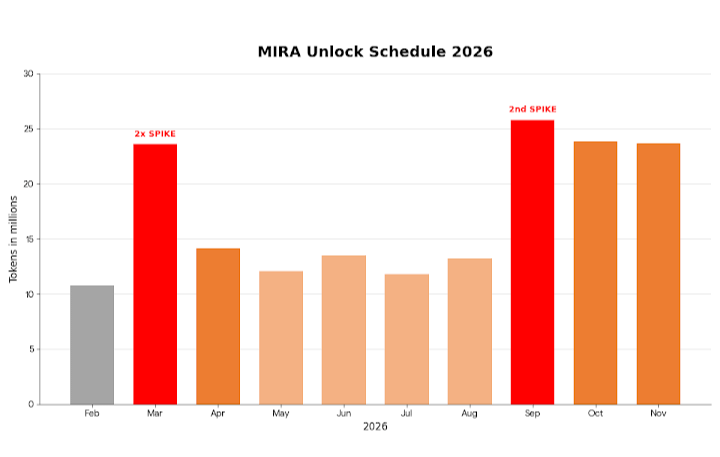
the unlock schedule doesn't give breathing room. today — Feb 26 2026 — 10.79M tokens unlock. $954K worth. two allocations hitting simultaneously. March 26: 23.6M tokens. $2.08M. more than double today's unlock in a single month. April through August runs at 11 to 14M monthly. September 26 brings the second major spike — 25.82M tokens across five allocations at once. October and November follow with 23M+ each. 38 unlock events still ahead in total.
the frame nobody is running: Mira token demand depends entirely on verifications per day multiplied by the fee captured per verification. Klok processes billions of tokens daily — but the fee per verification isn't publicly documented anywhere. you cannot model token demand without that number. and without that model, the bull case is a story, not a calculation.
the timing mismatch is the real mechanism of harm here. insider allocations vest during the early adoption phase, before fee revenue has had time to scale. for the token price to hold flat, fee volume needs to grow fast enough to absorb a continuous stream of monthly unlocks. if ecosystem growth runs even slightly behind schedule, each unlock becomes a ceiling. not a single wall event like some projects face — a repeated monthly ceiling that compounds over time. that's a diferent kind of pressure and harder to recover from.
the diversity-as-security model is the most interesting part of this project. the assumption is that if you run verification across multiple AI models trained on different datasets, correlated errors become less likely. five nodes agreeing across five different training sets is meaningfully stronger than one model checking its own output. the architecture makes sense.
the team backgrounds add credibility to the execution. the partnerships with Klok, KGeN and Phala show real integrations, not just whitepaper promises. the SDK being live means the barrier for new integrators is low. ecosystem incentives at 25.97% — larger than team, larger than investors — signals at least an intention to distribute value outward rather than concentrate it.
and the Base network choice matters. Coinbase's L2 brings lower fees, existing liquidity rails and regulatory familiarity. for a verification layer targeting enterprise and DeFi use cases, that's a more credible foundation than a new or untested chain.
holder concentration is the number that stops me cold. wallet 1 holds 28.08M MIRA — 63.54% of the entire float. wallet 2 holds 10.00M MIRA — 22.62% of float. top two wallets combined: 86.16% of circulating supply. top 10 wallets: 99.02%. total holders across the entire network: 2,960 people.
that's not a community token. that's a token with a community-shaped content strategy.
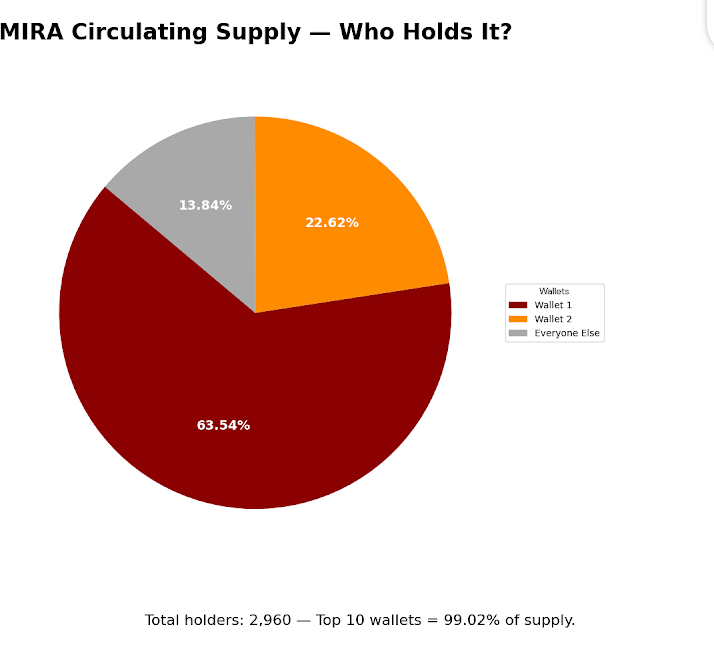
24h volume to market cap ratio sits at 37.18%. for a low-float token with this level of concentration, that volume number reads as a possible distribution signal. when two wallets control 86% of what's tradeable and volume spikes to 37% of market cap in a day — something is moving. whether that's accumulation or exit is the question nobody can answer cleanly right now.
honestly don't know if the fee volume from three known integrators can outpace 38 scheduled unlock events, or if this is a protocol that genuinely works but a token that slowly bleeds regardless. those are completely diferent outcomes sitting inside the same project.
#Mira @Mira - Trust Layer of AI $MIRA
