

Crypto loves big numbers.
More validators.
More nodes.
More “decentralization.”
But here’s a question most people avoid:
Does increasing participation always improve coordination?
After studying distributed systems more closely, I’ve started to doubt that assumption. And Fogo is one of the few projects forcing that conversation into the open.
When Uptime Becomes Dogma
In most blockchain networks, uptime is sacred.
Every validator must be online.
Every region must participate.
Every second must be covered.
Slashing enforces it. Absence is punished. Inactivity is framed as weakness.
But distributed systems don’t reward ideology — they reward efficiency.
Constant participation sounds resilient.
In practice, it can introduce latency variance, longer communication paths, and unnecessary coordination overhead.
Sometimes, more voices don’t create stronger consensus. They create noise.
Coordination Over Uniformity
What makes Fogo interesting isn’t just speed. It’s philosophy.
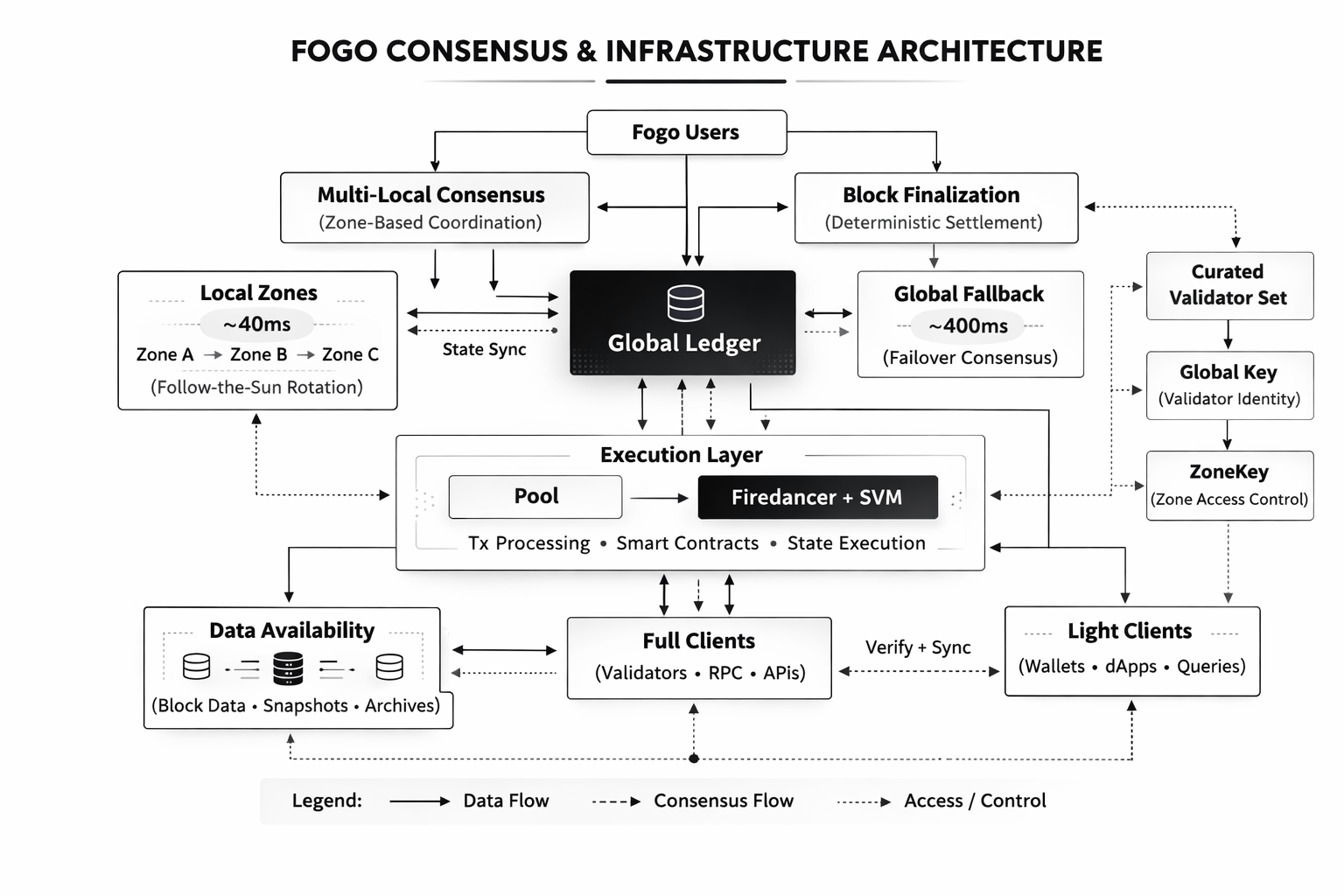
Through its Multi-Local Consensus and “follow-the-sun” architecture, validator activity becomes structured rather than random.
Zones rotate based on trading demand.
Participation aligns with activity windows.
Infrastructure is activated intentionally.
This isn’t about excluding validators. It’s about aligning them.
Right hardware.
Right geography.
Right timing.
Instead of forcing every node to be active at once, Fogo treats consensus like a coordinated system — not a permanent town hall meeting.
Rethinking Decentralization Metrics
The industry often measures decentralization by counting validators.
But what if the better metric is outcome integrity?
If consensus is tighter, cleaner, and more predictable, the system functions better — even if validator participation is dynamically structured.
That shifts decentralization from optics to engineering.
Not “How many nodes are online?”
But “How reliable is the result?”
That’s a very different standard.
The Market Infrastructure Parallel
Traditional financial markets don’t operate on uniform global activity 24/7.
They structure sessions.
They manage participation windows.
They coordinate liquidity flows.
Risk is reduced through alignment, not randomness.
Fogo applies similar logic to blockchain consensus — which makes it feel less like a hobbyist experiment and more like engineered infrastructure.
Firedancer and Hardware-Aware Performance
The integration of Firedancer as a validator client reinforces this direction.
This isn’t just faster software.
It’s hardware-conscious optimization designed for real-world performance environments.
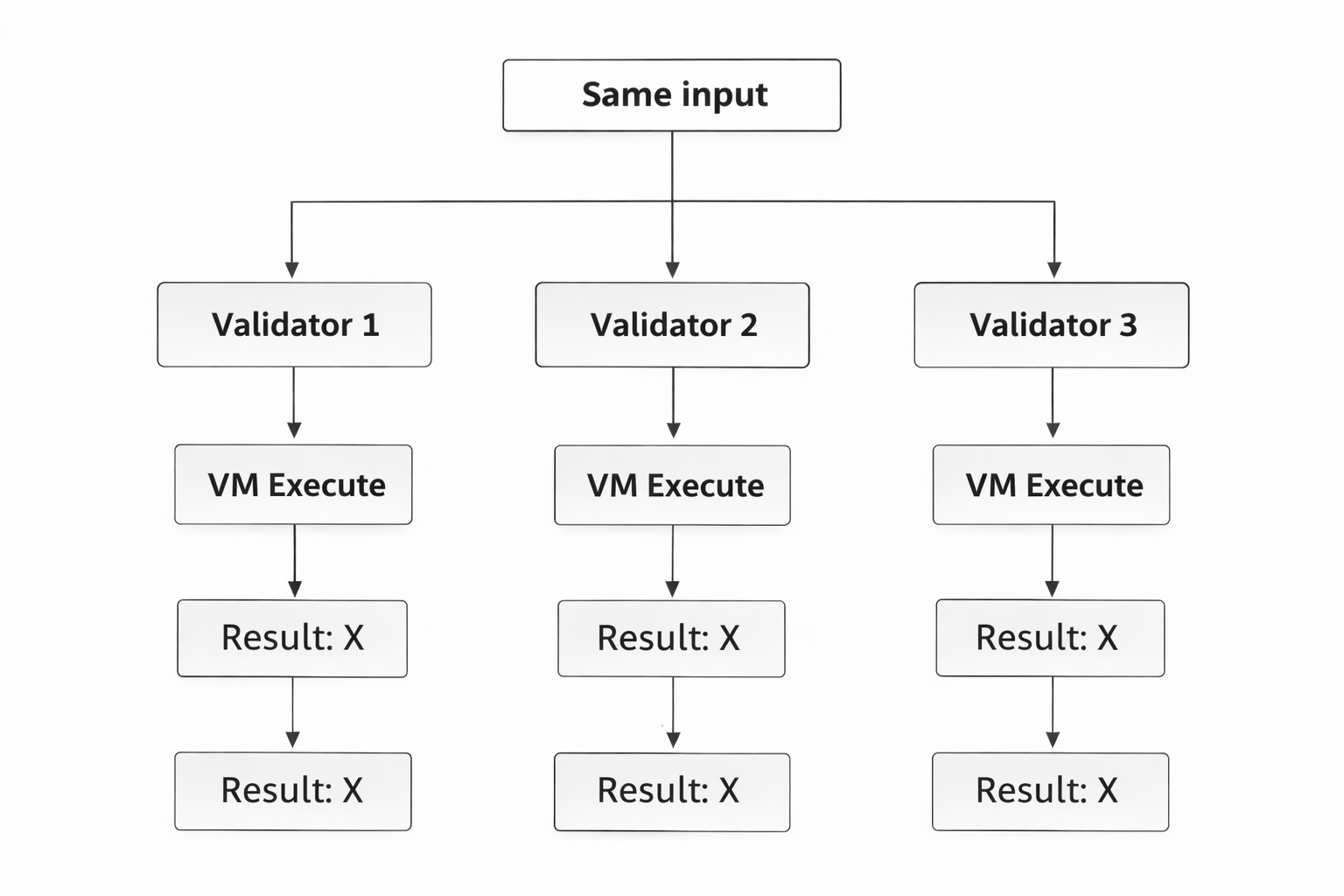
When you combine zone-based coordination with performance-tuned infrastructure, you get something different from typical blockchain design.
You get predictability.
And in financial systems, predictability is power.
Layered Resilience Instead of Constant Activity
One of the most overlooked strengths in Fogo’s architecture is fallback design.
If a validator zone fails, the network can revert to broader consensus.
Slower — but secure.
That’s not fragility.
That’s layered resilience.
True robustness isn’t about staying in one mode forever. It’s about adapting safely when conditions change.
The Bigger Implication
Fogo isn’t simply optimizing validator performance.
It’s challenging how the industry defines decentralization itself.
Not participation for its own sake.
Not validator count as a marketing metric.
But engineered coordination that produces predictable, resilient outcomes.
And whether the broader crypto space is ready to admit it or not — coordination engineering may be the evolution blockchain infrastructure has been waiting for.
