
Let me explain Fogo in the simplest, most human way.
Most blockchains today compete on numbers.
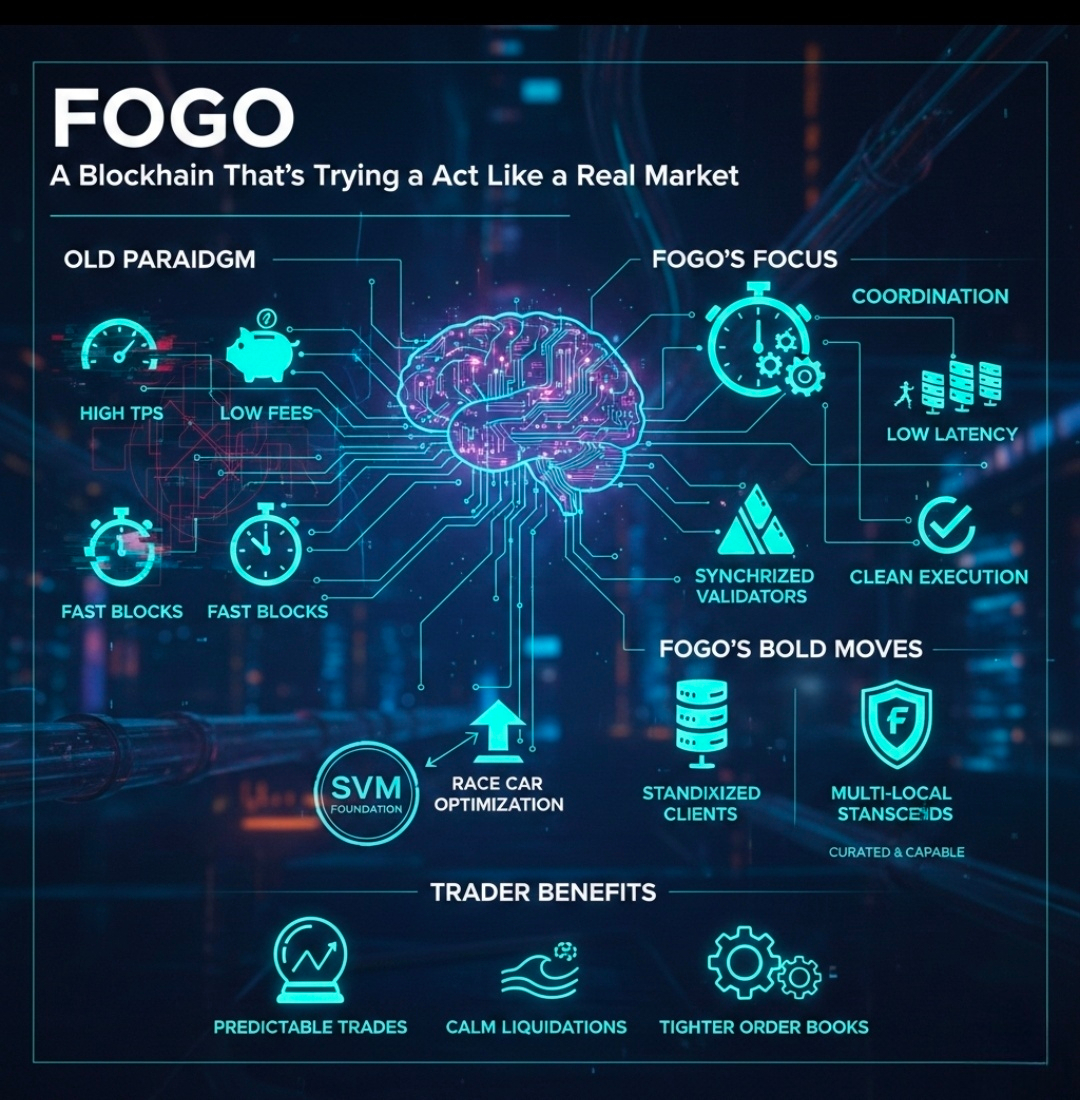
Higher TPS. Lower fees. Faster blocks.
But if you’ve actually traded in fast markets, you know something important:
Speed alone doesn’t fix messy execution.
What really matters is how the whole system behaves when things get busy — when volatility hits, liquidations trigger, and everyone rushes at the same time.
That’s the angle where Fogo starts to feel different.
The Question Fogo Is Really Asking
Instead of saying, “Look how fast we are,” Fogo is asking something deeper:
> If we want real financial markets on-chain, why aren’t we building blockchains the way real markets are built?
In traditional finance, people obsess over tiny delays. Exchanges spend huge money just to shave milliseconds because those milliseconds change outcomes.
In crypto, many networks still treat latency like a side metric.
Fogo doesn’t.
It treats latency like physics — something you must design around from day one.
It’s Not Just About Speed — It’s About Coordination
Here’s where many people misunderstand fast chains.
A network doesn’t become “market-ready” just because one part is fast. Problems usually come from the full pipeline:
clocks drifting
messages arriving unevenly
validators handing over poorly
network jitter during busy periods
different clients behaving differently
Fogo’s core belief is simple:
Clean markets require tight coordination across the entire system.
Not just a fast engine — a well-synchronized machine.
And honestly, that mindset feels much closer to how serious trading infrastructure is built.

Why Fogo Builds on the SVM Foundation
Fogo is built on the Solana Virtual Machine stack, and that choice is very practical.
Instead of reinventing every component, the team is starting from technology that already proved it can handle high throughput and parallel execution.
But the goal isn’t to copy anyone.
The goal is to take a proven performance base and push it further toward something that feels reliable under real trading pressure.
Think of it like building a race car. You don’t start by inventing metal. You start with what works and then optimize the parts that decide the race.
The Bold Move Most Chains Avoid Talking About
One of Fogo’s most controversial ideas is its approach to validator clients.
In theory, having many different clients increases diversity and safety. That’s true in some ways.
But there is a tradeoff people don’t always talk about:
Networks often slow down to accommodate the weakest widely used client.
If half the validators run slower software, the whole system can inherit timing inconsistencies — especially during leader changes and high load.
Fogo takes a very direct stance here.
It prefers to standardize around a high-performance client path inspired by Firedancer, with a gradual migration plan instead of a sudden switch.
This feels very similar to how real exchanges operate. They don’t run five matching engines for comfort. They run the one that performs best.
You may agree or disagree with the philosophy — but at least the logic is clear and consistent.
Multi-Local Consensus: Respecting Real-World Distance
This is probably one of the most interesting parts of Fogo’s design.
Crypto often talks like geography doesn’t matter. But in reality, data still travels through physical cables. Distance still creates delay.
Fogo actually leans into this reality.
The idea is to keep active validators physically close enough to each other to reduce communication delay. When machines are near each other, messaging is faster, block production tightens, and the window for market manipulation shrinks.
But the team also understands the risk of staying in one place forever.
So the design includes zone rotation, allowing the network to shift regions over time through coordinated agreement.
In plain words:
Stay close to gain speed
Rotate to avoid being stuck
It’s a very practical way of balancing performance and resilience.
Validator Standards: The Uncomfortable Truth
Another thing Fogo is unusually honest about is validator quality.
Permissionless systems sound beautiful in theory. But in practice, poorly equipped validators can drag down the entire network during stressful moments.
Weak hardware. Bad networking. Poor operations.
These don’t just hurt one node — they can affect block quality, propagation, and overall stability.
Fogo’s answer is a curated validator approach that looks at both stake and operational capability.
This will always be debated in crypto circles. Some people will love it. Others will hate it.
But from a market-performance perspective, the reasoning is straightforward:
If you want professional-grade behavior, the infrastructure must meet professional standards.
Why Traders Should Actually Pay Attention
At the end of the day, traders don’t care about architecture diagrams.
They care about three feelings:
Does the system stay consistent when markets get wild?
Do orders behave predictably?
Is the hidden “bot tax” getting smaller or bigger?
Fogo’s entire design is trying to reduce that invisible friction.
If it works, you won’t notice it through marketing slogans. You’ll notice it when:
trades execute more cleanly
liquidations feel less chaotic
order books feel tighter
the network feels calm even when volume spikes
In markets, those small feelings matter a lot.
The Bigger Picture
When you zoom out, Fogo isn’t just trying to be another fast chain.
It’s trying to answer a more serious question:
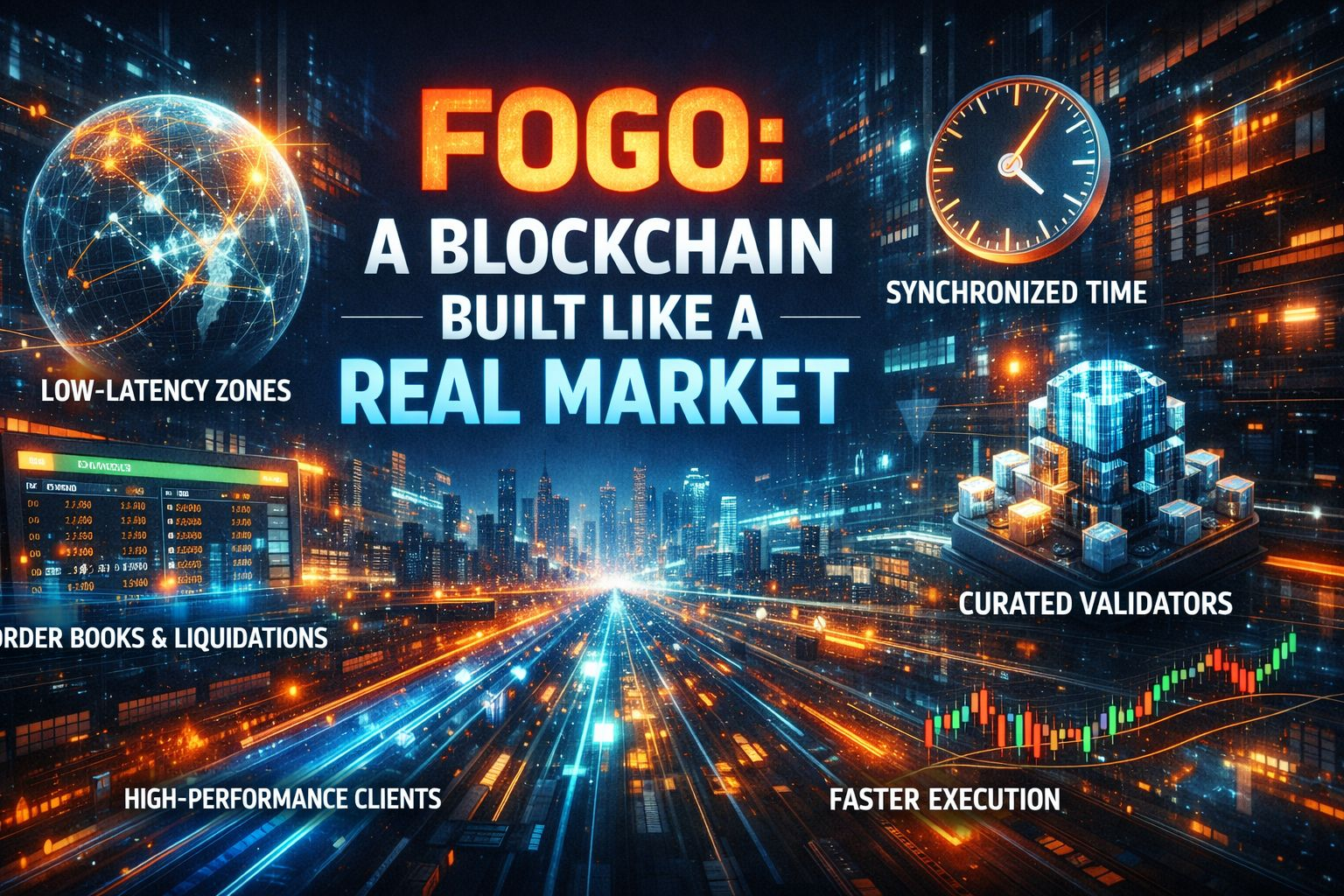
What would a blockchain look like if it were designed like real market infrastructure from the beginning?
That means:
respecting latency
coordinating validators tightly
standardizing performance
smoothing user interaction
and focusing on execution quality, not just headline speed
You can absolutely debate the tradeoffs. Reasonable people will.
But one thing is clear:
This is not a generic Layer-1 story.
Final Thoughts
If Fogo succeeds, the win won’t be a flashy TPS number.
The real win would be something traders feel instantly:
Execution that is calm, predictable, and clean — even when markets get busy.
And in trading, that quiet reliability is often more valuable than raw speed.
