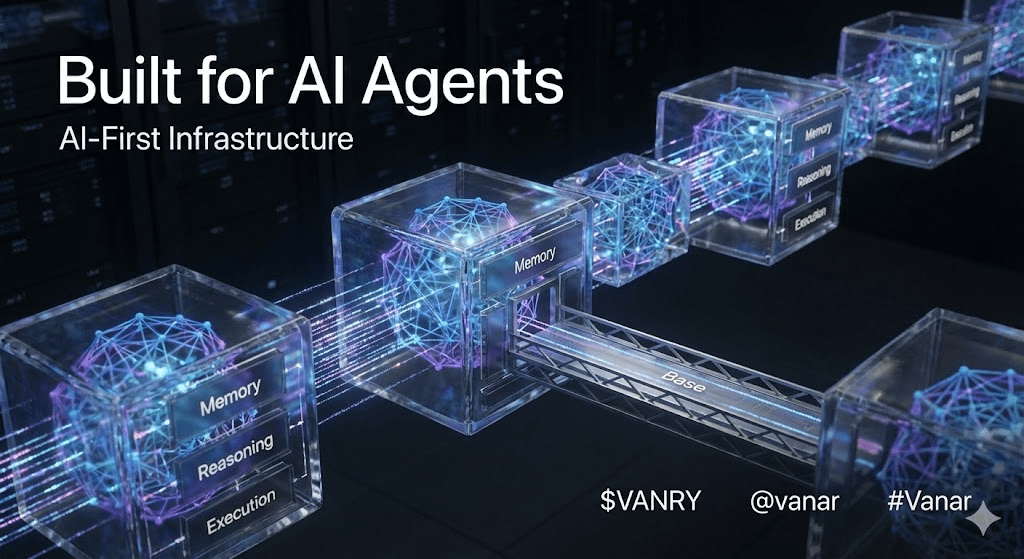
The subsequent competitive level of Web3 will not be regarding small profits in TPS and minuscule reduction of fees. It will depend on whether artificial intelligence is designed into the infrastructures. It is not just that AI added systems and AI first systems differ. @Vanarchain is obviously an AI first company.
Artificial intelligence infrastructure is an attempt to add machine learning related capabilities to existing blockchain architectures. The designs had primary applications of token transfer and smart contract execution. The insertion of intelligence in them introduces strain, additional reliance, and faulty workflow. Conversely, native intelligence is one of the primary requirements of the construction of the @vanarchain. This is not just a cosmetic modification but it dictates long term sustainability. What is AI ready at the infrastructure level?
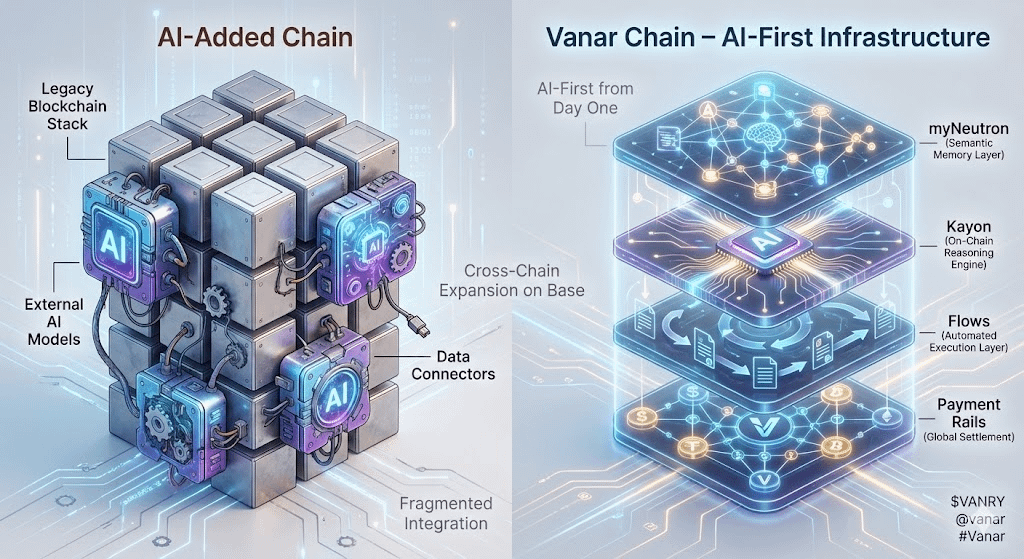
On the AI, there are four structural elements required persistent memory, reasoning capability, automation and settlement rails. These needs cannot be reduced only to transaction throughput. Intelligence requires semantic memory layers which retain structured context. It does not only need engines of reasoning, but also run conditions. It must have automated execution frameworks that convert decisions to safe actions. And it should have submissive, worldwide payment railways in economic settlement. Vanar Chain depicts such elements in actual products, not just designs.
my Neutron demonstrates that semantic memory and long term AI condition can exist on the infrastructure layer. Organized data is not merely stored, but it is stored in such a fashion that it allows contextual continuity.
Keyon demonstrates that it is possible to reason and to be explainable on-chain. This is essential in agent-based systems which require clear logic, as opposed to off-chain computation which is opaque.
Flow makes intelligence automated execution, allowing structured rationale to cause safe and verifiable behavior in decentralized settings. These components constitute an embedded smart stack together. $VANRY can be used throughout this stack making token utility match infrastructure demand or demand at the expense of speculation.
Cross-chain expansion is another strategic factor. The AI first infrastructure can not remain confined to a single ecosystem. It opens up to other chains, with Base as the first step, Vanar technology has additional liquidity, communities of developers, and users. This increases the possible applications of $VANRY across more than one network enhancing the scalability in the long run.
When in the modern market, new generic Layer 1 chains begin to be launched without demonstrated AI preparedness, it is a structural issue. There is already core infrastructure through Web3. The market actually requires ready to produce intelligent systems. Distinction is not consensus novelty now, it is demonstrated AI integration.
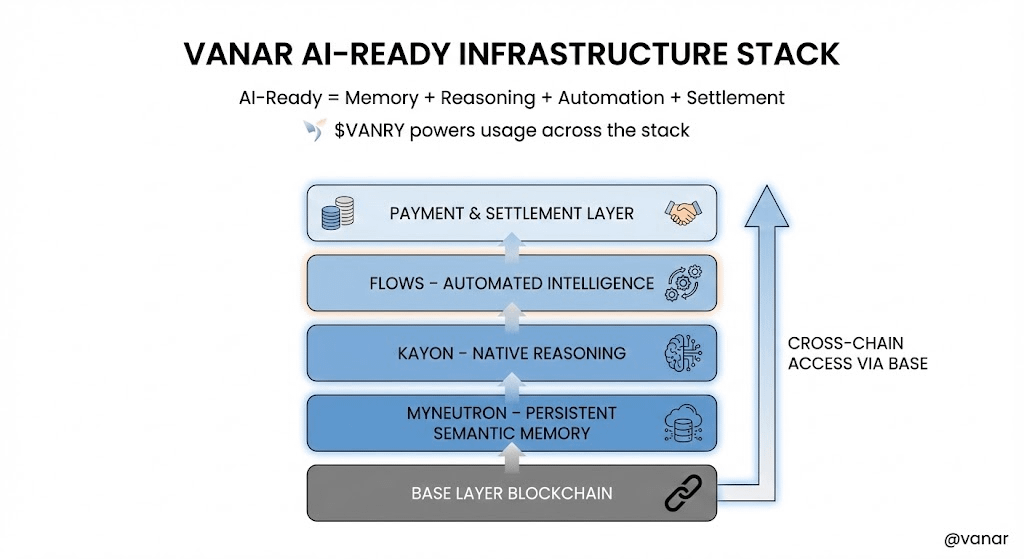
The complete AI-first architecture is made up of payments. AI agents do not interact with traditional wallets. They require programmable, conforming settlement systems that can realistically perform economic activity. AI systems remain experimental without the built-in payment rails. They make them economically functional. This is what is positioned by $VANRY, it makes the company not based on demos but real usage and transactional activity.
The larger connotation is strategic exposure. VNARY incurs with infrastructure to support the agents, enterprises and AI native applications. With the increase in the use of AI in various sectors, blockchains, which have not been designed with intelligence, will be constrained in architecture. Whose first layer is AI will be structurally advantaged. The thesis of @Vanarchain is straightforward in its nature: intelligence cannot be retrofitted on a large scale. It has to be constructed at its inception. In the age of artificial intelligence, marketing is not preparedness but the precursor to a long-term value.