
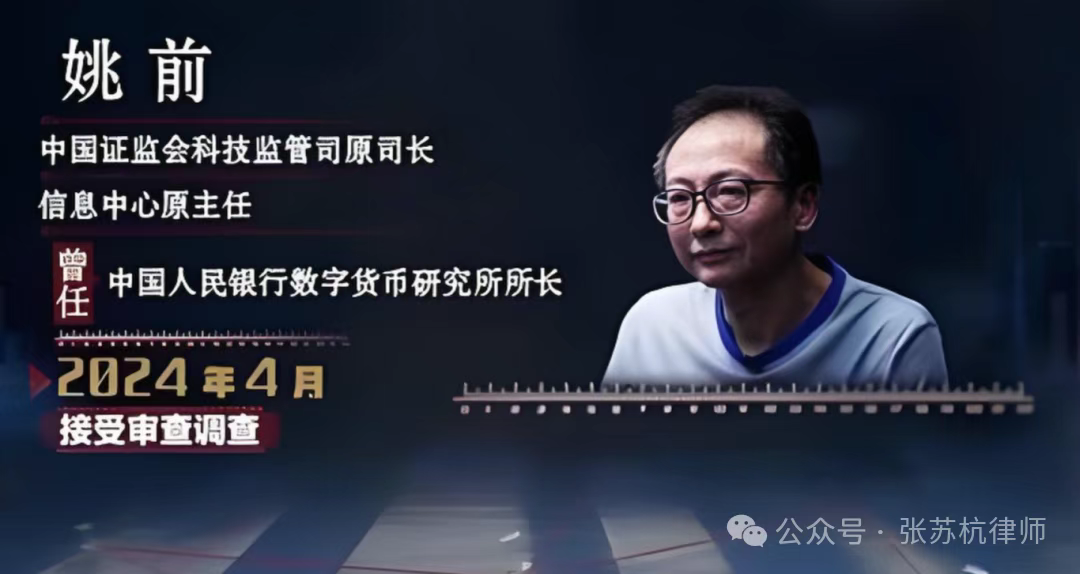
The case of Yao Qian, I've been closely following it for several days, and the more I analyze it, the more intriguing it becomes.
Former head of the Technology Regulation Department at the China Securities Regulatory Commission, former director of the Digital Currency Research Institute at the People's Bank of China, a widely recognized blockchain expert, was caught on 2,000 ETH, expelled from the party and the public service, and placed under investigation, with the involved amount exceeding 60 million yuan.
A seasoned insider who understands both regulatory rules and blockchain technology, using virtual currencies to build a path for corruption, ultimately targeted and brought down with precision.
For Yao, this is a tragic story.
Yao, the former head of the Digital Currency Research Institute, later took charge of technology regulation at the China Securities Regulatory Commission. He had deep knowledge of blockchain, private keys, hardware wallets, and on-chain transactions—more than many in the cryptocurrency community.
It is precisely because he understands that the bribery path he designed is more targeted.
Knowing the wallet address does not require real-name registration, specifically having subordinates act as intermediaries, using multiple layers of addresses to cut off the direct connection with the briber; knowing that hardware wallets are easier to hide than cash or gold bars, with no need to worry about physical checks, and without the mnemonic phrase, it is just an ordinary electronic device;
He even calculated the cashing-out rhythm, first transferring 370 ETH to exchange for tens of millions of funds, using a shell account to pay for the real estate, attempting to sever the connection between virtual assets and real assets.
But it can be said that he made two core mistakes from the very beginning:
First, seeing only the anonymity of blockchain but not its traceability.
Everyone in the circle knows that the core of public chains is openness, transparency, and immutability. Every transfer of ETH, including address, time, and amount, is permanently recorded on the chain and can be checked indefinitely.
The 2000 ETH from Yao Qian, from the briber's wallet to the subordinate's transit account, and then to his own hardware wallet, including that cash-out transfer in 2021, the entire chain is clear and traceable.
The so-called multi-layer transit cannot sever the financial connection in front of professional on-chain tracing technology; it only delays the verification speed.
Second, the ultimate destination of virtual currency is cashing out, and cashing out must leave traces.
ETH cannot be used directly to pay for real estate or for direct consumption. No matter how hidden the on-chain flow is, it ultimately has to connect with real assets to complete the realization of benefits.
Yao Qian's villa is the most direct example; the ETH on-chain is exchanged for fiat currency, flowing into a shell account, and then into the property transaction stage. Every step cannot escape the real regulatory system, but once virtual assets are cashed out, all disguises are nonsense.
Here we can delve into a hypothesis that is often discussed within the circle:
If the briber does not transfer funds but directly hands over the mnemonic phrase of a cold wallet containing Bitcoin to the bribed party, and the bribed party does not exchange it for fiat currency but only exchanges it for stablecoins like USDT through flash exchanges, holding it long-term or only circulating on-chain, can this operation really evade regulatory penetration?
My conclusion is very clear: it cannot be, and it is fundamentally impossible to hide.
As long as the bribed person operates the wallet using the mnemonic phrase - even if it is just to check the balance, as long as they initiate on-chain interactions, they will leave signature records. The special investigation team can easily associate this wallet with the bribed person's other actions through address clustering analysis.
Flash exchanges are essentially currency swaps completed through smart contracts. Each exchange leaves transaction hashes, contract interaction records, and fund flows on two chains.
The so-called 'anonymous transfer' is merely adding a few traceable nodes in front of on-chain tracing tools.
Professional on-chain analysis tools have long matured and can easily restore the complete path of cross-chain flash exchanges. Even if split into multiple small transactions, as long as the address clustering points to the same controller, it can be accurately identified.
More importantly, stablecoins are also products of centralization.
The issuers of stablecoins like USDT and USDC, as well as major trading channels, are all under the global regulatory perspective. It has become a norm for issuers to cooperate with law enforcement to freeze assets of involved addresses.
Even if stablecoins are held long-term without converting to fiat currency, as long as the address is marked as suspicious, regulators can lock down assets through on-chain monitoring and restrict their flow and transactions, equivalent to holding a string of numbers that cannot be cashed out.
Moreover, you still have to cash out in the end.
For the bribed person, even if they only hold stablecoins in the short term, they will eventually need to use them for foreign consumption, asset acquisition, etc. Once they trigger off-chain scenarios, they will inevitably be linked to real identities, and the evidence chain naturally closes.
The logic of investigating the Yao Qian case is precisely tracing on-chain funds back to real assets, and then reversely locking down on-chain addresses. This dual penetration approach has already become standard for handling such cases.
Looking beyond individual cases, virtual currency has long become an important carrier of new types of corruption. The common operational paths within the circle today can be classified into two types, neither of which is new:
One type involves direct token transfers + multi-layer transit, where the briber uses an anonymous wallet to transfer tokens, which then transit through multiple unrelated addresses before reaching the bribed party's wallet, attempting to weaken the connection;
Another type involves holding + cross-border cashing out, finding small holding institutions in the cryptocurrency circle to manage tokens, and when the time is ripe, using over-the-counter channels to exchange fiat currency in batches, or directly settling foreign real estate and consumption with tokens, thus evading domestic capital regulation.
Many people think public chains are decentralized and that regulation cannot penetrate; in fact, they confuse technical attributes with regulatory capabilities.
Now, regulation is no longer at the stage of being oblivious to virtual currencies. On-chain tracing, address clustering analysis, and fund flow penetration are all mature verification methods.
Even tokens that have gone through five or six layers of transit can be traced back along the entire chain as long as any associated address can be locked down.
The over-the-counter currency dealers, holding institutions, and cross-border settlement channels are all breakthroughs in reality. As long as cashing out is involved, there will be traces to follow.
The investigation of the Yao Qian case is essentially a combination of on-chain tracing + real fund penetration. There is no technical barrier; it is just a matter of precision.
The most worth pondering aspect of the Yao Qian case is the two objective issues hidden in the case, which I have been repeatedly contemplating these days.
First, relying solely on prohibition cannot stop corruption with virtual currency; it requires technology to confront technology head-on.
The domestic ban on virtual currency trading and speculation has been to prevent financial risks, which is not a problem. However, the Yao Qian case can understand that the ban cannot control corrupt individuals using tokens for power and money transactions - what they want is not to profit from trading coins, but the property of covert token circulation.
Relying solely on 'prohibiting transactions' cannot block loopholes; the core still needs to keep up with the pace of technology.
Regulators need to have people who understand blockchain and can perform on-chain analysis, who can understand wallet address connections and restore cross-chain transaction paths. Using the same technical means to counteract, they can accurately catch the culprits.
The reason the Yao Qian case could be solved is that the case handlers understood the on-chain logic deeply; this is the most effective method.
Second, the carrier of corruption is changing, but the underlying logic has never changed.
From cash, gold, and equity to the current BTC and ETH, the things used for bribery have always changed, but the core has always been the transaction of power and money, ultimately falling to actual benefits.
Yao Qian thought virtual currency could be invisible, but he actually got it wrong: power is tangible, and the benefits to be exchanged are also tangible. Even if tokens are transferred on-chain very covertly, they ultimately have to turn into real things like houses and consumption; as long as they materialize, there will be traces.
In short, regardless of the carrier used, the essence of corruption has not changed. The means to catch you will only increase; this point cannot be avoided.
Just remember, do not reach out; reaching out will surely get you caught.

