
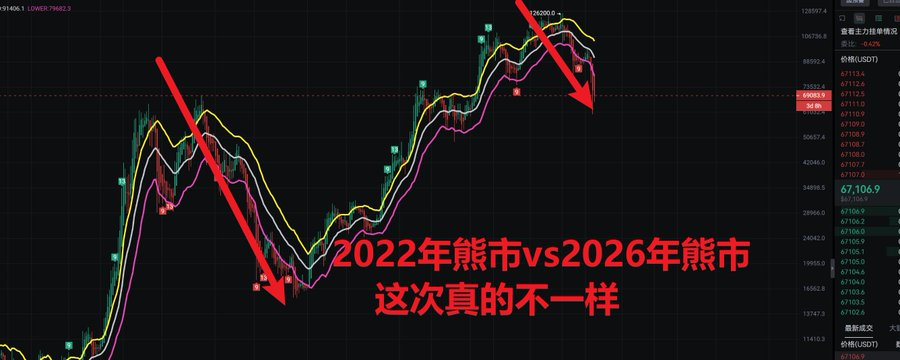
 (Let's assume we are already in this round of the bear market.)#比特币
After Bitcoin enters the adjustment period in 2026, many people will naturally ask:
What are the essential differences between this round of bear market and the one that started in 2021?
If we only look at the price trends, both rounds of decline have experienced the process of 'peaking - falling back - cooling emotions'. But when you delve into trading volume, leverage structure, institutional movements, and macro background, you will find -
This is not the same bear market.
Let's start with the conclusion:
The 2021 bear market was a 'liquidity withdrawal bear market'.
The 2026 bear market is more like a 'structural bear market in a high-leverage mature market'.
The former is macro-driven,
The latter is driven by market structure.
Next, we will break down from five core dimensions
1. Trading volume structure: Slow tide vs Rapid stomp
Early stage of the bear market in 2021
The trading volume in the top area gradually increases
The decline is 'falling while increasing volume'
During this period, there are continuous shrinking rebounds
Real panic volumes appeared during the Luna and FTX events in 2022.
This is a typical 'liquidity tide' decline.
Funds do not disappear overnight, but gradually withdraw.
At that time, a large amount of chips were still held in spot, and the market was still repeatedly betting on 'whether the bull market has ended'
Early stage of the bear market in 2026
Top trading volume is highly concentrated
The decline is accompanied by large-scale liquidations of derivatives
Leverage liquidation drives short-term violent fluctuations
The rebound volume is obviously insufficient
This is more like a 'leverage stomp.'
The trading volume in 2026 is not generated from divergent games, but driven by the clearing mechanism.
Perpetual contracts, ETFs, options, and structured products overlapping have made the market's reaction speed much faster than in 2021.
The difference in one sentence:
2021 is a slow tide receding
2026 is a rapid stomp
2. Driving factors: Macro killing valuations vs Market internal defoaming
The main reason for 2021
The Federal Reserve turns hawkish
Interest rates entering an upward cycle
Technology stocks peaked
Global risk assets are under overall pressure
The bear market in 2021 is essentially a macro liquidity turning point.
At that time, Bitcoin was already highly correlated with the Nasdaq, belonging to 'part of risk assets.'
Macroeconomic liquidity is shifting, and valuations are being compressed overall.
The main reason for 2026
ETF funds show a net outflow.
Institutions realize profits
Excessive leverage triggers chain liquidations
Long-term holders begin to differentiate
Macro has not seen a similar 'extreme liquidity turning point' as in 2021.
More of a structural correction after overheating within the crypto market.
This is more like:
Rebalancing after excessive crowding in the bull market
3. Speed of emotional collapse: Gradual vs Rapid
The emotional path in 2021
Optimism → Divergence → Disbelief → Buy on dips → Further decline → Real panic
At that time, the market consensus was:
'The halving cycle bull market will not end so quickly.'
Belief is very strong, and the emotional collapse in the early bear market has not completely occurred.
The emotional path in 2026
Extreme enthusiasm → Leverage explosion → Rapid panic → Wait and see
The speed of emotional collapse in this round is much faster than in 2021.
The reason is simple:
The market is more mature
Information spreads faster
Leverage ratios are higher
Institutions are more rational
The current market no longer has a long 'fantasy buffer zone.'
4. Deleveraging rhythm: Segmental clearing vs Early concentrated release
This is the biggest difference between the two rounds of bear markets.
2021-2022
Deleveraging is 'segmental':
May 2022: Luna
November 2022: FTX
The bear market is not a one-time event, but a series of structural explosions.
2026
In the early bear market, large-scale liquidations had already occurred.
Because:
The volume of perpetual contracts far exceeds that of spot
Leverage multiples are higher
ETF and derivatives are highly intertwined
This means:
The decline is more severe, but the deleveraging speed is faster.
In a sense, the pain comes earlier.
5. Institutional role: Incremental stage vs Stock realization
2021
Institutions have just entered the market:
MicroStrategy continues to increase positions
Traditional funds begin to allocate
'Institutional entry' is the core narrative of the bull market
In the early bear market, institutions did not withdraw on a large scale.
2026
Institutions have already experienced a complete bull market cycle and made huge profits.
Now is the rebalancing phase:
ETFs show stage net outflows
Some funds flow back into yield-bearing assets
Adjustment of allocation ratios
This indicates:
2021 is the tide of new funds receding
2026 is the realization of mature funds
6. Essential differences
We can condense the two rounds of bear markets into one sentence:
Bear market in 2021
Liquidity tide-type bear market
Triggered by macro turning points, the market gradually cools down.
Bear market in 2026
Structural bear market in high leverage mature markets
Triggered by overheating within the market and profit realization, the decline is more severe, but the clearance is faster.
The final key question
If 2021 was macro killing valuations,
So what does 2026 look more like?
More like cyclical rebalancing in mature markets.
This does not mean there will not be a deep decline,
But its logic and rhythm are already different from the previous round.
The market has changed, the structure has changed, and the participants have changed.
But what really determines the future is not 'whether it looks like 2021',
But it is——
Has this round of deleveraging been completed?
