


Most blockchains still assume the main user is human. Wallet. Click. Sign. Confirm. Done.
That model already feels outdated.
AI systems don’t log in. They don’t hesitate before signing. They don’t wait for UI clarity. If agents are going to operate in real environments — coordinating services, managing assets, executing logic continuously — the infrastructure underneath them has to be built differently from the start.
That’s the angle Vanar Chain takes, and it’s honestly not a small shift.
Vanar isn’t trying to “add AI.” It’s built around the idea that intelligence will be a native participant in the network. That means memory, reasoning, automation and settlement can’t be optional modules bolted on later. They have to exist at the infrastructure layer.
A lot of chains call themselves AI-ready. Usually that means they can host AI apps or run inference somewhere. But AI-ready infrastructure actually means something else. It means systems can remember context over time, explain decisions, act safely without constant human input, and settle value globally without friction.
Vanar’s stack reflects that assumption.
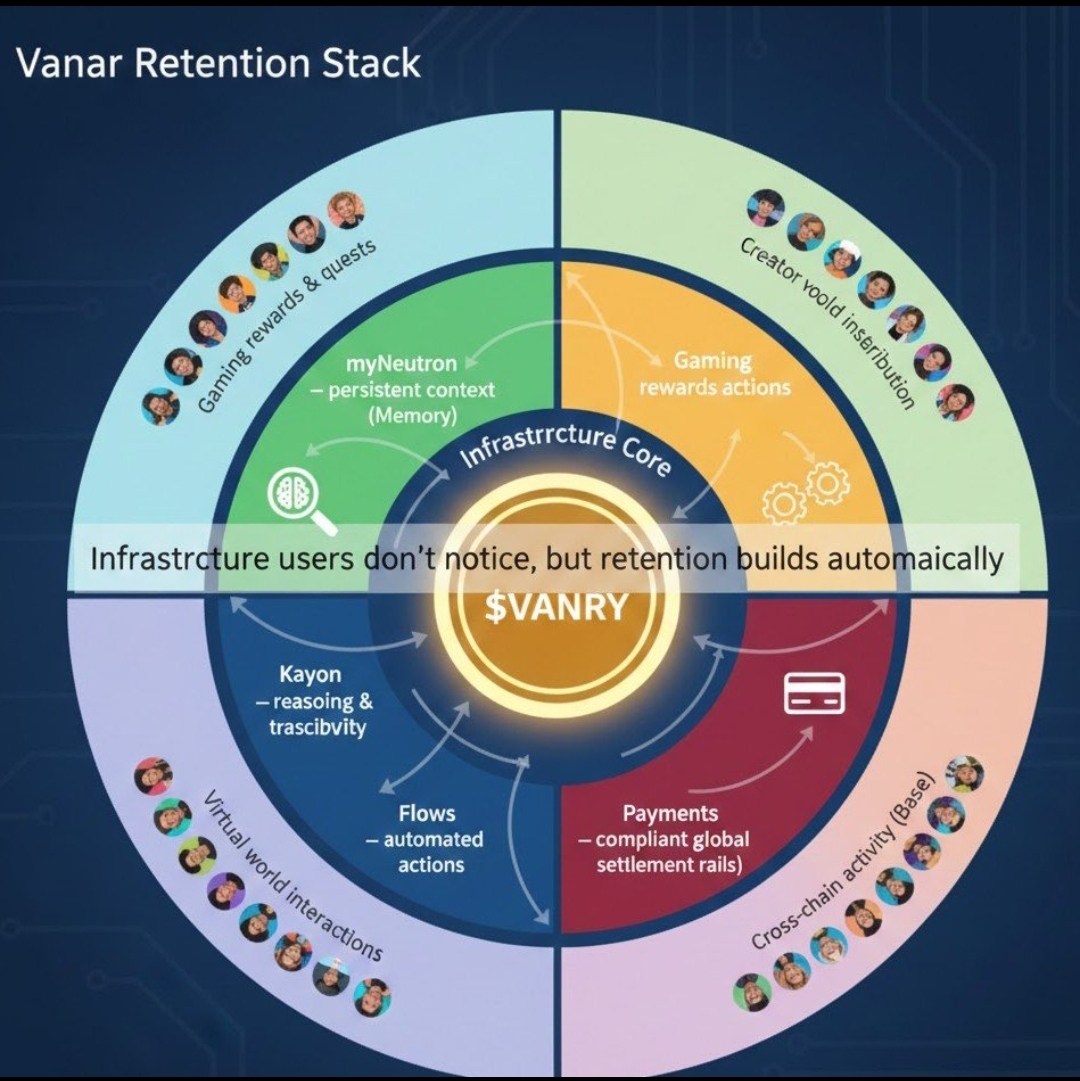
myNeutron is probably the clearest example. It shows that semantic memory and persistent context don’t have to live off-chain in some external database. They can exist at the infrastructure layer. That changes how agents behave. Instead of reacting statelessly, they can build continuity. That sounds subtle, but continuity is the difference between a tool and a system.
Kayon tackles another gap — reasoning and explainability. AI without explanation is hard to trust, especially in enterprise or regulated settings. Kayon proves reasoning can be anchored on-chain in a way that makes outputs inspectable. That matters if AI decisions are tied to capital, governance, or compliance.
Then there’s Flows. Intelligence is useless if it can’t translate into action. But automated action without guardrails is just risk. Flows is built to allow automation that is constrained, explainable, and safe. Not reckless scripts, but structured execution.
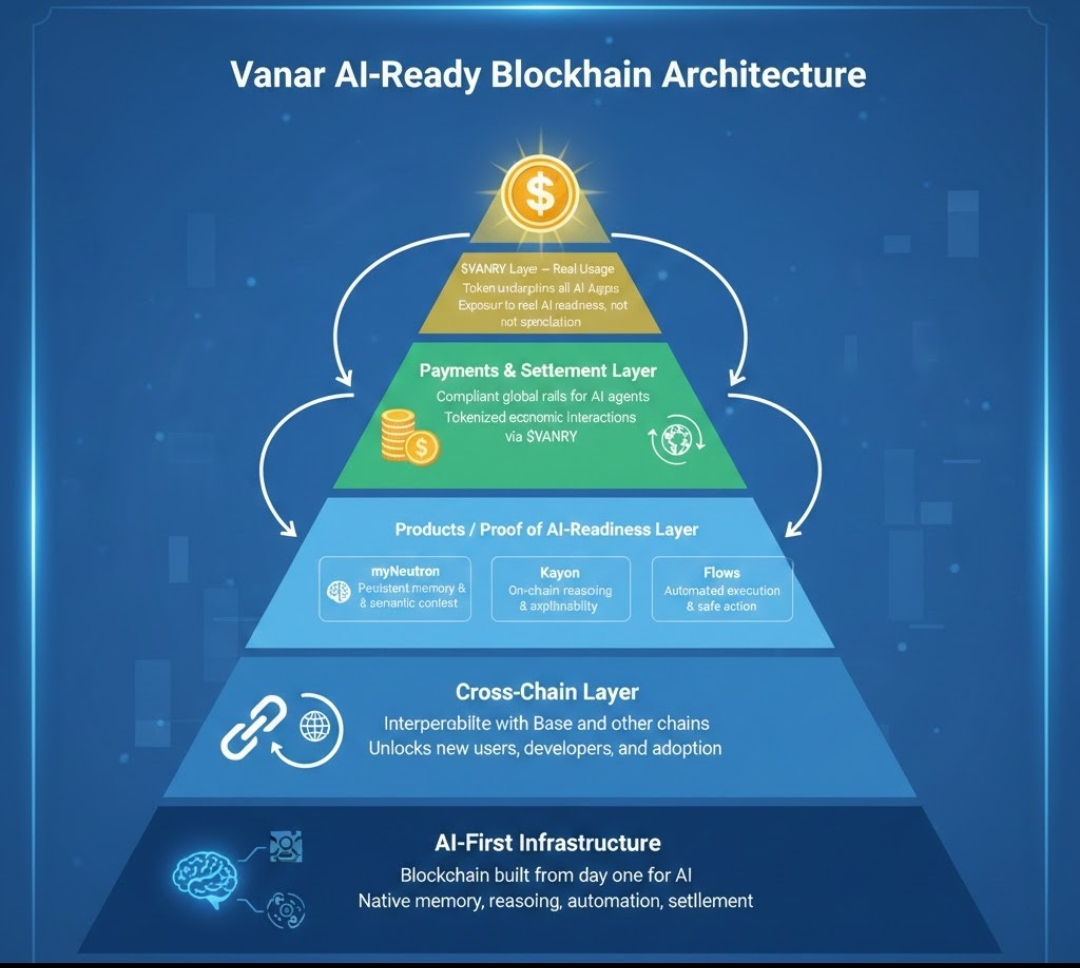
All of this sits on top of infrastructure that assumes automation is normal. Vanar isn’t optimized just for users clicking buttons. It assumes services, agents and background processes are constantly interacting with the chain. That’s closer to how modern software actually runs.
Cross-chain expansion into Base reinforces this direction. AI-first infrastructure can’t remain isolated. If intelligence is going to scale, it needs access to liquidity, users, and developer ecosystems beyond one network. Making Vanar’s technology available on Base extends its reach and increases the environments where $VANRY has relevance.
This is not just expansion for visibility. It increases actual potential usage. AI systems don’t care about tribal chain boundaries. They care about where they can operate effectively.
Payments are another piece that often gets overlooked in AI conversations. Agents don’t navigate wallet UX. They don’t manually approve transactions. If AI is going to participate economically, settlement rails need to be compliant, global, and automatic.
Vanar treats payments as part of the infrastructure conversation, not an afterthought. Intelligence without economic rails is just a demo. With settlement built in, AI systems can move from analysis to participation.
$VANRY underpins this stack. Not as a marketing narrative, but as the connective layer between memory, reasoning, automation, and settlement. As usage grows across these layers, the token aligns with activity that is functional rather than speculative.
There’s also a broader point here. The Web3 space does not need more base infrastructure competing on TPS. It already has plenty. What’s missing are systems that prove they are built for AI from the beginning.
Launching another generic L1 in an AI era feels late. Designing infrastructure specifically for agents feels early.
Vanar is making a clear bet: that AI systems will require native memory, explainability, safe automation, and cross-chain settlement — and that retrofitting those features later will always be more complex than building around them from day one.
If that thesis holds, growth won’t come from hype cycles. It will come from real usage of intelligent systems running continuously in the background.
And infrastructure aligned with that kind of usage tends to age differently than narrative-driven networks.
