

$ETH sitting under $2,000 isn't just a number on a chart. It reflects a market caught between fear and quiet conviction, where surface-level weakness hides something more nuanced underneath.
That $2,000 mark flipped from support to resistance weeks ago. Every attempted bounce gets sold into by holders desperate to exit near their cost basis. With roughly 58% of addresses currently underwater, there's a thick wall of overhead supply. People don't sell at a loss easily, but they absolutely sell at breakeven. That dynamic alone explains why rallies keep fading before gaining any real traction.
What makes this cycle different from previous selloffs is the behavioral shift among large holders. Whales haven't dumped aggressively. They've trimmed exposure gradually, rotating toward caution rather than heading for the exits. Meanwhile, mid-tier and smaller wallets have been growing steadily. Ownership distribution is widening, which reduces the risk of single-entity manipulation but also means any sustained recovery needs broad-based demand, not just a handful of big buyers pushing price.
The exchange flow data adds an interesting layer. Significant ETH continues moving off exchanges even as price bleeds. That's not panic behavior. That's cold storage positioning, staking, and long-term holds. Accumulation wallets, addresses that historically only receive and never send, have been absorbing ETH at a pace that mirrors previous bottoming phases. No guarantees obviously, but the pattern rhymes with past setups that preceded major reversals.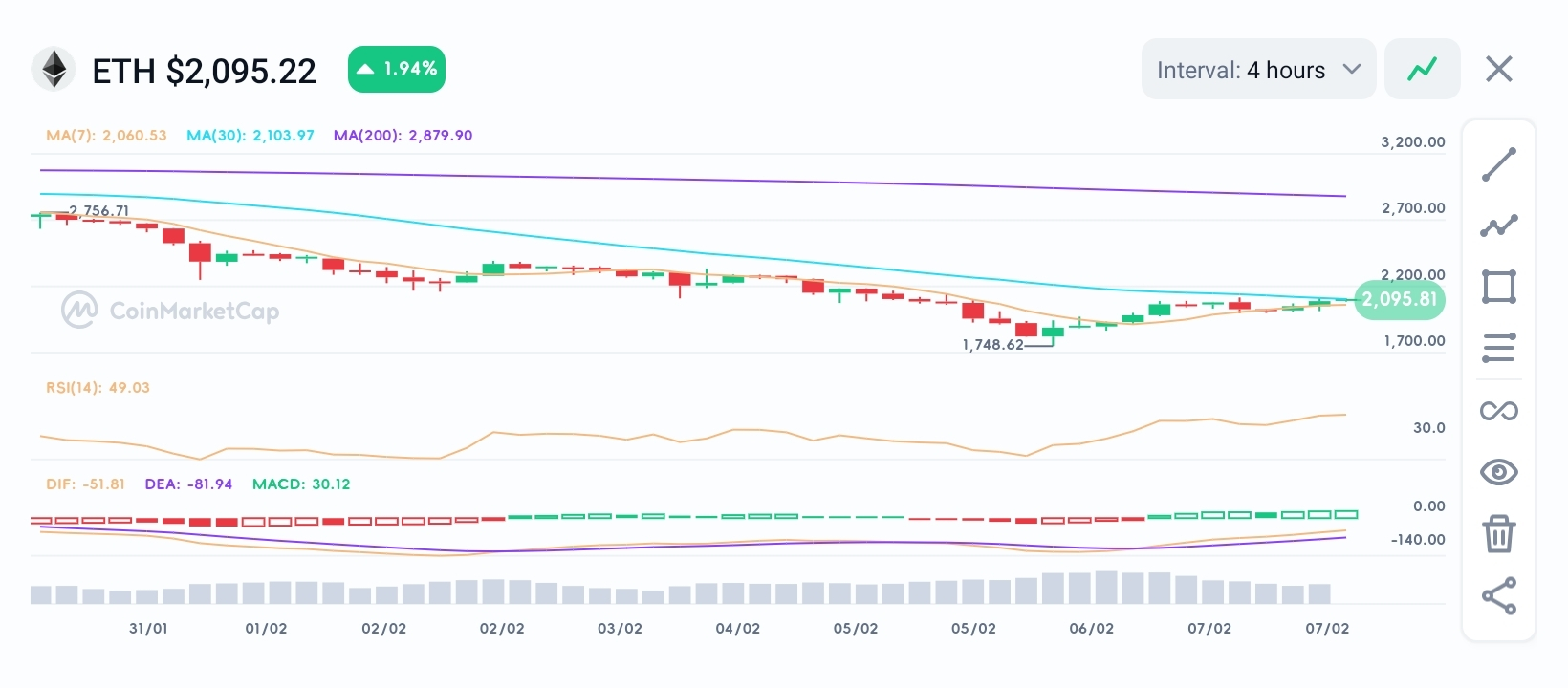
DeFi remains a weak spot though. Total Value Locked dropped hard, meaning less capital cycling through lending protocols, DEXs, and yield strategies. Lower TVL translates directly to reduced network revenue and weaker on-chain fundamentals. Until that metric stabilizes, the bullish case lacks a critical pillar.
On the institutional side, ETH ETFs are sitting on heavy unrealized losses yet continue attracting inflows. That kind of behavior signals conviction over convenience. These aren't traders chasing momentum. They're allocators building positions through pain, which historically provides a stabilizing floor over time.
Broader macro pressure accelerated the drawdown too. Risk assets got hit across the board, gold swung wildly, and crypto absorbed collateral damage from forced de-risking. Some analysts frame this as a mini crypto winter rather than a structural breakdown, and the data largely supports that interpretation.
Key levels remain straightforward. Support clusters around $1,850 to $1,900 with $1,800 as the psychological backstop. Resistance stacks at $2,000, $2,150, and eventually $2,400. Until $2,150 breaks convincingly, the short-term bias stays defensive.
This isn't a screaming buy and it's definitely not time to panic sell. It's accumulation territory for patient capital and a danger zone for emotional decision-making. Smart money builds quietly in markets like this. Everyone else gets shaken out.
