


Introduction
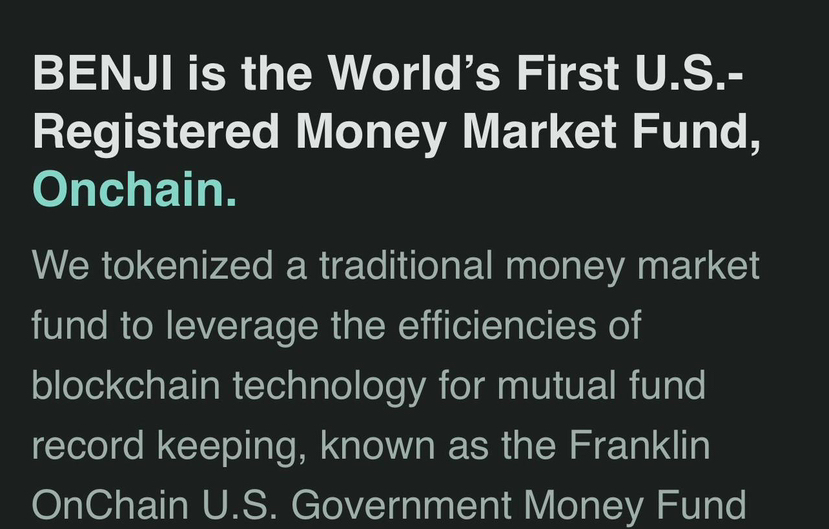
Today, Binance and Franklin Templeton declared a novel means through which big merchants can post collateral. Rather than depositing cash or the keeping of stablecoins on an exchange, the qualified institutions can now pledge tokenised shares of a money-market fund (MMF) that will remain off-exchange. The tokenised shares are Franklin Templeton Benji, which make units of a U.S. government money-market fund a token in blockchain (each BENJI token is equal to one share of the fund). The tokens are held in controlled custody by the custody partner of Binance, Ceffu, and are mirrored in the value of the tokens within Binance trading system.
This alliance will help to reduce counterparty risk, utilize capital more efficiently, and yield on collateral. I describe the reasons the news is trending, the mechanism, why it is relevant to business and regulation, and my opinion about its consequences below.
Why It's Trending
1- The initial offering of a more extensive joint venture. In September 2025, Binance began collaborating with Franklin Templeton to explore tokenised real-world assets. It is the first actual product of that collaboration that is an off-exchange collateral program. The time frame indicates that there is momentum in the larger trend of real-life asset tokenisation, so market observers were looking forward to actual applications.
2- Institutional risk management of collateral. Numerous crashes of crypto platforms in recent times have made institutional traders cautious about leaving money on exchanges. This pain point is solved by a model in which assets remain in regulated custody and are still available as margin. There is also the promise in the program of the ongoing yield on the money-market fund shares provision which at present is approximately 4-5 percent as per Franklin Benji platform.
The Operations of the Off-Exchange Collateral Model.
In order to make the explanation easy to understand, consider collateral mirroring as a three-layered system:
1- Tokenised MMF shares off-chain. Benji platform is a tokenisation of shares of Franklin Templeton MMF (FOBXX) in the U.S. government. Transfer agent of the fund maintains a formal register of share holders as it interacts with public blockchain. Every BENJI token corresponds to one share and generates income on a daily basis.
2- Regulated custody via Ceffu. Institutional clients place Ceffu deposits of their BENJI tokens in a Ceffu custody. The tokens remain off-exchange, according to the press release, Ceffu continues to hold the tokens in a bankruptcy-remote setting and offers settlement facilities. This practically means that the assets are not combined in the hot wallets of Binance.
3- Binance mirror inside collateral. The trading engine of Binance identifies the value of tokens deposited into the system of BENJI and provides a margin credit on the same. That credit can then be used by the traders to trade derivatives or spot pairs in the exchange. Meanwhile, the underlying tokens remain with Ceffu and any variation in their value (because of yield or price fluctuations) is updated periodically. The statement indicate that the assets are still off-exchange and are reflected in the trading accounts within Binance.
Possible Impact on Liquidity and Microstructure.
Reduced idle capital. The option of allowing traders to promise yield-based MMF shares would help capitalize on the idle cash/stablecoins in exchange wallets, enhancing capital efficiency.
Reduced counter-party exposure. Since the tokens do not go out of custody, there is less exposure to an exchange failure or hacking. It resembles other off-exchange settlement designs such as prime brokerage except that on-chain tokens are used as security.
The liquidity patterns during the day. Provided this is widely adopted, we might observe a reduction in the parking of stablecoins on Binance and an increase in the range of margin allocation, which can potentially impact demand of stablecoins as well as intraday funding rates. This will require on-chain measures of the BENJI issuance/redeeming and exchange credit flows information, which is not made publicly available yet.
Latency and reconciliation. An empirical query is the rate at which Binance uses the collateral mirror when issuing BENJI tokens, redeeming them or when their price fluctuates. Any delay may contribute to market risk in case collateral value changes in turbulent times. Information on speeds of updates and failure modes is not available to the public; it is likely to be a secret between suppliers and customers.
Essential Analysis: Business, Regulatory and Partnerships.
Business Motivation and Strategy.
Since 2019 Franklin Templeton has been trying blockchain and Benji is the first U.S.-registered on-chain money-market fund. The asset manager has the opportunity to tap into a crypto-enthusiastic market by collaborating with Binance and gain additional revenue through fees, as well as demonstrate the utility of tokenised real-life assets.
In the case of Binance, the initiative builds its institutional wing and makes the exchange a linkage between conventional finance and crypto. Catherine Chen of Binance told Business day that the next logical step in the process of bridging digital and traditional finance is the ability to offer tokenised real-world assets. The ability to take on regulated and yield-bearing collateral has the potential to make the derivative business of Binance different than the rest.
Regulatory Considerations
Money-market funds are controlled investments which adhere to the laws of securities. The Benji platform created by Franklin remains compliant because the transfer agent and record-keeping of the fund remains within regulatory measures. However, putting these tokens on a crypto exchange as collateral makes one question:
Securities classification. BENJI tokens are securities or shares of a mutual fund. Binance should ensure that they do not become unregistered sales where securities regulations are in effect by offering them as collateral.
Custody regulations. The provider of the custody, Ceffu, is licensed in Dubai and is subject to domestic virtual asset regulations. The institutions of other nations may be limited or require additional authorization to participate.
Bankruptcy‑remoteness. The arrangement is based on the controlled arrangement of Ceffu to maintain the tokenised assets independent of Binance. This reduces risk, but any regulatory intervention on Binance or Ceffu might have some effect on collateral access. The information on legal frameworks, as well as collateral haircuts, is confidential; critical due diligence is necessary.
Partnership Dynamics
Roger Bayston, Franklin Templeton Head of Digital Assets, mentioned that the off-exchange collateral program is one of the major steps to ensure that digital finance would become a viable aspect of institutions. The program demonstrates the long-term plans of Franklin to transform regulated assets into tokens and provide them on scale. It is also comparable to the objective of Binance to restore institutional trust that had been lost in the previous crises through the provision of segregated custody and lessening re-hypothecation.
Possible Market Implication and Risk.
Price and Liquidity Impact
The program will not shift the native token of Binance (BNB) or the entire crypto market significantly in the short term. BNB however dropped a notch especially during the launch day despite the news according to The Defiant. In the medium-term scale, the initiative would enhance the liquidity of derivatives since larger traders would be allowed to take larger capital amounts without sacrificing safety. When this is embraced on a larger scale, it would help reduce the spread of funds and reduce volatility in the case of extreme market conditions.
Risk Assessment
- Operational complexity. In order to coordinate on-chain tokens, off-exchange silence and real-time margin recognition, it is a demanding task. Traders might face the risk of being liquidated or be at risk of a funding failure due to bugs or integration failure.
- Concentration risk. The establishment is greatly dependent on the custody of Ceffu. In the event that Ceffu has operations issues or is subjected to regulative control, all collateral would be caught. Custodial provider diversification can come in handy.
- Regulatory uncertainty. The utilisation of mutual-fund shares as security in a crypto exchange may be questioned by securities regulators. Unexpected changes in the regulations may cause the program to be ceased.
- Adoption and liquidity.
It may take institutions a long time to embrace such systems before they can have confidence in it and find evident incentives. The difference between the yield of MMFs and stablecoins, as well as the administrative expenses, will impact uptake.
Self Analysis and Reflections.
As a practitioner, it comes as a transition between the new and old financial worlds. Money-market funds are secure types of investments, generally short-term government bonds. It is easy to tokenise those shares and use them as crypto trading collateral: promise a low-risk asset and trade high-risk assets without it having to be moved physically.
The program is reminiscent of the prime brokerage schemes in standard markets where customers hold their assets with a custodian and trade on credit lines. The trick, however, is that the collateral is the on-chain tokens reflected in the systems of Binance. There are three implications that I can think of:
1. Controlled assets fulfill crypto markets. This can motivate conservative establishments to put their hands on crypto derivatives, aware that they will have to work with known instruments as collateral. Regulatory transparency will be the pace setter.
2. The competitive advantage becomes yield. Trading on collateral at 4-5 per cent is very eye-catching, particularly with cash yields going up once again. Such collateral exchange or brokerage can acquire market share.
3. Real world assets are being tokenised faster. We have had tokenised Treasuries, real-estate and commodities; money-market funds are now part of margin operations. The program can be an example on how other managers may tokenise mutual funds or ETFs to be used in trading venues.
However, I’m cautious. Reliability in operations and acceptance by the regulators is critical to success. Liquidations in speedy markets might arise as a result of minor collateral recognition delays. Even though Ceffu sounds well in custody, it is the participants who should conduct their own due diligence. The early adopters are exposed to additional risk, as it is with any innovation.
Conclusion
Another important step in the process of integrating conventional and cryptocurrency finance is the Franklin Templeton-Binance off-exchange collateral program. It will allow institutions to commit tokenised money-market fund shares in regulated custody to promise less counter-party risk, and higher levels of capital efficiency and yield on collateral. Its adoption, operational resilience and regulatory acceptance is what will determine whether it becomes a standard model or not. Being a follower of the real-life asset tokenisation, I consider it to be a positive logical step that is yet to be proven in the real world.
