
I used to think about Vanar the same way most people do. You look at it, and the instinctive reaction is to compare it. Ethereum for security. Solana for speed. You start lining up benchmarks, metrics, and charts. That’s just how crypto conversations usually go.
But the more I looked into @Vanarchain , the more that framing started to feel wrong. It doesn’t really feel like Vanar is trying to win that race at all. That race is already crowded.
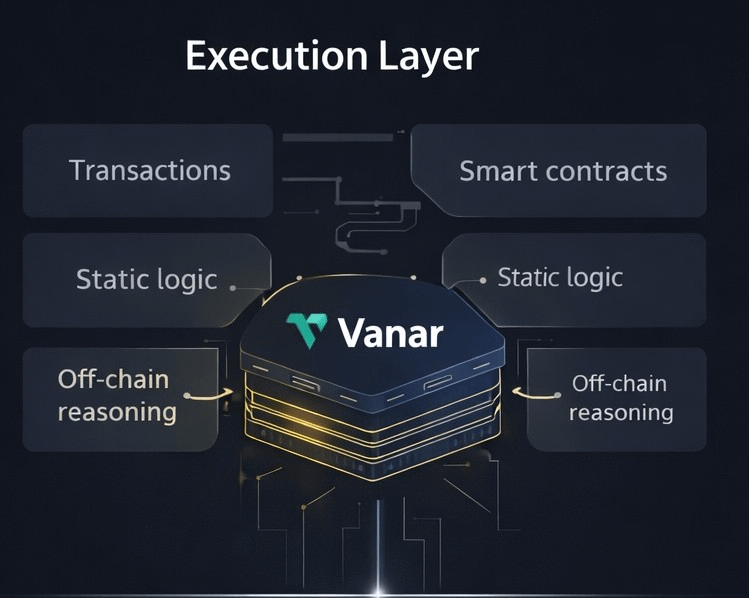
What Vanar seems to be doing instead is aiming higher up the stack. Not competing with other blockchains directly, but trying to become something closer to an operating system for on-chain applications.
Once that idea clicks, the rest starts to make sense.
Most blockchains today are basically execution engines. You send a transaction, a smart contract runs, data gets written, and the chain moves on. Anything that requires reasoning, interpretation, or intelligence usually lives somewhere else. Off-chain servers. APIs. Custom middleware.
That setup works, but it also means the “thinking” part of most Web3 apps doesn’t actually live on-chain.
Vanar looks like it’s questioning that assumption.
On the surface, it still feels familiar. It’s EVM-compatible. Solidity works. Existing tooling works. Nothing about the entry point feels exotic. And that’s probably intentional. But once applications are deployed, the environment behaves differently.
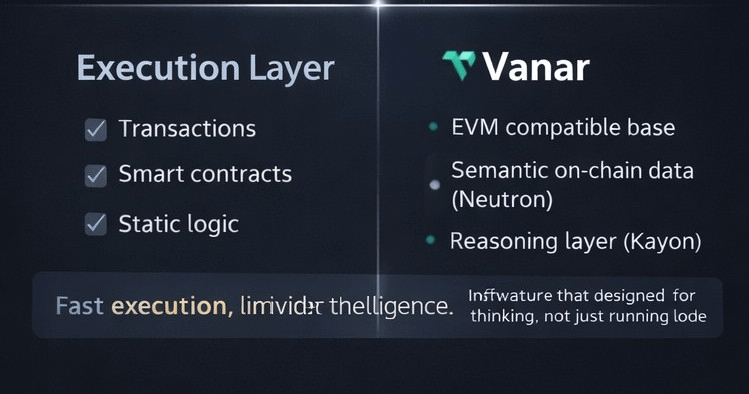
Data isn’t just written and forgotten. With Neutron, information is structured in a way that gives it meaning. Instead of data being something contracts simply reference, it becomes something systems can actually understand and reason over. Then there’s Kayon.
Instead of locking every rule into a smart contract forever, applications can query data, interpret context, and adjust behavior dynamically. That’s a subtle shift, but it changes the mental model completely. It feels less like programming a rigid machine and more like setting up an environment where software can adapt.
At that point, the usual blockchain comparisons start to fall apart.
Ethereum feels like a very secure calculator. Solana feels like a very fast one. Vanar feels like it’s trying to be the place where software can think, not just execute. And that’s much closer to how operating systems work than how blockchains are usually described.
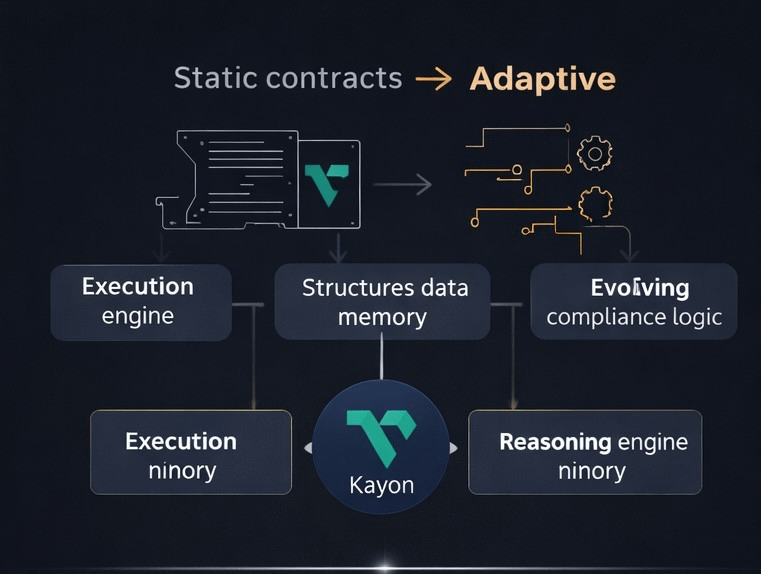
An operating system doesn’t replace applications. It makes everything running on top of it more capable.
This matters because Web3 itself is changing. Static contracts are starting to feel limiting in a world moving toward AI agents, automated finance, and adaptive systems. Compliance logic can’t stay frozen forever. Payment flows need to react to conditions. Intelligence needs memory and context.
Execution alone isn’t enough anymore.
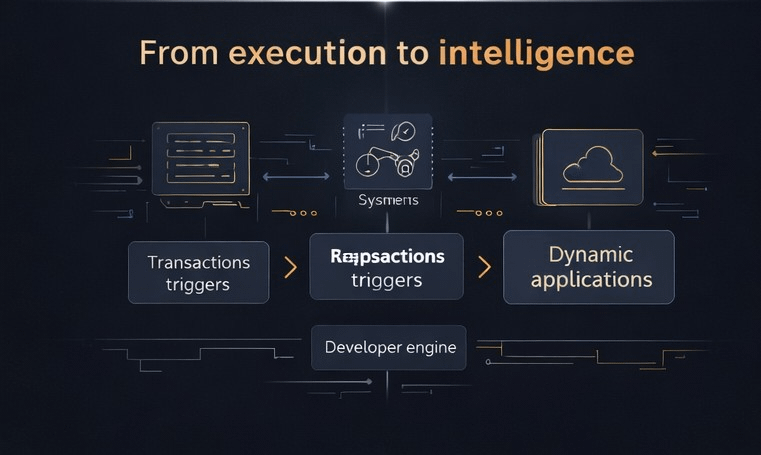
You can already imagine where this leads. Payment flows that adapt instead of blindly following scripts. Compliance systems that evolve without redeploying contracts. AI agents that reason over on-chain memory instead of bouncing between off-chain services. These aren’t edge cases. They feel like where the space is slowly heading.
What makes this approach more than just a narrative is that Vanar is starting to tie it to real economics. Advanced features like Neutron and Kayon are moving toward subscription-based access paid in #vanar . That means usage isn’t just theoretical. It directly connects to demand. That detail is easy to overlook, but it matters.
Of course, this path isn’t without risk. Competing at the operating-system layer is hard. Developers need time to understand new primitives. Tooling has to mature. Until meaningful applications scale, the vision can feel abstract. And with $VANRY still being a low-cap asset, volatility and liquidity are part of the equation.
But those aren’t hype risks. They’re infrastructure risks.
Vanar doesn’t feel like it’s chasing short-term narratives. It feels like it’s laying groundwork. Identity. Semantic memory. Reasoning layers. Subscription economics. These are decisions you make when you’re thinking in terms of systems, not cycles.
Most chains are optimizing for execution.
Vanar feels like it’s optimizing for intelligence.
That’s why it doesn’t really register as just another Layer 1 anymore. It feels like it’s trying to become the environment smarter applications eventually choose to run on.


