
The latest correction $BTC strengthened the belief in the four-year halving cycle, which traditionally defines market movement. This conclusion was reached by analysts at Kaiko Research in a fresh report.
Earlier, many market participants assured their colleagues that the cyclicality of Bitcoin's movement was disrupted. However, BTC's behavior indicates the opposite.
Bitcoin repeats the four-year cycle against the backdrop of a sharp correction.
Bitcoin dropped from a peak of $126,000 to a range of $60,000–$70,000 by early February. The correction was approximately 52%.
Kaiko believes: the decline fully fits into the classic bearish periods that occur after halving and does not indicate a change in established market models.
“The drop of Bitcoin from $126,000 to $60,000 confirms, rather than disproves, the four-year halving cycle, which consistently brings declines of 50–80% after reaching peak values,” says the analysis from Kaiko.
The report notes: the halving of 2024 occurred in April. Bitcoin's maximum was updated approximately 12–18 months later, which aligns well with the dynamics of past cycles. Historically, prolonged bearish periods of about a year began after this — then the accumulation phase started.
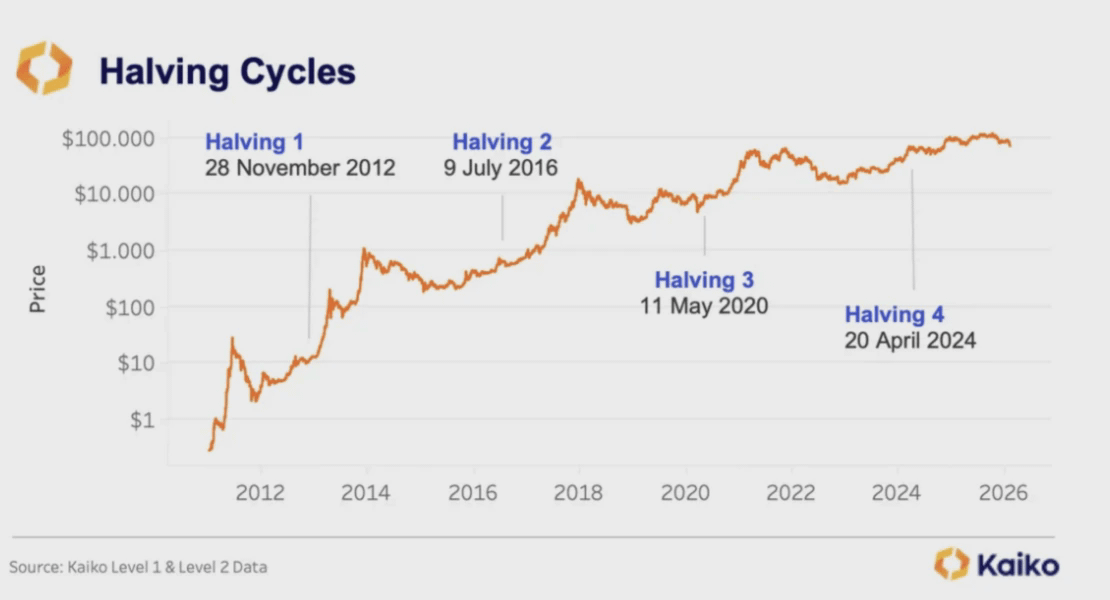
Kaiko believes that the current price dynamics indicate: Bitcoin has exited the phase of euphoria after halving and has entered the expected correction period.
Experts have repeatedly expressed doubts about the relevance of Bitcoin's four-year cycle. In their opinion, under today's conditions, this scenario no longer works. For example, in October 2025, Arthur Hayes stated that the four-year cycle for Bitcoin has ended and that price movements are now shaped by global liquidity.
There is another point of view: some analysts believe that Bitcoin is now evolving according to a five-year cycle rather than a four-year cycle. Arguments include the influence of global liquidity, increasing participation of institutions, and changes in macroeconomic policy.
Kaiko noted that due to structural changes such as the launch of spot Bitcoin ETFs, more defined regulation, and the maturity of the DeFi sector, the years 2024–2025 are noticeably different from past market cycles. Nevertheless, these changes have not been able to stop the expected correction after the peak.
However, they have changed the nature of volatility. Against the backdrop of a recent sell-off from spot Bitcoin ETFs, investors withdrew more than $2.1 billion. As a result, market pressure intensified, making it clear that institutional access leads to increased liquidity both during price rises and falls.
“Although the DeFi infrastructure has shown notable resilience compared to 2022, the decline in the total value of locked assets and the slowdown in staking rates indicate that no sector is immune to bearish trends. Even certainty in regulation has not yet spared the crypto market from the impact of major macroeconomic risks: uncertainty in the actions of the Fed and the weakness of risky assets continue to drive the market,” say experts at Kaiko.
Analysts also noted the main question that concerns market participants — where is the bottom for BTC. The report states: the intraday bounce of Bitcoin from $60,000 to $70,000 may indicate the formation of the first support.
At the same time, past experience shows: bearish markets usually last 6–12 months and are accompanied by several unsuccessful attempts at growth before a sustainable bottom is formed.
Kaiko noted that the share of stablecoins reached 10.3%, funding rates nearly reached zero, and open interest in futures decreased by about 55% — all indicating a significant reduction in leverage in the market. Nevertheless, the company emphasizes that it is still unclear whether current conditions reflect the early, middle, or late phase of capitulation.
“According to the four-year cycle model, we are currently around the 30% mark. Bitcoin repeats the scenarios of all previous cycles, but it seems that many participants have convinced themselves that this time will be different,” analysts write.
In February 2026, market participants will need to consider both scenarios. The next steps of Bitcoin will show whether history repeats itself or a new market order is formed.
