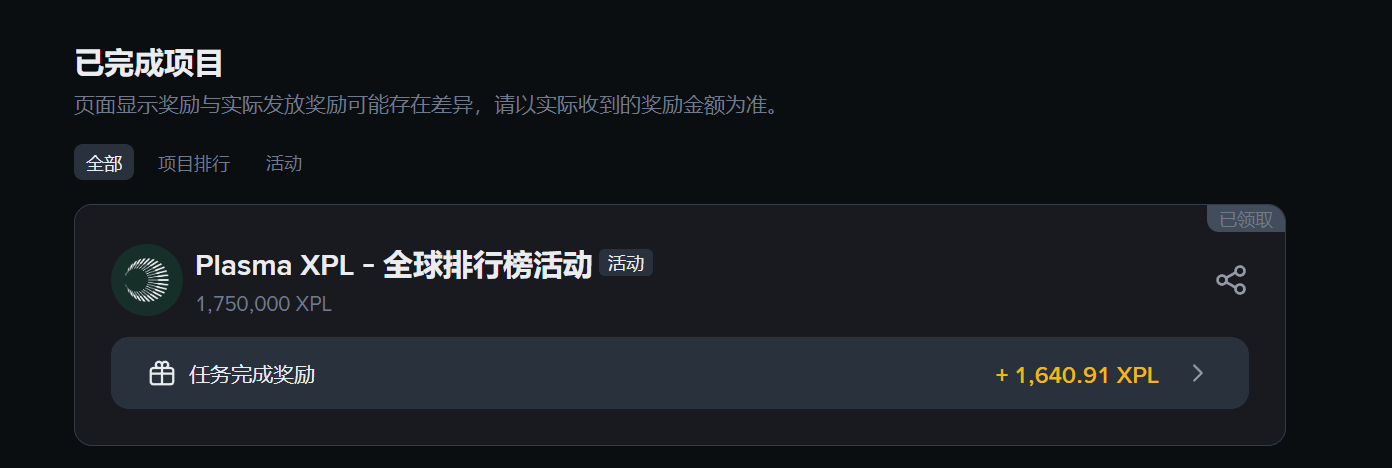
I received 1640 $XPL 130U.
500 people received!!
My mindset is different from the beginning. When I first started writing the series, I was easily driven by the narrative: stablecoin liquidation networks, dollar internet, payment-level experiences… these terms sound grand and can easily excite people. But the more I write, the calmer I become, because I increasingly believe in one thing: the opportunities that can genuinely be realized in the long term do not rely on emotions and imagination, but on something more fundamental — verifiable progress. Is Plasma worth following in the long term? Look at whether it is continuously improving, and whether these 'improvements' can be seen by you, sensed by users, and proven by data.
I am now more willing to break down the value of Plasma into three verifiable directions. The first is progress on the experiential level: is the stablecoin transfer becoming smoother, is the failure rate decreasing, is the fluctuation in confirmation time becoming smaller, and has the entry truly reduced the learning cost? These things do not require you to understand the technical details; you just need to have used it a few times to know whether it's 'smooth' or not. The moat of the payment system will ultimately be written in these details. The second is progress on the funding behavior level: once the funds come in, are they more willing to stay, can the incentives hold up after the rush subsides, and are the funds starting to circulate naturally within the ecosystem rather than just stagnating in one pool? The third is progress on the system capability level: is the payment on behalf controllable, is the risk control effective, is the transaction state machine clear and traceable, and is the reconciliation and refund process for merchants gradually being improved? They collectively determine whether Plasma can evolve from 'usable once' to 'usable in the long term.'
So I now view Plasma more like an infrastructure curve: it may not surprise you every day, but as long as it can continue to reduce uncertainty, continually standardize the experience, and gradually fill in the capabilities of stablecoins—'transferring, earning, using, reconciling, and correcting'—its value will slowly compound. Many people like to chase hotspots, but the growth of infrastructure is often not driven by hotspots; instead, it's about making a bunch of details that no one wants to change, and then one day you suddenly realize: users can start using it without needing explanations, funds are willing to stay without subsidies, and merchants can connect without a technical team. Only at that moment will you understand that the so-called network effect is not something shouted out; it is built from everyday usage.
I also want to write a more realistic reminder in A26: the narrative around stablecoins can easily lead to misjudging risks. Because you are dealing with stablecoins, you may feel that the risks are inherently lower. However, the real risks do not only come from the price of the coins; they come more from opaque mechanisms, uncertain exits, unchecked authorizations, and from entrusting your funds to complex strategies without understanding. The more you treat Plasma as a stablecoin settlement network, the more you should demand it by the standards of payment systems: predictable, explainable, and recoverable. If you use these three words to filter any product and opportunity, you will avoid many pitfalls and be able to stay at the table longer.
My expectations for Plasma have not diminished; they have just become more rational. I no longer focus solely on grand narratives but rather pay more attention to the verifiable progress made each week and with each iteration. Because the real opportunity in the era of stablecoins often lies not in the 'next hot topic,' but in the 'next certainty.' When certainty is delivered consistently, the network effect will occur unknowingly, and that is when the infrastructure truly becomes valuable.