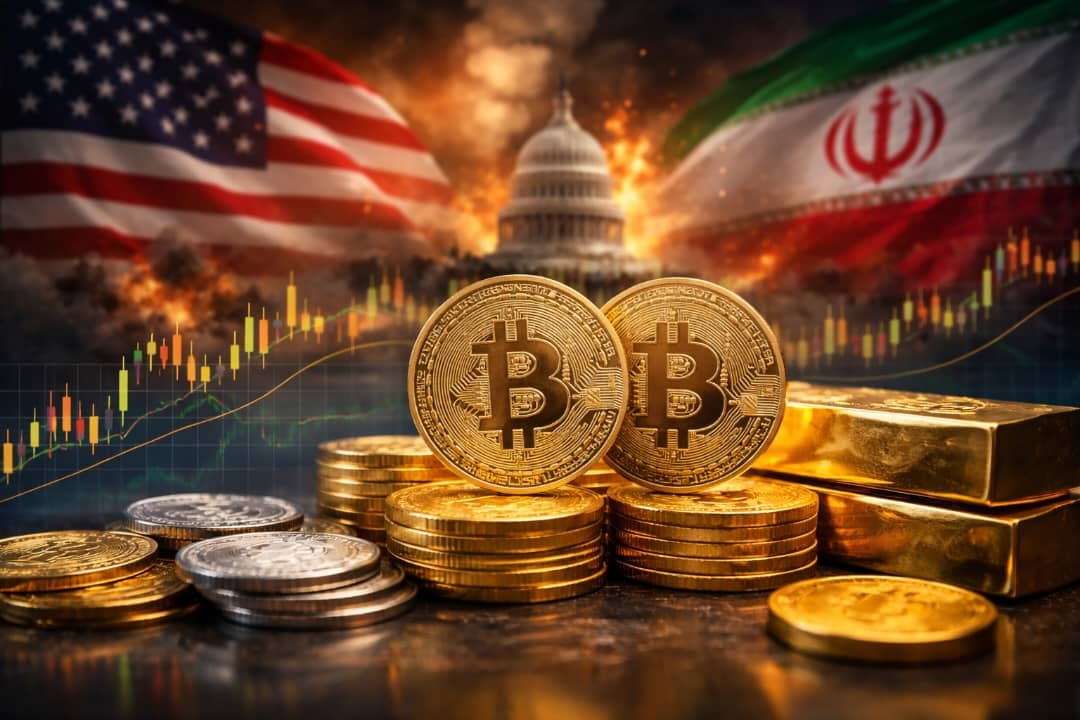
In my reading of the market scene during the year 2026, I find that we are living in a pivotal stage that combines geopolitical tensions, fluctuations in traditional assets, and the hesitation of digital assets between accumulation and launch. The picture is not linear but complex; where politics intersects with currency, economics with risks, and trust with regulations. In this article, I present my personal vision of what is currently happening, and what may await gold, silver, and bitcoin, in addition to the impact of hot political files and potential decisions within the United States.
Tensions between the U.S. and Iran: A hidden driver for safe-haven markets
In my view, the geopolitical tensions between the United States and Iran are not only read as a political event but as a direct driver of liquidity flows. The higher the tension rises, I notice a clear shift of funds towards gold and silver as traditional safe havens.
But what's striking this year is not just the rise, but the intensity of volatility. The market no longer rises quietly; it moves in rapid waves of fear, then calm, then repricing. This indicates that investors are reacting to news at high speed, frequently repositioning themselves, making price movements more jittery than usual.
Gold and silver: Cautious rise and rapid corrections
I see that gold and silver are going through a 'risk pricing' phase more than being a stable upward wave.
The increases exist, but they are followed by rapid corrections, and the reason, in my opinion, goes back to three factors:
1️⃣ Lack of clarity on the complete geopolitical path
2️⃣ Watch the course of U.S. monetary policy
3️⃣ Rapid liquidity shifts between assets instead of long consolidation
Gold still maintains its strong structure in the medium term, but short-term movements have become more tactical than directional. Silver, on the other hand, is more sensitive and faster to fluctuate, making it more attractive to speculators than conservative investors.
Bitcoin between $65,000 and $71,000: Decision area, not a loss area
I don't see Bitcoin moving between $65,000 and $71,000 as weakness, but as a decision and potential accumulation area. After strong upward cycles, it is normal for the market to enter a sideways range to redistribute positions.
In my opinion, the digital market is now waiting for a clear catalyst, not just liquidity. The catalyst could be:
Clear regulatory legislation
Change in the Federal Reserve's tone
New institutional inflows
Or a major macroeconomic event
The current range — in my opinion — is not the end of a wave, but a pause before determining the next direction.
Could 2026 witness a new surge wave?
I think this possibility exists, but it is conditional and not guaranteed. A surge wave needs three elements:
🔹 Regulatory clarity for cryptocurrencies
🔹 Less stringent or more flexible monetary policy
🔹 Continued entry of major institutions
If these elements come together, we may witness a new surge wave. If two of them are absent, we will see a long-lasting volatile market instead of a rapid price explosion.
The Jeffrey Epstein case: The buzz and institutional trust
The renewed buzz around the Jeffrey Epstein case — in my opinion — affects psychologically more than its direct financial impact. Such files, when they return to the forefront, open the door to questions about transparency and trust in institutions.
Will the issue be resolved completely? So far, I do not see indicators of a final comprehensive closure, but rather a continuation of revelation and tug-of-war. Markets usually do not directly react to these issues, but the level of public trust may be affected, which is an important indirect factor in the investment environment.
If Kevin Warsh were to take over the Federal Reserve: What do I expect?
If Kevin Warsh were to take over the Federal Reserve, I expect a tilt towards monetary discipline and a focus on price stability. This could mean:
Short-term pressure on high-risk assets
Support for the dollar
Greater volatility in stocks and cryptocurrencies initially
But in the medium term, any clear policy — even if it is strict — is better for the markets than ambiguity. Clarity creates direction, while ambiguity creates volatility.
Will Congress pass a comprehensive law for cryptocurrencies?
In my opinion, the issue of cryptocurrency legislation in the United States is no longer 'if' but 'when and in what form.' The general trend leans toward regulation rather than prohibition. If a clear law is passed outlining the frameworks, it would, in my view, be one of the strongest long-term catalysts for the crypto market, as it would provide institutions with a solid legal grounding to enter.
In summary: A year of consolidation before the big move
My current reading is that 2026 is the year:
Repricing of risks
Organized volatility in gold and silver
Decision range for Bitcoin
And a decisive legislative and monetary watch
It may not be a quiet year, but in my opinion, it is a foundational year for what follows. Markets do not always move with noise; sometimes they move after periods of tense silence.
#البيتكوين #الذهب #العملات_الرقمية