

@MidnightNetwork #night $NIGHT
In blockchain conversations, privacy is often discussed as a feature. Builders, however, tend to look at it differently. For developers and infrastructure teams, privacy is more accurately described as a missing layer of the current Web3 stack.
Most public chains optimized for transparency. That design works well for auditability and trustless verification, but it also exposes transaction metadata, user relationships, and sensitive application data. As blockchain adoption expands into sectors like finance, identity systems, enterprise coordination, and AI agents, the lack of controlled privacy becomes a structural limitation.
This is where Midnight Network is positioning itself-not simply as another privacy token project, but as a programmable privacy layer designed to integrate with existing blockchain ecosystems.
Mainnet Approaching: A Critical Infrastructure Moment
According to Charles Hoskinson, the Midnight mainnet is expected to launch in the last week of March 2026, signaling that the project is transitioning from conceptual architecture into operational infrastructure.
Before full decentralization, the network is currently operating within the Kūkolu phase, a federated stage designed to stabilize network mechanics, developer tooling, and validator coordination.
This staged rollout mirrors how many infrastructure-heavy blockchain systems mature:
Controlled federation
Infrastructure stabilization
Developer onboarding
Full decentralization
Instead of prioritizing immediate decentralization optics, Midnight appears to be focusing on network reliability, developer tooling, and ecosystem readiness-a strategy that infrastructure builders often value more than rapid launches.
Privacy Through Selective Disclosure
A defining technical concept behind Midnight is selective disclosure powered by zero-knowledge cryptography.
Traditional blockchain privacy approaches typically fall into two categories:
Full transparency (most Layer-1 chains)
Full opacity (certain privacy coins)
Midnight attempts a third path.
Using Zero-Knowledge Proof, applications can verify that data is valid without exposing the underlying information.
This model allows developers to design systems where:
Users maintain control over sensitive data
Regulators or counterparties can verify compliance when required
Applications remain interoperable with public chains
For builders working on identity, DeFi compliance layers, AI coordination systems, or enterprise workflows, this design introduces a new programmable privacy primitive.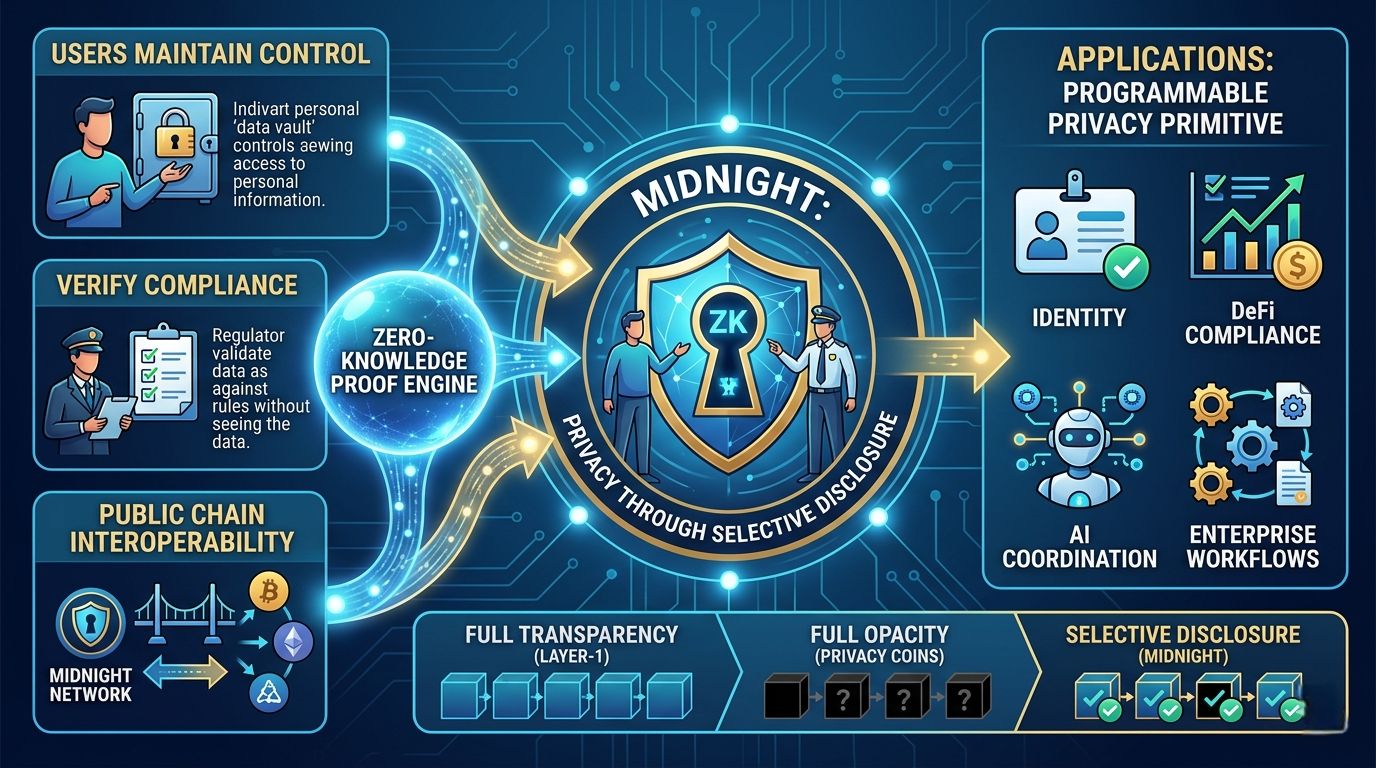
Midnight City: A Practical Demonstration of Privacy Infrastructure
On February 26, the Midnight team launched Midnight City, a live simulation designed to demonstrate how selective disclosure works in real-world interactions.
Instead of presenting technical documentation alone, the simulation allows users to interact with a virtual city powered by Midnight’s ZK infrastructure.
Participants can explore scenarios where:
Identity verification occurs without revealing personal data
Transactions prove compliance without exposing financial details
Permissions are validated without sharing raw datasets
For developers, this type of simulation provides something more valuable than marketing announcements-it shows how privacy primitives behave inside complex systems.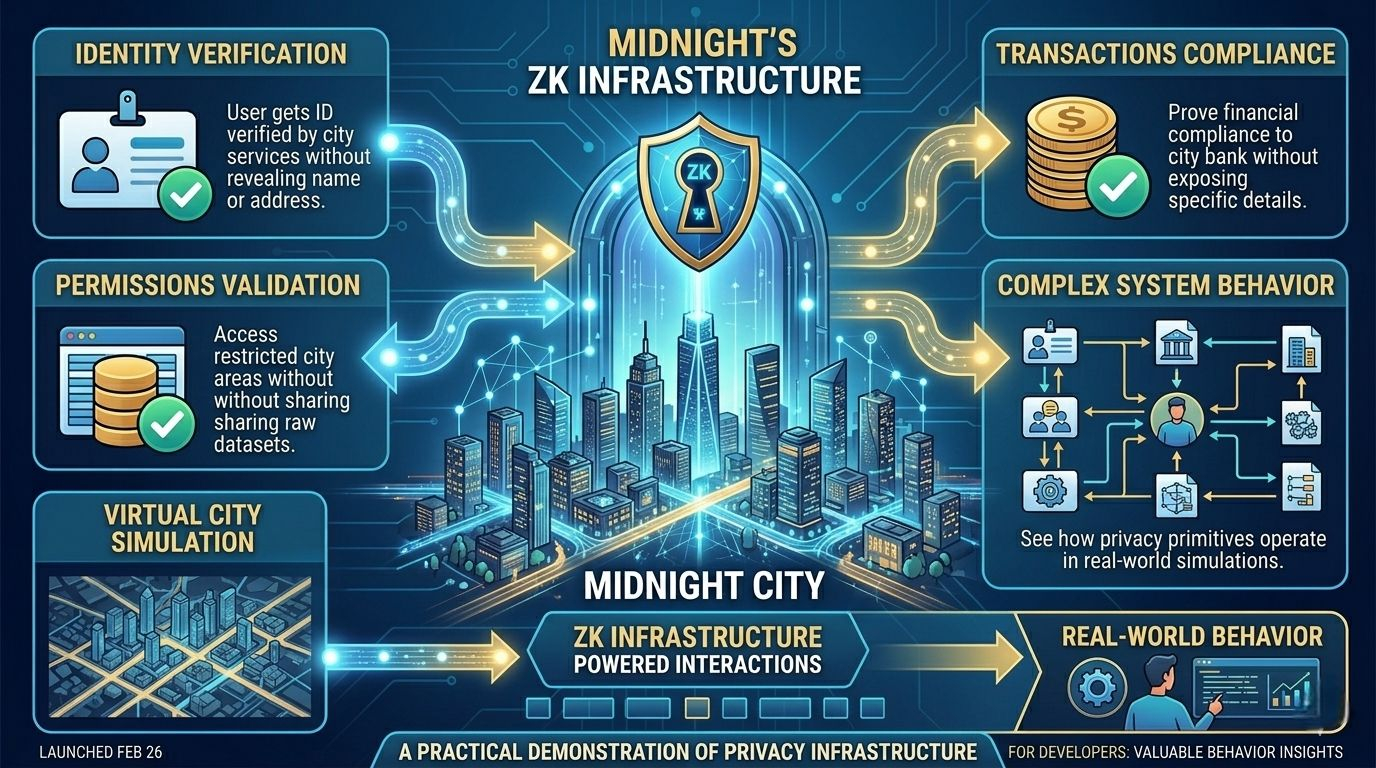
The Hidden Challenge: Metadata Propagation
One of the most overlooked challenges in blockchain privacy architecture is metadata propagation.
Even if transaction data is encrypted, metadata can still reveal:
Interaction patterns
User relationships
Application activity graphs
For privacy infrastructure to be effective, developers must consider how metadata moves across networks, nodes, and off-chain systems.
Midnight’s architecture is designed with this challenge in mind. The network attempts to manage how information flows through:
selective disclosure policies
zero-knowledge validation layers
controlled data access models
If implemented successfully, this approach could reduce one of the major weaknesses of current blockchain privacy models.
Distribution and Ecosystem Integration
Technology alone rarely drives adoption in Web3. Infrastructure becomes meaningful only when distribution and ecosystem integration exist.
Midnight’s relationship with Cardano provides a strategic advantage in this area.
Because the network is designed as a companion chain within the Cardano ecosystem, developers already familiar with Cardano tooling may find the transition smoother compared with learning entirely new ecosystems.
For builders, this could mean:
easier developer onboarding
faster application prototyping
shared infrastructure resources
cross-chain interoperability potential
In other words, Midnight is not attempting to build adoption from zero. Instead, it is leveraging existing ecosystem gravity.
Developer Accessibility as a Technical Moat
In blockchain infrastructure, the real moat is rarely just cryptography.
The deeper advantage usually comes from developer accessibility.
A network with strong cryptography but weak developer tooling struggles to build applications. Conversely, networks that provide:
clear documentation
accessible SDKs
developer simulations
predictable infrastructure
tend to accumulate builders over time.
By introducing experimental environments like Midnight City and progressing through structured phases like Kūkolu, the project appears to be prioritizing builder-first ecosystem development.
Why Builders Are Paying Attention
Privacy is moving from an ideological debate to a practical infrastructure requirement.
As blockchain integrates with AI systems, digital identity frameworks, and enterprise workflows, the need for verifiable privacy becomes increasingly important.
Projects like Midnight are attempting to provide a framework where developers can build applications that are:
verifiable
interoperable
privacy-aware
compliant when necessary
If the upcoming mainnet launch proceeds smoothly, the network may become an important experiment in how privacy-enabled smart contracts and programmable disclosure systems evolve within modern blockchain infrastructure.
For builders, the real question is no longer whether privacy matters.